
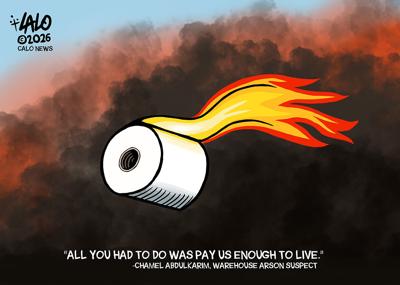



Wealth inequality. in the US is only getting hotter and hotter, and it's actually getting close to the ignition point. To badly paraphrase Chris Rock, this cartoonist does not condone violence, but he understands why some frustrated people might resort to it...
In the Inland Empire, where many citizens and residents lean slightly more conservative than in Los Angeles, it would seem like a sociopolitical act of violence would be rare.
In 2024, Donald Trump won San Bernardino County by 49.67% while Kamala Harris got 47.53%.
But that is what appears to have happened when a warehouse was set on fire in Ontario, a city in San Bernardino County.
On April 7, Chanel Abdulkarim allegedly started a fire at the Kimberly-Clark warehouse where he worked.
The 29-year-old Highland resident was employed by NFI Industries, a company that works with Kimberly-Clark to distribute products. NFI pays $18 an hour for a warehouse worker position on average, according to Indeed.
In a video that appears to show someone setting the fires, a voice can be heard, allegedly Abdulkarim’s voice, saying, “All you had to do was pay us enough to live.”
According to San Bernardino County District Attorney Jason Anderson, the warehouse that burned to the ground is worth $150 million and the paper product within it was worth about $500 million.
Three days later, another person allegedly started several fires inside the Ontario Mills mall.
Luis Javier Gallegos Jr., from Rancho Cucamonga, was arrested as a suspect of setting the fires on April 10. Gallegos has been charged with 16 felonies. It is unclear if Gallegos was also trying to make a statement with what he is being accused of.
But what can be observed from the warehouse fire is that the Inland Empire has increasingly become a hub for warehouses.
“The Inland Empire’s warehouse boom has turned what once was a serene escape into a never-ending chorus of beeping loading docks surrounded by staggering gray walls,” Raquel Ramirez wrote for IE Community News. “With nearly 4,000 warehouses concentrated in the region, most of which rely on diesel trucks that release nitrogen dioxide, the transportation and logistics industries are jointly responsible for growing environmental and health concerns.”
For 11% of Latinos in the Inland Empire, the work is in warehousing, transportation and utilities, according to a UCLA report.
The study includes a statement from Adrian, a lifelong resident of the Inland Empire and research coordinator at a local university. He reflected on the limited industry diversification and lack of job benefits in the region’s dominant sectors: “Yeah, it’s a warehouse industry out here. A lot of people I went to high school with just branched right into a warehouse after graduating, and initially, it was pretty attractive to me, right? But historically, the pay has not really kept up with inflation and other aspects. The benefits can be tough, depending on where you work, and how long you’ve [worked] there, and those kinds of things.”
There have been some efforts to stem the rapid growth of warehouses in the area. Last year, a San Bernardino Superior Court overturned the approval of a massive warehouse complex on more than 2 million acres in Bloomington. Soon after, Governor Gavin Newsom signed a bill that reins in warehouse development statewide.




(0) comments
Welcome to the discussion.
Log In
Keep it Clean. Please avoid obscene, vulgar, lewd, racist or sexually-oriented language.
PLEASE TURN OFF YOUR CAPS LOCK.
Don't Threaten. Threats of harming another person will not be tolerated.
Be Truthful. Don't knowingly lie about anyone or anything.
Be Nice. No racism, sexism or any sort of -ism that is degrading to another person.
Be Proactive. Use the 'Report' link on each comment to let us know of abusive posts.
Share with Us. We'd love to hear eyewitness accounts, the history behind an article.