
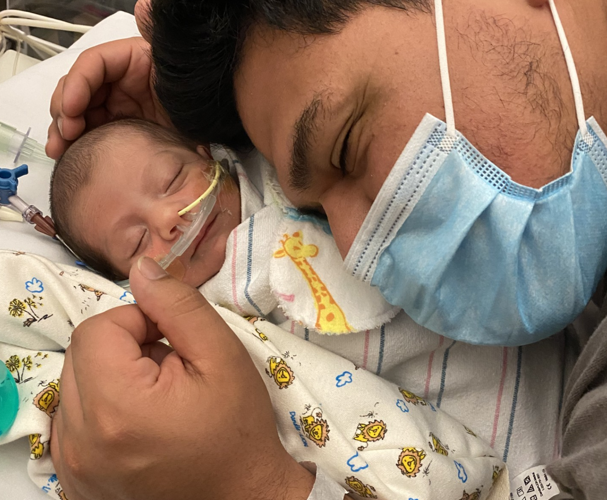
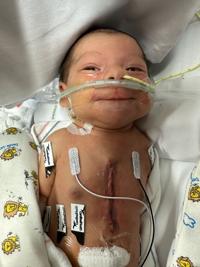


Arianni Sanchez in the hospital. (Photo courtesy of the Sanchez family.)
Suleima Sanchez and Freddy Sanchez were ready to embrace the responsibility of becoming first-time parents. However, their journey took an unexpected turn when they learned that their 10-day-old baby Arianni needed heart surgery to treat a congenital heart defect.
In the U.S., congenital heart defects affect nearly 1% of births, which is about 40,000 babies each year. Infants with critical heart defects generally need surgery or other procedures in their first year of life.
Throughout Suleima’s pregnancy, everything seemed normal. It wasn’t until she gave birth that concerns arose, when Arianni was born with high levels of jaundice. After being discharged from the hospital, she was instructed to follow up with her pediatrician, who noticed that the baby’s bilirubin levels were still elevated. As a result, Arianni was admitted to the NICU for blue light therapy.
“Upon arrival, she was hooked on all the monitors they place you when you're admitted, and they noticed that her oxygen was pretty low,” Suleima shared. “Infants shouldn't drop past 94%, and so she was reading at 40%, and they thought that maybe she was overwhelmed because they had a lot of nurses on her sticking things on her body so they let her settle.”
After waiting five minutes, Arianni’s oxygen levels did not improve, and she began gasping for air. Her doctor ordered a chest X-ray and initially suspected that she had the flu, since Suleima had it at the time of delivery. They immediately started treating Arianni for a respiratory infection, gave her antibiotics and had her on oxygen assistance. Eventually she started getting better but by day nine once they took off her oxygen support, she dropped back down to 40%, and she was again struggling to breathe.
Suleima said that if it hadn’t been for the rotating doctors in the NICU, she might still be searching for answers about what was wrong with her baby. One of the other physicians who evaluated Arianni recommended an X-ray to determine whether there was an issue with her heart. That imaging ultimately revealed that Arianni had a congenital heart defect.
In less than an hour, Suleima had to drive to the NICU to sign all the paperwork to have Arianni flown out to Loma Linda’s Children’s Hospital for the open heart surgery. Congenital heart defects are structural abnormalities of the heart present at birth and are the most common type of birth defect in the U.S. These defects can involve the heart muscle, valves, walls or major blood vessels connected to the heart. Because of advancements made through research, death rates from congenital heart disease in the U.S. have declined by nearly 37.5% since 1999, according to the American Heart Association.
Suleima shared that she was going through different emotions after her daughter’s diagnosis. “It was honestly heartbreaking, confusing and really scary. Following that phone call from the doctor we just had no choice but to snap into action and make our way to her,” she said.
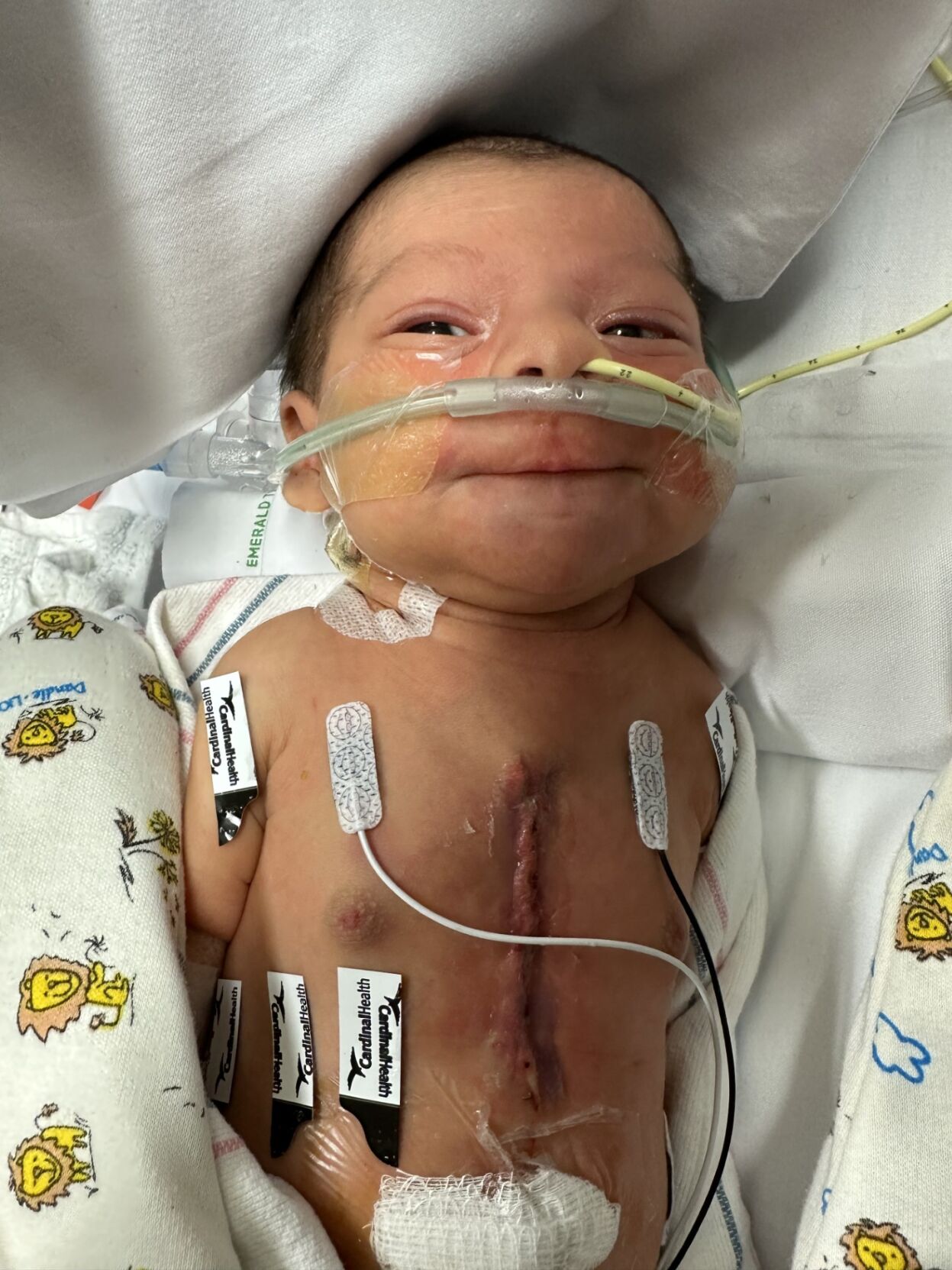
Arianni at the hospital after open heart surgery. (Photo courtesy of the Sanchez family.)
Suleima said that faith played a big role during those difficult moments, especially when Arianni had open heart surgery, “My husband and I come from the Catholic faith and growing up we always talked about God, and went to church, but I think that our faith was so small compared to what it is now,” she said. “We knew God, but we really didn't meet him yet until we had to come face to face with almost losing our child. God really reveals himself in ways that we didn't know possible, and he truly showed us that miracles are possible.”
Suleima shared that it was heartbreaking once again to learn that for at least 12 days, her daughter hadn’t been receiving enough oxygen, as her heart condition prevented oxygen-rich blood from properly circulating throughout her body.
During 1999–2017, about one in every 814 deaths were attributable to heart defects in the U.S. Nearly half 48% of the deaths due to heart defects occurred during infancy (younger than one year of age). Suleima said that it was a miracle that they were able to diagnose her daughter early on without leading to much worse health conditions.
Suleima describes post-operation care being really difficult. “She was my first daughter and my husband and I were super excited to bring her home and finally be able to live a normal life and hug her and never let her go, but unfortunately, because she had open heart surgery and she was so fragile, we weren't able to pick her up like you would with a regular baby and we weren't able to feed her the way that a normal baby gets fed,” she said. “We weren't able to cuddle her or swaddle her. There were a lot of limitations physically, which was heartbreaking because that's all you want as a parent to hold them close, especially after such a traumatic event.”
After undergoing neonatal open-heart surgery, Arianni’s recovery was better than expected. Her doctors were able to fully close her chest and she did not require any additional procedures. She also did not experience significant swelling, allowing the surgical team to fully close her incision. Survival of infants with heart defects depends on the severity of the defect, such as timing of diagnosis, treatments and presence of other conditions.
For Suleima, spreading awareness about congenital heart disease and its impact. “I wish that the Latino community would be a little more receptive to learning CPR measures because even if it's not a congenital heart defect anyone can suffer from a heart condition whether it's a stroke, a cardiac arrest, no one's safe,” she said.

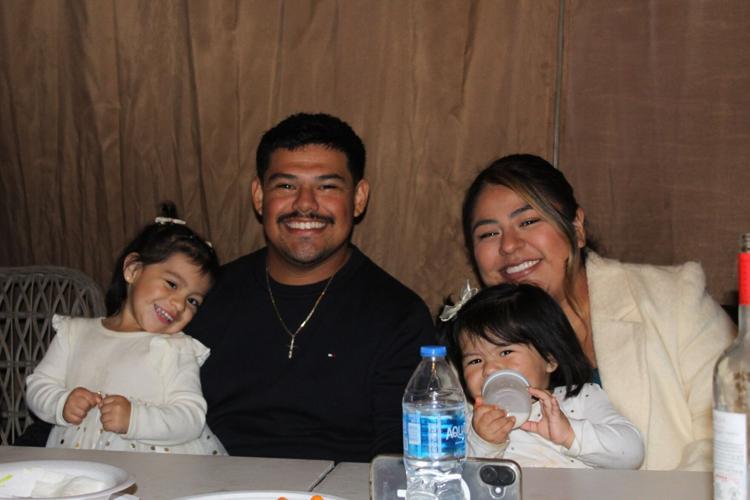
Arianni alongside her parents and her younger sibling. (Photo courtesy of the Sanchez Family.)
Arianni’s mother also told CALÓ News about ways individuals and organizations can step up to support families going through similar situations. “The American Heart Association hosts numerous heart walks all over different cities and states. I would recommend the community to get involved and sign up for a heart walk, and if you're not able to sign up donate to the American Heart Association, which does a lot of advocacy for heart disease for children and adults,” she said.
Arianni just turned three years old this week and is now living a healthy life years after her open-heart surgery. She is a happy, energetic little girl who loves to dance, sing and stay active.





(0) comments
Welcome to the discussion.
Log In
Keep it Clean. Please avoid obscene, vulgar, lewd, racist or sexually-oriented language.
PLEASE TURN OFF YOUR CAPS LOCK.
Don't Threaten. Threats of harming another person will not be tolerated.
Be Truthful. Don't knowingly lie about anyone or anything.
Be Nice. No racism, sexism or any sort of -ism that is degrading to another person.
Be Proactive. Use the 'Report' link on each comment to let us know of abusive posts.
Share with Us. We'd love to hear eyewitness accounts, the history behind an article.