
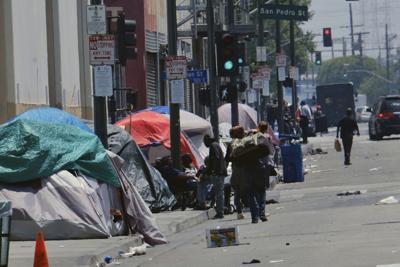


In this May 30, 2019 file photo tents housing homeless line a street in downtown Los Angeles. The number of homeless people counted across Los Angeles County jumped 12% over the past year to a total of 58,936. The Los Angeles Homeless Services Authority presented the results of January's annual count to the Board of Supervisors on Tuesday, June 4. (AP Photo/Richard Vogel,File)
Homelessness in the county increased by 3.3% overall, according to the count from the Los Angeles Homeless Services Authority (LAHSA). L.A. County officials said federal and state cuts to funding are to blame for the increase in homelessness.
LAHSA released its 2026 Los Angeles Homeless Count Point-in-Time numbers, which also show an increase of 7.9% in unsheltered people.
In the federally required annual report, LAHSA wrote that the increase doesn’t come from the failure of any particular program, but that the primary reason for the increase is due to funding reductions, which forced a pause on enrollments and Time Limited Subsidies (TLS), often used for rapid re-housing.
As a result, the number of people newly housed using TLS dropped from 10,308 in 2024 to 6,590 in 2025.
Other numbers from LAHSA’s report include:
The movement of people from interim to permanent housing decreased by 36% (12,120 to 7,770)
The movement from the street to interim housing decreased by 8% (16,724 to 15,380)
Movement from interim housing back to the street increased by 24% (4,708 to 5,842).
According to Inner City Law Center, a Los Angeles homelessness-centered nonprofit, the rising numbers of homelessness is linked to a lack of immediate dollars from California's Homeless Housing Assistance and Prevention (HHAP) program, made by the state during last years’ budget cycle.
The Homeless Housing, Assistance and Prevention (HHAP) Program provides one-time, flexible block grants to cities, counties, Continuums of Care and other eligible local entities. The state allocated $1 billion in one-time General Fund support for HHAP in 2024, but appropriated no new General Fund dollars for the program in the 2025 – 2026 budget, according to Jed Leano, senior policy advisor with the Center.
Leano told CALÓ News that local governments had to respond to those substantial cuts by approving a homeless services budget that cut 25%.
“They had to come up with a strategy that was trying to preserve bed space to their best ability possible. Anything else was on the chopping block,” Leano said. “So what these numbers show us are the direct responses and consequences of the choice, by example, the state of California to not fund half last year. That has a bunch of consequences at the local level, and it has a human suffering consequence in homelessness.”
But Leano projects that those numbers will improve because, in late June 2026, Governor Gavin Newsom signed California’s 2026-2027 state budget, which included $900 million for the HHAP program.
As more Angelenos react to the LAHSA recently released report, L.A. Mayor Karen Bass, who’s headed into November to face Councilwoman Nithya Raman for L.A. mayor, posted via a social media video that there are two things to blame for the increased numbers, naming the federal government and the 50% cut in funding from the state.
“The Trump Administration has driven up the cost of gas, groceries and rent — pushing more families to the edge — and slashed critical safety net funding. And, last year’s 50% cut in state HHAP funding from $1 billion to $500 million — resulting in a $70 million hit to L.A. city alone — severely impacted our work to keep people housed and get more Angelenos off the streets,” Bass said in a press release. “We raised philanthropic dollars to help supplement the cuts, and this year I fought alongside other mayors to reverse these cuts, restoring it to $900 million [as cited by Leano].”
Despite restoring funding, Bass said that “The lack of adequate services provided by L.A. County continues to be a real problem and a contributing factor to people cycling in and out of homelessness.”
Nearly 60% of newly unhoused people cited economic hardship as the main cause of their homelessness, according to LAHSA.
In a press release, Gita O'Neill, the Interim Chief Executive Officer of LAHSA, said that this year’s count underscores the need to expand access to permanent housing, arguing that moving people into stable housing is the key to ending homelessness
“When our unhoused neighbors lost access to rental subsidies, the system slowed, there was less upward movement in interim housing, and progress stalled,” O’Neill said. “Our community needs to come together to reinvest in permanent housing resources and advocate for resources from our state and federal partners to clear this bottleneck and get our region back on track.”



(0) comments
Welcome to the discussion.
Log In
Keep it Clean. Please avoid obscene, vulgar, lewd, racist or sexually-oriented language.
PLEASE TURN OFF YOUR CAPS LOCK.
Don't Threaten. Threats of harming another person will not be tolerated.
Be Truthful. Don't knowingly lie about anyone or anything.
Be Nice. No racism, sexism or any sort of -ism that is degrading to another person.
Be Proactive. Use the 'Report' link on each comment to let us know of abusive posts.
Share with Us. We'd love to hear eyewitness accounts, the history behind an article.