
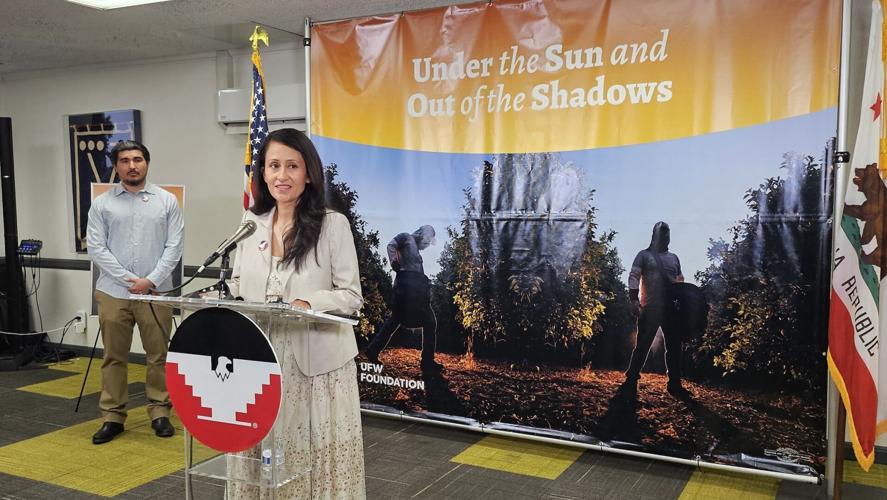


Erica Lomeli Corcoran, UFW Foundation’s CEO and Jonathan Angulo, research and policy analyst with UFW Foundation during the press conference on July 30, 2026. (By Jacqueline García)
Since the massive ICE raids started in mid-2025, Jazmin, a farm worker and a DACA recipient, has lived in fear and anxiety. Her husband is undocumented and her 11-year old twin daughters are U.S. citizens.
“My family and I had to make changes and create a family plan. I even had to talk to my daughters on what to do in case the worst happens,” she said referring to one of the parents being detained.
Jazmin, who didn’t provide her last name, is one of 2,250 farm workers who participated in an in-depth survey titled “Under the Sun and Out of the Shadows.” Here, the participants express their experiences during ongoing immigration raids and mass deportations as well as their hopes and aspirations for their future in the United States.
“Immigration raids have impacted my employment because I’m afraid to go to work. I’m afraid I won’t be back and never see my daughters again,” Jazmin said. “We are honest people trying to make the best and providing for our families.”
Ezequiel, another farm worker, said he has been living in the country for more than 40 years and also lives in fear of being detained and separated from his family. However, he decided to participate in the survey because he has learned that when you speak your voice matters and can create change.
In the fields, the fear is the same for everyone regardless of immigration status, he said.
“We have seen U.S. citizens being detained,” Ezequiel said. “[Immigration officers] took them and then they verified their identities.”
He said before it was very common for him and his family to go to the park or have fun outdoors but lately they hesitate even to go to the store, unless it is needed.
The findings
Since the Trump administration’s crackdown on immigration began in early 2025, farm workers have expressed severe impacts on their lives and employment, said Jonathan Angulo, research and policy analyst with UFW Foundation.

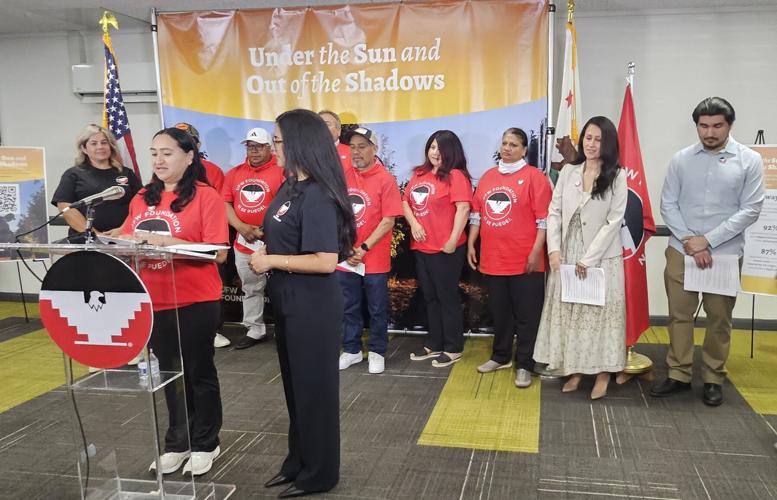
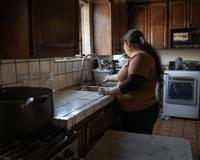
Jazmine (left) speaks about her experience since the ICE raid sstarted. (By Jacqueline García)
While the majority of respondents are from California, there were farmworkers from 12 other states that participated, including Washington state, Michigan and Georgia.
The survey showed 92% of farm workers have been affected by their employment.
“Several farm workers mentioned having to take days off during days of heavy enforcement,” he said. “88% of farm workers fear detention and deportation.”
He said beyond the worries, many farmers have established lives for many years in the U.S., making it extremely difficult to just pack and leave.
The survey revealed that 80% have lived in the U.S. for more than 10 years; of that, 41% for more than 20 years and more than 40% have labored in agriculture for more than 20 years. About 43% have worked between 10 to 19 years.
The data showed that 90% of farm workers worry about family separations due to deportations.
87% of them want to visit a family member in their native countries after an immigration reform law; 76% desire protections from deportation and detentions.
The hopes for the future
Erica Lomeli Corcoran, UFW Foundation’s CEO, said they hope the survey can create awareness and become an educational piece. She also hopes this information is used by congressional members to make a case that farm workers need better wages, better labor protections and legalization.
“Many of these workers that participated in our survey, the majority of them have been here for 10 or 20 years or more. So this is their home and what we hope to do is that we use it to make policy changes,” Corcoran said.
She explained one of the priorities now is the H-2A lawsuit, which is cutting farmworker wages across the nation. According to analysis of the Trump administration rule, an estimated $2.4 billion dollars will be transferred from farmworkers to the agricultural industry.
Angulo said legal status and a path to citizenship would protect farm workers while keeping families together. Despite the very real risk of arrest, deportation and family separation, the survey also demonstrates many undocumented workers aspire to fully participate in the country they call home.
“Restoring ties between farm workers and the public ensures a stronger economy. This reform will benefit them, agricultural employers and the country by having a secure food system,” Angulo said.







(0) comments
Welcome to the discussion.
Log In
Keep it Clean. Please avoid obscene, vulgar, lewd, racist or sexually-oriented language.
PLEASE TURN OFF YOUR CAPS LOCK.
Don't Threaten. Threats of harming another person will not be tolerated.
Be Truthful. Don't knowingly lie about anyone or anything.
Be Nice. No racism, sexism or any sort of -ism that is degrading to another person.
Be Proactive. Use the 'Report' link on each comment to let us know of abusive posts.
Share with Us. We'd love to hear eyewitness accounts, the history behind an article.