
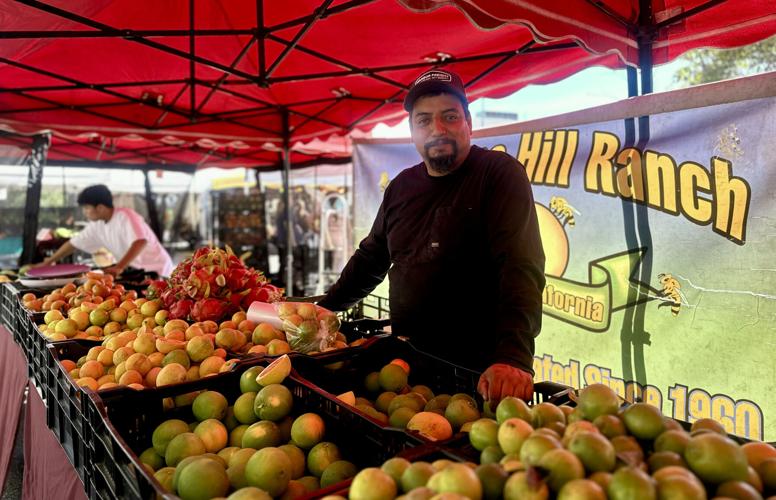
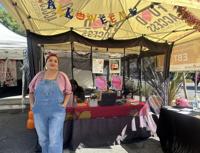
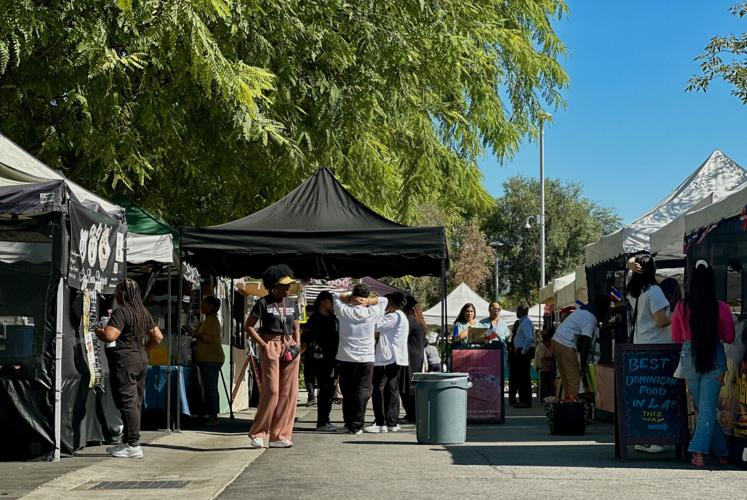
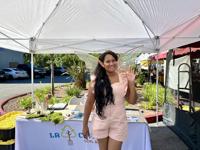


Manuel Hernandez with Sycamore Hills Farms at the Watts-Willowbrook Farmers' Market. Photo by Brenda Verano
In 2018, research revealed that South L.A. had few grocery stores and mostly corner and convenience stores, as well as fast food restaurants.
Alice Tiffany at Loyola Marymount University examined the community and concluded that 94% of food retail outlets in South L.A. were convenience stores or corner and liquor stores. Her research also showed that the neighborhood had 12.5 times as many fast food restaurants as grocery stores.
Food justice advocates have steered away from using the term “food desert” and advocated for a language shift to "food apartheid," arguing that food access, unlike a desert, which is a natural phenomenon, stems from deliberate systemic and discriminatory disparities as well as historical injustices like racism, segregation and economic inequality.
To address the nutrition deficiencies that communities like South L.A. face, the nonprofit Food Access LA connects residents with fresh, local food while supporting small- and mid-sized farms and local food businesses.
Leah Galitzdorfer, director of nutrition education at Food Access LA, said the farmers market is more than just a place where working-class communities buy and sell food; it is a community hub where food justice is actively taking place.
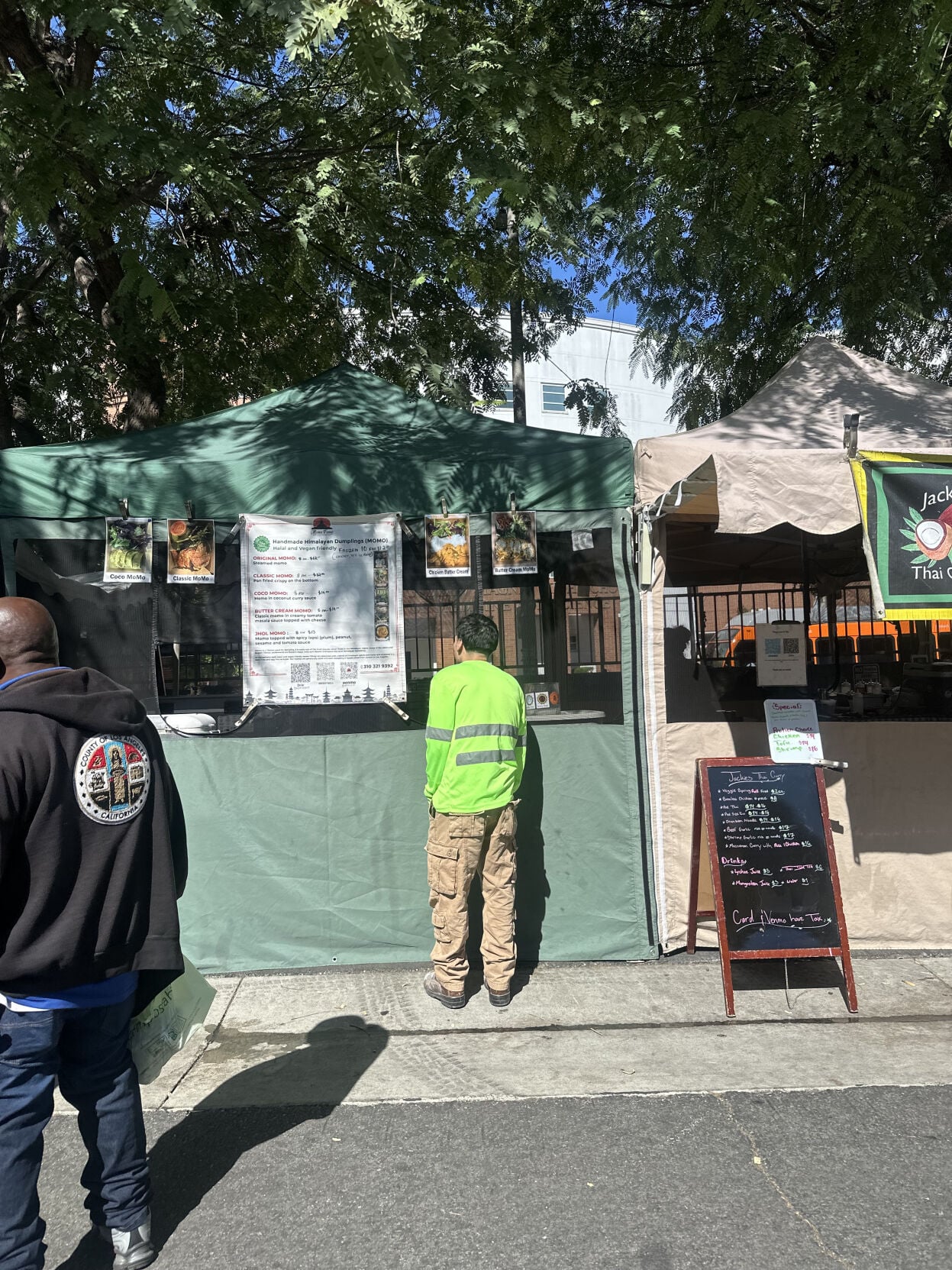
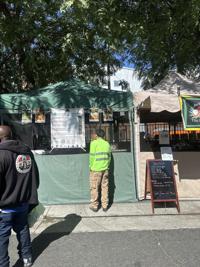
Watts-Willowbrook Farmers' Market is visited by county workers, working-class families and many of the doctors and nurses that work across the street. Photo by Brenda Verano
“We are very intentional about prioritizing this connection that communities have with their farmers and really helping people to understand these direct grower-to-consumer spaces that are farmers' markets,” she said. “Ultimately, it's the farmers who are the best resource for understanding more about the food that community members are purchasing. That type of connection you will not get in grocery stores.”
Why local farms matter
In the summer of 2026, a major Cyclospora outbreak tied to lettuce hit 21 states, resulting in at least 570 hospitalizations and two deaths. The lettuce came from central Mexico and was supplied by Taylor Farms de México. Foodborne illness, also commonly referred to as food poisoning, affects an estimated 48 million people each year, according to the Centers for Disease Control and Prevention (CDC).
Galitzdorfer said that when outbreaks like these affect community members, knowing where food comes from is vital.
“Foodborne illnesses are becoming more and more common. That's leading to a lack of confidence in our overall food system and reducing fruit and vegetable consumption among communities that are already experiencing these health disparities,” she said.
Can farmers’ markets be cheaper than grocery stores?
Part of the economic inequalities that affect communities like South Central L.A. show up in myths that circulate around farmers' markets and have been hard to dispel. One example of this is the idea that farmers' markets are always more expensive than grocery stores, when in reality prices depend heavily on the item, season and organic status. Cesi Campos, manager of the Willowbrook Farmers’ Market, said many people who attend the event for the first time are surprised when they realize that peak-season produce and organic options are frequently comparable or more affordable than supermarket prices.
“A lot of working-class folks think that farmers' markets are very expensive or that they can't afford it, but that is not true. Reframing that narrative has been difficult,” Campos said.

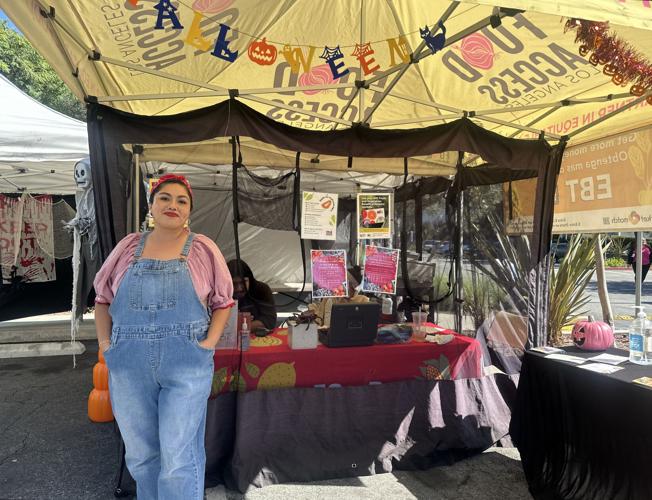
Cesi Campos, manager of the Willowbrook Farmers’ Market. Photo by Brenda Verano
Born and raised in South Central L.A., Campos said she has seen firsthand what it's like not to have healthy options to rely on. As a mother, she said educating her community and loved ones on what food access can look like has been an active journey for years. One that she said she is committed to because of how personal this issue has been for her throughout her life.
“I was a mom at 20. I was working as a medical assistant, always on the go and fast food was just kind of the way to go,” she said. "But working in food access, I have built community and changed certain norms in our family. I see the difference in my kids.”
She said working at the Watts-Willowbrook Farmers' Market has been a full-circle moment, as the market sits in the parking lot of the Martin Luther King Jr. Community Hospital, where many medical professionals stop by to access healthier food options.
Latino farmers supplying food in South LA
Florentino Santiago Hernández is one of the farmers who, as part of Hernandez’s Farming, travels to Los Angeles at least twice a week to sell some of their farm's fresh produce at different farmers' markets, including the Willowbrook Farmers’ Market in Watts. He and his family from Hernandez’s Farming travel about 3.5 hours from their Santa Maria farm to bring fresh produce over to Southern California.
“All of our produce, we grow it ourselves; we harvest and bring it to this community. It's all fresh produce,” Santiago-Hernández said.
The 21-year-old said he and his family are proud to be one of the few Latino-owned farms bringing fresh produce, grown without genetically modified organisms (GMOs).
“Despite the distance, we feel very proud of bringing the type of produce we grow from the ground up all the way here,” he said.

Inside the Willowbrook Farmers’ Market. Photo by Brenda Verano
Hernandez’s Farming is one of the many vendors at the Willowbrook Farmers’ Market in Watts, operated by Food Access LA, a nonprofit organization that, apart from managing farmers' markets across L.A. neighborhoods — including Atwater Village, Central Avenue, Compton, Crenshaw, Echo Park, Hollywood and the L.A. River — also runs food access programs and nutrition initiatives across the city.
Food assistance
To incentivize more people to visit and buy from farmers' markets, the federal government created Market Match in 2009, expanding it further in L.A. between 2021 and 2024. The nutritional incentive program allows CalFresh or EBT beneficiaries to use their food assistance cards to buy from farmers' market stands.
Market Match doubles people's CalFresh food dollars at participating farmers' markets so they can buy more fruits and vegetables. CalFresh and EBT beneficiaries get an extra $1 in Market Match funds for every $1 of CalFresh benefits they spend. A market staff person will swipe their CalFresh EBT card for the amount of their choice and community members will receive tokens or paper vouchers to spend on any CalFresh-eligible food items at the market.
“Programs like this help our community access organic fruits and veggies without it necessarily hitting their pockets,” Campos said. “We do notice that because of these programs we are able to get more people to participate.”
Beyond providing healthy food options, another part of Food Access LA’s work is its free nutrition education and cooking classes at some of the farmers' markets it manages.
The classes use culturally used ingredients for “good cooking,” a hands-on cooking and nutrition session that provides a physical space for community members to learn about new cooking methods that take into consideration people's budgets, reading labels and shopping for fresh produce at farmers' markets. The recipes taught in these classes are available in both Spanish and English.
Galitzdorfer said that, beyond hands-on cooking, seasonal tastings, and food systems lessons, the classes build personal confidence for women, caregivers and foster or systems-impacted youth.
”We focus on the holistic connection that is making food. Starting from the very beginning. When people feel confident in not just preparing but also purchasing produce at the farmers market, they're going to be more willing to allocate some of their budget to fruits and vegetables that they purchase,” she said. “Our classes really focus on incorporating interactive, hands-on everyday skills, such as how to select produce and how to prepare meals using seasonal fruits and vegetables that they can directly purchase at the market. Participants also learn best practices for storing produce at home to help them stretch their food dollars while also reducing food waste.”
SNAP cuts
Given the recent attacks and cuts to programs like SNAP, driven by congressional Republicans, such as the 2025 budget reconciliation law that reduced SNAP funding and shifted program costs to states, Food Access LA said their work has become more challenging but also more important.
According to the Center on Budget and Policy Priorities, the 2025 Republican budget reconciliation law enacted significant SNAP cuts projected to affect over 4.5 million people.
Campos said she is more concerned about working-class families who already live within zip codes that are facing scarcity and have high rates of diabetes.
Despite that, research shows that people, including working-class people, do want and are inclined to consume healthier products, but economic disparities make it harder to do so.

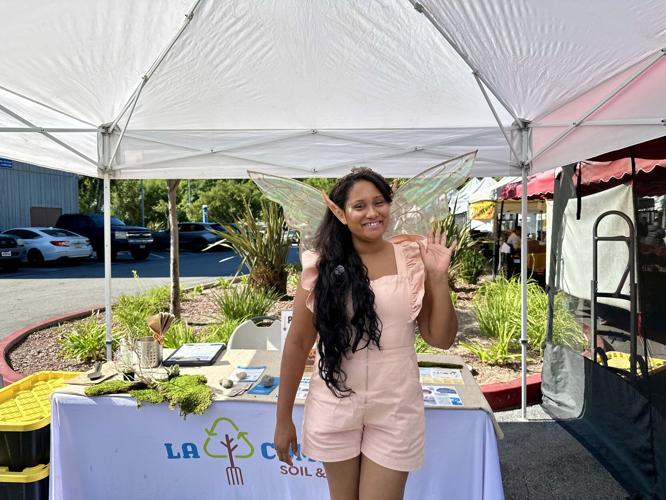
Tamara Duncan with LA Compost, an organization that collects food scraps inside the Watts-Willowbrook Farmers' Market. Photo by Brenda Verano
In September 2026, the CDC reported that the percentage of adults who consumed any fruit on a given day increased with family income, from 56.9% among adults with family income less than 130% of the federal poverty level to 67.4% among adults at 130%–349% of the federal poverty level and 76.5% among those at 350% or more of the federal poverty level.
‘This is our lifeline’
For Manuel Hernandez, a vendor with Sycamore Hills Farm and at the Watts-Willowbrook Farmers' Market, hearing that people are more inclined to go beyond a supermarket is what motivates him to keep selling his produce at farmers' markets.
“Right now, farmers' markets are what is helping us stay afloat in this economy,” he said. “Right now that the economy is a bit bad; this is our lifeline.”
He said the relationship with the clients is a two-way street.
“They buy from us and in return we make sure our produce is of great quality and fresh. We do not use pesticides because we care about our community,” Hernandez said.
The Watts-Willowbrook Farmers' Market is open Wednesdays from 9 a.m. to 2 p.m.
It is located at 1670 East 120th St, Los Angeles, CA 90059.
To learn more about Food Acess LA, visit https://foodaccessla.org/.







(0) comments
Welcome to the discussion.
Log In
Keep it Clean. Please avoid obscene, vulgar, lewd, racist or sexually-oriented language.
PLEASE TURN OFF YOUR CAPS LOCK.
Don't Threaten. Threats of harming another person will not be tolerated.
Be Truthful. Don't knowingly lie about anyone or anything.
Be Nice. No racism, sexism or any sort of -ism that is degrading to another person.
Be Proactive. Use the 'Report' link on each comment to let us know of abusive posts.
Share with Us. We'd love to hear eyewitness accounts, the history behind an article.