
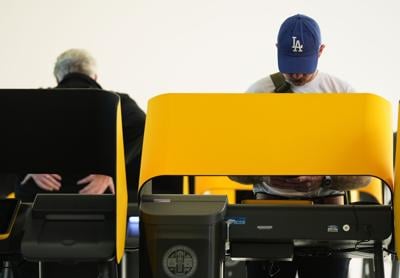


Voters work on their ballots at a polling location. (Chris Pizzello/AP Photo)
A week after the blue wave of the midterm elections, which gave Democrats control of Congress and elected two Latinos as governors for the first time in Texas and California, a panel of journalists and campaign strategists gathered at UC Irvine to highlight the role of Latino voters to achieve those historic wins.
While Latino voters are not a homogenous voting bloc, there are also many issues that hold them together, explained Mike Madrid, moderator of the panel.
“We are not just the swing vote; we are the definite vote,” added LA Times columnist Gustavo Arellano.
He explained how Latinos were the crucial factor in electing Nithya Raman, the first Democratic socialist mayor-elect of L.A. Heavy Latino communities like Boyle Heights and younger voters and renters voted for Raman, according to the NY Times.
Raman was one of many candidates who ran against candidates with million dollar-funded campaigns.
At the state level, Xavier Becerra went from the underdog to the newly elected governor of California.
Rosalina Cardenas, media director for Becerra’s campaign for governor, said what worked for the governor-elect is that he was relatable to many people: the working class, the middle class. From growing up in a working family to obtaining higher education and his experience in politics locally and nationally. However, his tenacity to continue even when he was told to drop out of the race showed his discipline.
“We had a candidate who was ready, and we were able to take advantage of the opportunity that was in front of us, and we saw our campaign literally change overnight,” Cardenas said.
For congressional seats, Randy Villegas shocked many in the Central Valley. A 32-year old community college professor with a vision for the future but little experience ran for Congress against the odds and beat out incumbent David Valadao for California's 22nd Congressional District. As of Friday afternoon, with 88% of votes counted, Villegas had received 68% of the votes and Valadao 32%.
Luis Alcauter, who ran Villegas’ campaign, said Villegas was also very relatable — born and raised in the Central Valley with immigrant parents and a sibling who benefits from DACA.
He did not have the support of the Democratic Congressional Campaign Committee (DCCC), but he did receive support from Sen. Bernie Sanders.
Part of the strategy to win the race was to be present and hear directly from concerned constituents, said Alcauter. There were unanswered questions regarding expensive gas and electricity, two vital elements needed in the Valley.
Despite Valadao being a politician since 2010 and in Congress since 2023, Alcauter said he hadn’t hosted a town hall for years.
“So even though he was a representative, [constituents] didn't have representation,” he said.
So Villegas listened to working families, rural communities and kept knocking doors even when the polls were about to close on Nov. 3.
The anti-establishment campaign
Arellano said a key moment during the campaign was when, at USC, there was a cutoff line for gubernatorial debate participants. Candidates like San Jose Mayor Matt Mahan, who was barely known, were allowed to be on the panel, but Latinos like Becerra or former L.A. Mayor Antonio Villaraigosa couldn’t join.
He compared the situation to Mexico's old pre-tactic “El dedazo,” or finger pointing, where it was previously approved who could join and who couldn’t. The Latino candidates revolted and USC ended up canceling the event entirely.
“But I think after that, that's when people realized, like, ‘wait a minute! This game's being rigged and it's being rigged in favor of a few candidates, and none of them happen to be Latino,’” said Arellano. “And that's also implying that people like Becerra and Villaraigosa and others had no chance at all.”
Journalists and strategists on the panel agreed that this election was an anti-establishment and anti-machine election. Big changes were not only seen in California cities like Los Angeles, Santa Ana, and Bakersfield, but also at the national level.
What’s next?
Panelists agreed that selecting their candidates is just the beginning of the work. In California, for example, the affordability issue is not something that will be solved in one governorship. It will be a several-step process.
Arturo Carmona, president of the Latino Media Collaborative and publisher of CALÓ News, said that a few days ago the governor-elect was asked if he could commit to providing health care for undocumented immigrants. Becerra didn’t commit, but said it’s going to be a process and even then there will not be coverage for everyone, but they are moving in the right direction.
“So I think if we set the right type of expectations, I think we're going to see progress,” Carmona, who also worked on the No on Prop. 40 campaign, said. “But our communities are not patient. The level of pain, the level of economic stress that they're undergoing is great and I think we have an electorate that's angry, that's upset and wants to see change.”
Some panelists agreed that Latinos are not a one-party group and some keep floating because they don’t see solutions to the issues they face on the daily. However, they also agreed that if prices are going up and life is not getting better, it is not the politicians' fault anymore, but voters who keep choosing them.
Therefore, this blue wave is the outcome of people choosing change after all the struggles.
The Nov. 9 event, titled “The Latino Vote, MidTerms 2026: A National Post-Mortem,” was presented by UC Irvine’s School of Social Ecology in partnership with The Latino Vote Podcast, the California Latino Legislative Caucus and The Latino Working Class Project.




(0) comments
Welcome to the discussion.
Log In
Keep it Clean. Please avoid obscene, vulgar, lewd, racist or sexually-oriented language.
PLEASE TURN OFF YOUR CAPS LOCK.
Don't Threaten. Threats of harming another person will not be tolerated.
Be Truthful. Don't knowingly lie about anyone or anything.
Be Nice. No racism, sexism or any sort of -ism that is degrading to another person.
Be Proactive. Use the 'Report' link on each comment to let us know of abusive posts.
Share with Us. We'd love to hear eyewitness accounts, the history behind an article.