
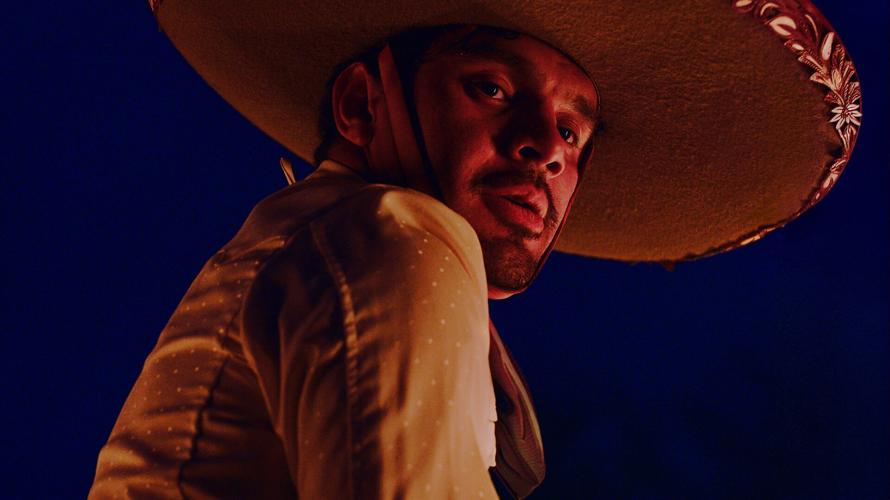
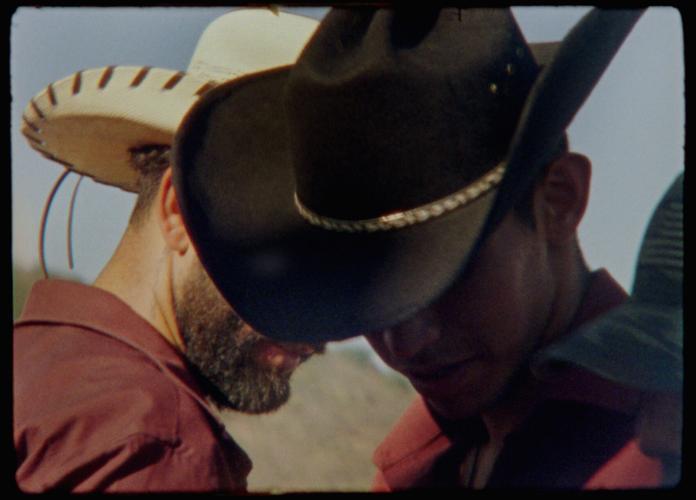


José A. Aguilar is featured in "Jaripeo" by Efraín Mojica and Rebecca Zweig, an official selection of the 2026 Sundance Film Festival. (Courtesy of Sundance Institute)
The documentary “Jaripeo” is premiering in Sundance’s NEXT section later this month and heading to Berlinale for its international premiere.
“Jaripeo” journeys into Michoacán’s hypermasculine rodeos, first as a celebration of tradition, then into queer desire and longing.
Efraín Mojica, a queer ranchero returning to their homeland, is the subject and co-directs with Rebecca Zweig the lyrical verité work.
Every Christmas in Penjamillo, Michoacán, the annual jaripeo, or central Mexican rodeo, draws locals and returning migrants from the U.S., celebrating what it means to be a cowboy from Michoacán. The rodeo evokes nostalgia and reinforces cultural norms, reminding the diaspora of "what it means to be a man" in rural Mexican society.
But what it means to be a man in this day and age is different than what Mexican society considers the macho prototype of masculinity. Beneath the jaripeo’s spectacle, another narrative unfolds: fleeting touches, knowing glances and secretive hookups in the woods behind the rodeo arena. These moments reveal a hidden queer subculture born out of this environment.
“We hope that it provides an opportunity for the communities of Michoacán and its diaspora to break stereotypes and taboos within the tradition of the jaripeo, and that rural queer people worldwide can see a part of their story reflected in this film,” said Mojica and Zweig in a statement.
Mojica grew up between Penjamillo and Riverside, California and guides viewers through this world, blending personal experience with layered storytelling.

Efraín meets two other protagonists at the Christmas jaripeo: Noé, a macho and desirable cowboy who, though out to some members of his family, still lives mostly in secret, and Joseph, a flamboyant diva and jaripeo super fan, a beloved pillar of his community.
“[Jaripeo] is one of those films that really opens a world into a place, an activity that you just don’t have the privilege of being part of, in this case, the jaripeos, which are like these rodeos often around Christmastime in Mexico,” said Basil Tsiokos, senior documentary programmer at Sundance to Deadline. “It looks at the sort of interesting queer undercurrent that takes place.”
Mojica is a photographer, filmmaker and multidisciplinary artist from Michoacán, living in Mexico City. Their work has shown in galleries around the world including Kunstverein Neukölln and MZ Galleries in Berlin, Magia Roja in Barcelona, the Factory in Seattle and most recently Museo Tlatelolco in Mexico City.
Rebecca Zweig is a filmmaker, journalist and poet based in Mexico City. Her work is featured in The New York Times, The Nation, and Revista Nexos, among others, and has been supported by Chicken & Egg Pictures, the Sundance Institute, SFFILM and the Points North Institute. She is a graduate of the Iowa Writers’ Workshop, where she was a Teaching and Writing Fellow and a Mitchell/Burgess Scholar.
"Jaripeo" will premiere at Sundance and will stream it online on Jan 29 at 7:00 a.m. PST and Feb 1 at 10:55 p.m. PST. You can purchase tickets at Sundance.org.




(0) comments
Welcome to the discussion.
Log In
Keep it Clean. Please avoid obscene, vulgar, lewd, racist or sexually-oriented language.
PLEASE TURN OFF YOUR CAPS LOCK.
Don't Threaten. Threats of harming another person will not be tolerated.
Be Truthful. Don't knowingly lie about anyone or anything.
Be Nice. No racism, sexism or any sort of -ism that is degrading to another person.
Be Proactive. Use the 'Report' link on each comment to let us know of abusive posts.
Share with Us. We'd love to hear eyewitness accounts, the history behind an article.