
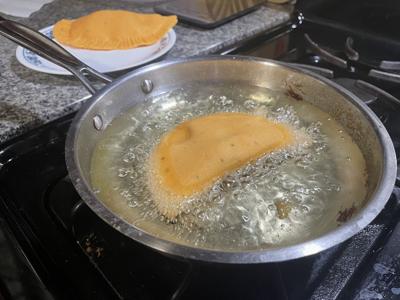


Empanadas frying in Gladys' kitchen. Photo by Gladys B. Vargas
My family, like many immigrant families, has no real ties to the American Thanksgiving. If we have the day off, we rest and enjoy good food with friends. There’s little wrong with this version of things. But I find that especially after having been raised in Massachusetts, where the incomplete version of history was taught to my sister and I throughout elementary school, there are a few ways to address the gaps with our families.
I encourage anyone reading this to consider, if not already, honoring the National Day of Mourning (NDM) that shares the calendar date with Thanksgiving. The United American Indians of New England host a ceremony commemorating the NDM each year and for those who cannot attend in person at Plymouth, MA, the event is livestreamed on YouTube. The rest of the year, it’s our collective responsibility to keep up to date with the affairs of the native nations or communities indigenous to our areas, whether the need is for mutual aid, political advocacy or fellowship.
However you spend your Thursday, let’s consider the food that might be left over. Being Latino, my family doesn't usually have a traditional bird on the menu. We often go for pernil, whether it’s a leg of pork from my dad’s Venezuelan side, or pork shoulder from my mom’s Puerto Rican side. One year my maternal grandpa came over from Brooklyn, NY to have dinner with us, and he brought a huge garlic-buttered salmon adorned with orange slices. Another year, my dad won the prize of a frozen 20-pound turkey from his union’s holiday party. Whatever protein we’ve got on the table, if there are leftovers in the fridge the next day, my dad loves to stew them and use it to fill empanadas.
When people think of empanadas, they usually picture a flaky pastry crust, like that of Puerto Rican empanadillas. While empanadillas are buttery delicious, I advocate for the cornmeal crust of Colombian and Venezuelan-style empanadas: fragrant with star anise and fried into a crispy shell with a lush, chewy inner lining. Whether your leftovers include turkey, chicken, pork or beef, the stewing process is very adaptable, and the dough formation is both fun and forgiving.
Recipe:
For the guiso (stew):
Set your large pan on the stove to medium heat.
Use the solidified fat and drippings from your protein as the cooking oil. If none is available, olive oil will do fine.
Pour chopped onions into the pan. Cook onions for a few minutes, then add roughly chopped garlic. Make sure to add a pinch of salt.
Take your leftover protein and slice or pull it apart into chunks.
Use a bouillon cube to make 3 cups of broth, either vegetable or chicken is fine, and preferably with annatto for color and flavor. You will use some of this for the stew and the other half for the dough.
Roughly chop a couple of roma tomatoes. And slice up some green olives as well. Put the tomatoes and olives into the pan along with the chunks of meat. For the one cup of broth, add a little at a time as the stew simmers for half an hour, stirring occasionally to pull the meat apart. The broth should cook off so the guiso resembles a wetter, pulled pork texture.
While the stew cools, make the dough.
For the dough:
Combine 1 cup Harina PAN with 1 ¼ cups of your broth. Also add a heavy pinch of salt, 1 tablespoon of sugar, and about ¼ teaspoon of anise seeds.
Using your hands, mix the water and cornmeal together until they form a soft, firm dough that doesn’t stick to your hands. Let rest while you set up your assembly station.
Assembling and frying the empanadas:
Place a large piece of plastic cling wrap onto your counter or cutting board. Make sure you have your dough, a spoon for the guiso and a fork or small bowl.
Take a section of dough and form it into a ball. Place the ball on the center of the cling wrap, and begin to flatten it into a circle with your hands. Wetting your hands with water will help if the dough starts to stick.
Once the dough circle is about ¼ inch thick, place a tablespoon or two of your stew into the center. You can also add white cheese or black beans at this point, and I recommend it.
Take one end of the cling wrap and fold the dough onto itself, forming a half moon shape.
Press the edges of the empanada together so the half-moon is closed. At this point you can either press the tines of a fork against the cling wrap to pinch the edges, or you can use the extra bowl to cut the excess off and seal the empanada. Or both! The fork is a good tool for marking the empanadas if you are using a variety of fillings.
Add vegetable oil to a pan, about an inch deep. Bring to 350 degrees Fahrenheit, and slip your empanadas in, frying for about 5 minutes each side.
Let your empanadas cool on a paper towelbefore taking a big bite.







(0) comments
Welcome to the discussion.
Log In
Keep it Clean. Please avoid obscene, vulgar, lewd, racist or sexually-oriented language.
PLEASE TURN OFF YOUR CAPS LOCK.
Don't Threaten. Threats of harming another person will not be tolerated.
Be Truthful. Don't knowingly lie about anyone or anything.
Be Nice. No racism, sexism or any sort of -ism that is degrading to another person.
Be Proactive. Use the 'Report' link on each comment to let us know of abusive posts.
Share with Us. We'd love to hear eyewitness accounts, the history behind an article.