
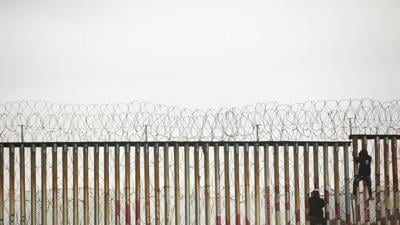



A new study from the University of California, Davis, suggests that violent competition among criminal organizations increases the risks migrants face at the border.
According to the analysis based on data from 4,945 migrants, 1,449 were exposed to extreme temperatures, 676 were abandoned by the smuggler, 887 lacked access to food or water, 419 got lost during the passage, 358 fell from cliffs or hills, 238 drowned, 188 were attacked by animals and 155 were physically assaulted.
“Migrants face significant dangers across all border regions where criminal organizations operate, but when rival groups fight for territorial control, those dangers escalate sharply,” said Oscar Contreras-Velasco, the study’s author and an assistant professor of sociology in the College of Letters and Science at UC Davis.
Increased security makes independent crossing nearly impossible, forcing migrants to rely on professional smugglers. This transforms migration into a lucrative revenue stream for cartels, fueling the very competition and violence that endangers migrants.
This increased violence, Contreras-Velasco said, can divert migrants to more perilous routes, putting their lives at greater risk. The study was published on December 4 in the peer-reviewed journal Social Forces.
The study examined Mexican government data on gun violence, U.S. government data on border enforcement, news reports and nearly 5,000 migrant survey responses.
Contreras-Velasco analyzed how violence among criminal organizations affects migrant risks in corridors for smuggling both illegal drugs and people near 23 Mexican cities from 2015 to 2019.
The study showed that cities along the Texas stretch of the U.S.-Mexico border have higher risk index scores than cities in the western border covering New Mexico, Arizona and California.
To identify a link between levels of violence and competition among criminal organizations, the researcher used male homicide rates as a proxy for cartel violence. Since most victims of turf wars are men, spikes in this specific rate effectively track the intensity of conflict among criminal groups where direct data is otherwise impossible to obtain.
The intensity of U.S. border enforcement, measured as encounters between U.S. Customs and Border Protection and migrants, influences both the strength of local criminal organizations and the routes migrants choose.
The study shows that while migrants face danger in all regions where criminal groups operate, the danger intensifies dramatically when control breaks down and rival groups fight for territory. Migrants are at higher risk of extortion, assault or abandonment, and avoiding the violence can drive migrants into harsher terrain.
Cartels have begun to act as a predatory quasi-state, Contreras-Velasco said. They can mimic state functions — such as controlling territory, policing entry and collecting “taxes” from those passing through — but they do so through coercion and violence.
“We are seeing a fragmentation of sovereignty,” said Contreras-Velasco. “Local authorities are often overwhelmed or co-opted, leaving migrants completely exposed to the whims of criminal groups fighting for control.”
Border enforcement or the aggressive disruption of criminal networks might have unintended consequences, he said. Policymakers should address the structural drivers of organized crime, strengthen local governance and foster binational cooperation, he said.








(0) comments
Welcome to the discussion.
Log In
Keep it Clean. Please avoid obscene, vulgar, lewd, racist or sexually-oriented language.
PLEASE TURN OFF YOUR CAPS LOCK.
Don't Threaten. Threats of harming another person will not be tolerated.
Be Truthful. Don't knowingly lie about anyone or anything.
Be Nice. No racism, sexism or any sort of -ism that is degrading to another person.
Be Proactive. Use the 'Report' link on each comment to let us know of abusive posts.
Share with Us. We'd love to hear eyewitness accounts, the history behind an article.