
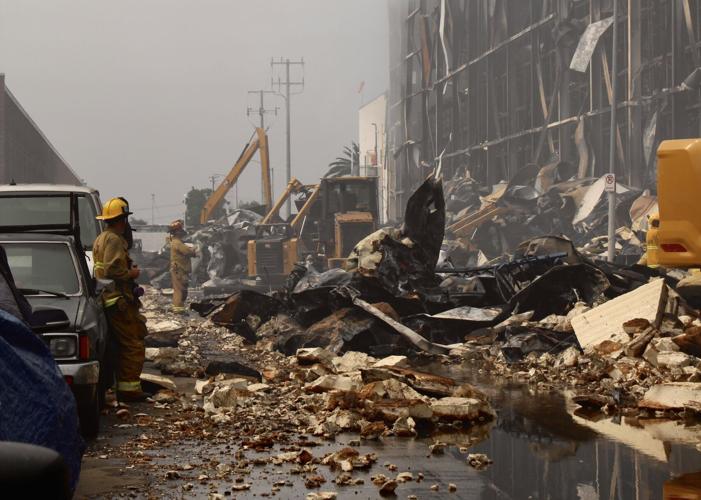
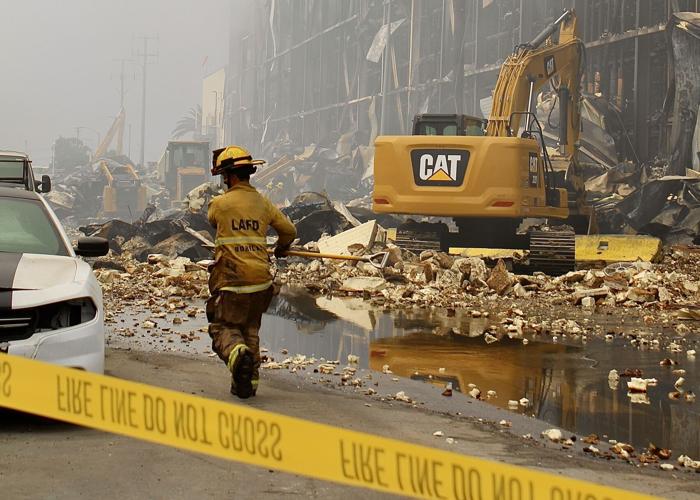


Firefighters at the Lineage Fire. Photo by Brenda Verano
Despite the containment of the Lineage Fire, a new information report found that residents living within the smoke advisory area, the majority of whom are Latinos, remain in direct danger.
After burning for eight days, the Lineage 500,000-square-foot facility in Boyle Heights, with more than 85 million pounds of frozen food inside, was extinguished by the Los Angeles Fire Department last Wednesday evening, June 24.

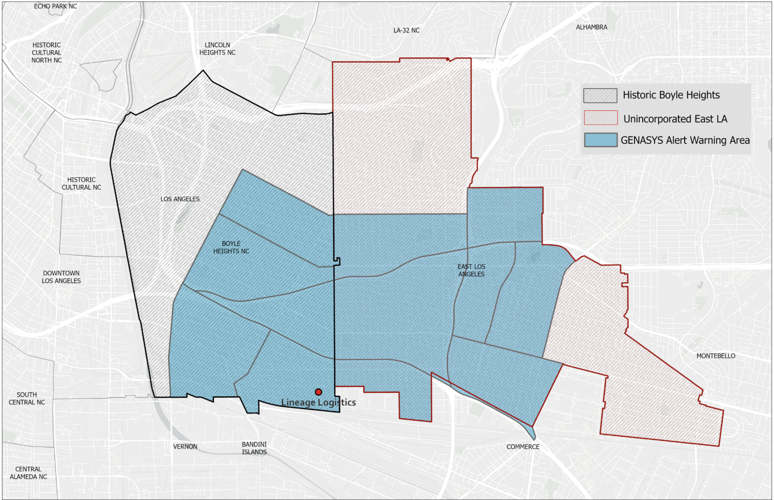
Lineage Logistics Warehouse Fire Smoke Advisory Zone, June 22, 2026. Image by the UCLA Latino Policy and Politics Institute and UCLA Center for Neighborhood Knowledge.
The briefing rapid-response conducted by the UCLA Latino Policy and Politics Institute (LPPI) and the UCLA Center for Neighborhood Knowledge (CNK) found that residents living within the smoke advisory area in Boyle Heights entered the disaster with higher environmental, health, housing and economic burdens than L.A. County overall, making them even more vulnerable to the aftermath of the fire.
Researchers say that the fire should not be treated as an isolated emergency that ends when the smoke clears.
“It should be a call to strengthen emergency planning, coordination and investment in communities that face the greatest barriers to protection and recovery before, during and after disasters,” said Arturo Vargas Bustamante, co-author of the study and faculty research director at LPPI.
L.A. Mayor Karen Bass stated that the air was “not dangerous” when questioned about air quality and potential evacuations in a press conference that took place last week.
But many residents and business owners in the affected area say they have experienced shortness of breath and headaches, among other ailments.
Janet Cerda, owner of Cafe Niña, a coffee shop and community hub in Boyle Heights, said she had to close her shop since the fire began. She told CALÓ News she was most worried about her son, who has asthma.
“I would step into my storefront and I would feel dizzy and sick to my stomach. My eyes were burning. I knew it was bad,” she said.
Cerda was among the many residents who expressed disappointment and frustration with the local and state response to the fire.
“I was shocked when I heard [Bass] say that. I wish she had shown up on the days when there was a huge black cloud above us. You couldn't even take a deep breath,” she said.
As previously reported by the Los Angeles Public Press and Capital & Main, the Los Angeles County Department of Public Health stated that emergency room visits increased during the time the fire burned. The monitoring data showed an increase in visits by people who lived within 10 miles of the warehouse. In some of these visits, smoke inhalation or the warehouse fire was mentioned. The data also showed that emergency room visits for throat pain were nearly twice as high on June 21, one of the days when the fire was still burning.
LPPI and CNK researchers also concluded that the warehouse fire compounds high environmental burdens and poorer baseline health conditions by adding another source of pollution exposure to a community that for years has already been disproportionately affected by environmental injustice.
They found that the advisory area has a CalEnviroScreen 5.0, a pollution score 63% higher than that of L.A. County. In addition, the area also has a substantially higher diesel level exposure, which is three times the county average.
The study also found that nearly 10,000 households in the smoke advisory area lack air conditioning.
“Residents in the smoke advisory area were already facing higher baseline health risks and lower access to care before the fire,” Vargas said. “Policymakers and emergency officials need to prioritize access to health care, smoke relief resources and long-term monitoring of air quality and health impacts so that recovery reaches the people most likely to experience lasting harm.”

Firefighters at the Lineage Fire. Photo by Brenda Verano
Apart from health disparities, the affected community also faces more economic inequities, now heightened by the fire. According to the study, 20% of residents in the affected area live below the federal poverty line, compared with 14% countywide. In addition, about 16% of them also lack health insurance. These conditions, researchers say, have left many households with fewer financial resources to absorb the costs associated with smoke-related illness, lost income or other disruptions.
Cerda was closed during the time the fire burned and said she had to figure out how to make ends meet as a local, family-owned business. Even now, as the fire is extinguished, she told CALÓ News she is worried about the aftermath and the smell of the now-rotten food, which could potentially keep clients from driving to Boyle Heights for coffee, lattes and pastries.
Silvia González, co-author and research director at LPPI, said public health guidance has to be matched with real resources as well as meet residents where they are, culturally and economically.
“Telling residents to stay indoors and close their windows is not enough when many households lack air conditioning, live in older homes or cannot afford to miss work or pay for care,” she said. “An equitable response should include income support, small business assistance, clean-air spaces and direct support for households trying to stay safe while smoke and air quality concerns continue.”
On Monday, Bass and other city officials, including Councilmember Ysabel Jurado, Los Angeles County Supervisor Hilda Solis and LAFD Chief Jaime Moore, issued two emergency executive orders requiring Lineage to remove all 85 million pounds of spoiled food and hazardous debris within 45 days and 90 days to complete all of the structural cleanup.
“We will hold those responsible accountable, and we will fight to change the longstanding systemic failures that have left Boyle Heights disproportionately impacted by industrial incidents,” she said on Monday.
The city also announced that it is considering legal action against Lineage.
“I’m also directing the city attorney to pursue every available legal and regulatory avenue to hold the responsible parties accountable,” Bass said.
Today, it is Latinos who continue to be the most impacted by the fire. LPP has said it is important and necessary for emergency alerts, public health guidance and recovery resources to be culturally and linguistically appropriate, as 96% of residents identify as Latino, 42% are also foreign-born and 98% speak Spanish.
“Effective communication will depend on delivering information in residents’ preferred languages and through trusted community organizations and messengers,” the study states. “These efforts may be particularly important at a time when heightened immigration enforcement activities may discourage some immigrant families from engaging with government agencies or seeking available public services, including health care.”
Those affected by the fires, regardless of their immigration status, can access recovery support at the Lou Costello Jr. Recreation Center, as well as at the East Los Angeles Civic Center.





(0) comments
Welcome to the discussion.
Log In
Keep it Clean. Please avoid obscene, vulgar, lewd, racist or sexually-oriented language.
PLEASE TURN OFF YOUR CAPS LOCK.
Don't Threaten. Threats of harming another person will not be tolerated.
Be Truthful. Don't knowingly lie about anyone or anything.
Be Nice. No racism, sexism or any sort of -ism that is degrading to another person.
Be Proactive. Use the 'Report' link on each comment to let us know of abusive posts.
Share with Us. We'd love to hear eyewitness accounts, the history behind an article.