



Arizona Rep. Stephanie Stahl Hamilton speaks at a roundtable discussion at the Tucson Small Business Center on June 23, 2026. (Noor Haghighi, AZPM News)
This article was originally published by AZPM.
Fernando Quiroz asked a room of about 30 people, with paper plates in front of them, to write down what they ate for dinner the night before.
“And once you do that, I want you to flip it over. What do you see?” he said. “You see an empty plate. That’s the reality que nuestra gente — our communities — are facing each and every day.”
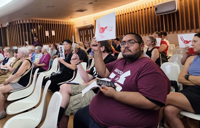
Quiroz is the Arizona organizer for Bread for the World, a faith-based organization that advocates for policies and programs addressing hunger. He was one of a few dozen people gathered in downtown Tucson on Tuesday to discuss the impacts of the One Big Beautiful Bill Act — or H.R. 1 — on local families nearly one year after it became law.
The discussion centered on the 450,000 Arizona families who lost their food assistance since the federal legislation was enacted and how the restrictions coming to Medicaid (known as ACCCHS in Arizona) in January could cut 420,000 people off their health insurance.
Stan Dorn is a health policy advocate with the nation’s largest Hispanic civil rights group, UnidosUS.
“The SNAP (Supplemental Nutrition Assistance Program) cuts already went into effect,” he said. “What we're seeing now is the appetizers on the menu. The main courses are yet to come."
The state’s Republicans in Congress, Dorn said, are responsible.
“Why do I say that? The bill passed by such narrow margins that if two of them had voted against it, it would have gone down to defeat,” Dorn said.
Changes to SNAP error rate
Last July, Reps. Andy Biggs, Juan Ciscomani, Paul Gosar, Abe Hamadeh, Eli Crane and David Schweikert joined the rest of the House Republicans to enact the Trump-championed H.R. 1 that, among many other things, tightens eligibility for programs like SNAP and Medicaid. It also now burdens states with SNAP payments and sets stricter standards for payment error rates.
Ciscomani defended the 6% error rate requirement set by H.R. 1 in August, saying it addresses “waste, fraud and abuse.”
Advocates at Tuesday’s roundtable saw things differently.
Dorn said it would further stress employees at the Department of Economic Security who will be forced to either deny applicants or send them more paperwork to ensure payment accuracy.
In 2025, Arizona’s error rate was almost 11%. If the state fails to meet the 6% standard this year, it would owe $100-300 million to the SNAP fund which would otherwise come from the federal government. DES says lowering the error rate has become one of its greatest priorities.
SNAP and Medicaid work requirements
Under H.R. 1, SNAP recipients between ages 18 and 63 who are able-bodied must prove that they work or volunteer at least 80 hours a month. Previously, the work requirements applied to applicants aged 18-53.
Groups who were previously — and no longer — exempt from those work requirements include veterans, unhoused people and foster youth under the age of 24. Refugees and people granted asylum are no longer eligible for SNAP.
The Medicaid reforms that many are anticipating will require at least 80 hours of work, volunteering or school of non-exempt adults, and would kick refugees and asylees off the program except for in emergency situations.
Research shows that the new SNAP work requirements haven’t actually enhanced labor market outcomes, something Joseph Palomino with the Arizona Center for Economic Progress echoed at the roundtable.
“We've also seen a very frozen labor market and the people most likely to be on SNAP are the ones that have inconsistent employment,” Palomino said.
Arizona Sen. Stephanie Stahl Hamilton shared her experience with federal aid programs and said she would continue to support policies that represent southern Arizona’s familial needs.
“I stood in those WIC (Women, Infants & Children Program) lines, I went to DES. My children were on ACCCHS, they were on Kids Care. We went without health insurance,” she said.
Others shared their personal stories and anecdotes about people they know struggling to afford basic necessities.
Miranda Haley with the Grace Saint Paul Food Bank said the number of people seeking food assistance there has doubled this year. Grant funding for the organization is set to run dry by November.
“These are our veterans, families. We have people who were living on the edge and we are watching them, in real time, fall off the edge. When we run out in November, we do not know where we are going to send them,” she said.
Representatives of U.S. Sen. Ruben Gallego, Tucson Mayor Regina Romero and U.S. Rep. Adelita Grijalva were also present. Rep. Ciscomani and Sen. Mark Kelly were invited.
SNAP payouts increase for first time since March 2025
Despite the 50% decrease in Arizona SNAP recipients, DES has reported slight improvements, like the first month-to-month increase in food aid payments in more than a year.
Since March 2025, the number of Arizonans on the Supplemental Nutrition Assistance Program had been decreasing due to federal requirements enacted last summer. By April, the number of recipients had been cut in half.
Staff training, performance reporting, expansion of overtime opportunities, and new phone kiosks are all improvements that the department has seen in recent months, according to spokesperson Brett Bezio. The increase is about 5% from April to May in Pima County.
About 450,000 Arizonans were on the program in May including 71,000 Pima County residents, 26,000 of whom are children. Last May, 910,000 Arizonans and 145,000 Pima County residents received benefits.
An additional $10.8 million in the state budget will go toward SNAP which Bezio says “enables DES to efficiently deliver benefits while meeting federal SNAP quality mandates and avoiding financial penalties.”








(0) comments
Welcome to the discussion.
Log In
Keep it Clean. Please avoid obscene, vulgar, lewd, racist or sexually-oriented language.
PLEASE TURN OFF YOUR CAPS LOCK.
Don't Threaten. Threats of harming another person will not be tolerated.
Be Truthful. Don't knowingly lie about anyone or anything.
Be Nice. No racism, sexism or any sort of -ism that is degrading to another person.
Be Proactive. Use the 'Report' link on each comment to let us know of abusive posts.
Share with Us. We'd love to hear eyewitness accounts, the history behind an article.