
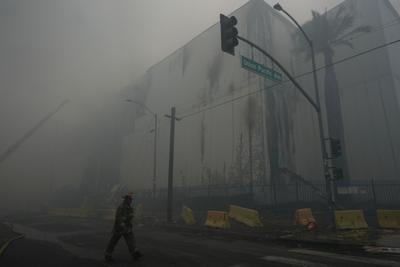

Smoke from a warehouse fire fills the air in the Boyle Heights neighborhood of Los Angeles, Sunday, June 21, 2026. (AP Photo/Jae C. Hong)
The smoke didn't ask whether you lived in Boyle Heights or East Los Angeles before entering your home or your lungs. The government did.
The smoke crossed city and unincorporated county boundaries without hesitation. It entered homes, schools, parks, churches and businesses. It settled into the lungs of children, seniors, pregnant women, essential workers and families who had no control over which direction the wind was blowing.
It took firefighters eight days to extinguish the Lineage Fire. For eight days, families were told to stay indoors, close their windows, wear masks and hope the air they were breathing wouldn't make them sick.
Yet residents living beneath the smoke received no evacuation orders, leaving many to wonder why precautionary measures weren't considered for the communities most directly affected.
The Lineage Fire exposed two separate failures.
The first wasn't how the fire spread. The first was why a massive industrial cold-storage warehouse was allowed to operate immediately adjacent to homes, schools, parks and small businesses in the first place.
That debate matters. It raises difficult questions about land use, zoning, environmental justice and why hazardous industrial facilities are so often concentrated in working-class immigrant communities.
The second failure unfolded after the fire began. Once disaster struck, every level of government had a responsibility to protect the people living beneath the smoke. That is where the emergency response failed.
For days, public officials and media outlets referred to this disaster as the "Boyle Heights Fire." While technically describing where the flames burned, it ignored the people who lived directly under it and across the street. Much of the emergency messaging, political attention and government resources remained concentrated on the city side of an invisible line on a map.
Smoke doesn't recognize city boundaries. Apparently, emergency response does.
That distinction had real consequences in real time.
Residents in East Los Angeles weren’t asking for special treatment. They were asking for the basics: honest information, timely communication, clean air and protection.
Instead, parents were left wondering whether it was safe to send their children outside. Seniors with respiratory illnesses questioned whether they should leave their homes. Workers had to choose between earning a paycheck and breathing toxic air. Families turned to neighborhood group chats and social media because official guidance was inconsistent, delayed or absent.
The most basic responsibility of government during an environmental emergency is to reduce uncertainty.
Instead, uncertainty became part of the disaster itself.
Then came the moment that exposed just how broken this response had become.
Residents from unincorporated East Los Angeles—people who had spent days breathing the same smoke as their neighbors in Boyle Heights—went to the City of Los Angeles 14th Council District office seeking air purifiers. News outlets have reported that people and children with cancer who were waiting in line, were turned away from Councilwoman Ysabel Jurado’s office because they didn’t live within the city lines.
Read that again.
Imagine explaining that to a parent of a child with asthma.
You breathed the same smoke. But you live on the wrong side of the map.
After breathing the same air, facing the same health risks and worrying about the same children and elderly family members, they were told that a jurisdictional boundary mattered more than the smoke in their lungs.
In East Los Angeles, Supervisor Hilda Solis' office eventually organized an air purifier distribution event, but it was held on Monday from 1-6pm with little notice. Many working families could not leave work to attend. Long lines formed. Supplies ran out. Residents who had already spent days living under toxic smoke left empty-handed. Those without cars, without smart phones, those with disabilities, bed or wheelchair bound were not considered.
While the City of Los Angeles organized and opened office space and came together, the county relied on a local park and a local church.
That isn't emergency management. That's a failure of emergency planning.
Disasters do not operate on business hours. Toxic smoke doesn't wait until Monday.
Neither should government.
This wasn't the fault of frontline staff handing out air purifiers. They worked under difficult circumstances with finite resources.
The failure occurred much earlier.
It happened when city and county agencies failed to coordinate as one emergency response.
It happened when no unified plan existed for communities outside the City of Los Angeles.
And it happened when government allowed residents to navigate bureaucratic boundaries while confronting a public health emergency.
This should never happen again.
The corporations at the center of this disaster also owe the public answers.
The Lineage cold storage facility became the source of an environmental emergency that disrupted thousands of lives. Under mounting public pressure, Lineage eventually identified Altus Power as the commercial rooftop solar operator where the fire originated. This is the second fire on the same rooftop. Altus Power has been silent.
Whatever the investigation ultimately concludes, both companies have a responsibility to engage directly with the community, answer questions and participate in rebuilding public trust.
Silence is not accountability. Neither is pointing fingers after the fact.
Government bears its own responsibility.
Just weeks before the Lineage Fire, East Los Angeles experienced another environmental emergency: an estimated 25,000-gallon crude oil spill that eventually contaminated the Los Angeles River. Residents demanded answers about public health, environmental cleanup and long-term impacts. Community organizations requested a public town hall. Businesses suffered economic losses. Families wanted transparency.
Supervisor Solis has yet to respond to residents directly. Many of their questions remain unanswered.
Now, the same community has endured another environmental disaster.
Another toxic exposure.
Another week of uncertainty.
Another reminder that East Los Angeles is too often expected to accept environmental harm while waiting for government to catch up.
That is not resilience.That is neglect.
We've confused resilience with abandonment.
East Los Angeles has become so accustomed to surviving environmental disasters that government mistakes our ability to endure for permission to continue failing us.
Environmental justice isn't measured by how many press conferences elected officials hold after a disaster.
It is measured by who gets warned.
Who gets protected.
Who receives resources.
Who is told the truth.
Who gets left behind.
And who is included in what happens next.
Supervisor Solis represents many of the residents most impacted by these back-to-back environmental emergencies. Leadership during a disaster requires more than statements and photo opportunities. It requires standing before the community, answering difficult questions, demanding accountability from every responsible agency and every responsible corporation and ensuring that East Los Angeles receives the same urgency, protection and respect afforded to their Boyle Heights neighbors across the street in the City of Los Angeles.
For generations, East Los Angeles has carried more than its fair share of environmental burdens. Freeways. Rail yards. Warehouses. Heavy industry. Diesel pollution. The EXIDE battery plant lead contamination. Now an oil spill. Now the Lineage Fire.
Working-class immigrant communities should not be expected to absorb disaster after disaster simply because they have learned how to survive.
Resilience has become government's favorite excuse for asking East Los Angeles to tolerate what wealthier neighborhoods never would.
That must end.
The families of East Los Angeles deserve answers from Lineage.
They deserve answers from Altus Power.
They deserve answers from every public agency charged with protecting public health.
Most of all, they deserve a government that understands a simple truth: when disaster strikes, your ZIP code should never determine whether you receive protection.
I am now a private citizen, but I’ve had the privilege of representing East Los Angeles in Sacramento for nearly eight years in the California State Assembly. I know every freeway, every neighborhood and every industrial corridor that has shaped our community. I also know that environmental injustice isn't one disaster. It's death by a thousand decisions—each one telling working-class immigrant neighborhoods that another warehouse, another rail yard, another pollution source is acceptable because we are the ones expected to live beside it.
The flames are out but the emergency isn't over.
Now comes the hazardous waste cleanup. The smell of spoiled food. The rats. The heavy equipment. The bulldozing. The constant noise. The environmental testing. The questions residents still deserve answered. And the long process of holding both government and the corporations responsible accountable for what happened and what comes next.
Weeks from now, the headlines will fade. The cleanup crews will leave. But the question that remains is whether we've learned anything from the Lineage Fire.
Environmental justice isn't about protecting politicians from criticism or corporations from scrutiny when accountability becomes politically uncomfortable.
It's about protecting families from preventable harm, it’s about ensuring that a child's health is never determined by a city boundary or a ZIP code. It’s about calling out hard truths, especially when government decides whose health, whose neighborhoods and whose lives deserve its full attention.
For too long, the common denominator hasn't just been environmental disasters. It's been a county government response that repeatedly leaves East Los Angeles waiting for information, resources and accountability.
That should never be normalized.
Surviving is not the same as living.
East Los Angeles deserves more than survival.
We deserve the opportunity to live with dignity.





(0) comments
Welcome to the discussion.
Log In
Keep it Clean. Please avoid obscene, vulgar, lewd, racist or sexually-oriented language.
PLEASE TURN OFF YOUR CAPS LOCK.
Don't Threaten. Threats of harming another person will not be tolerated.
Be Truthful. Don't knowingly lie about anyone or anything.
Be Nice. No racism, sexism or any sort of -ism that is degrading to another person.
Be Proactive. Use the 'Report' link on each comment to let us know of abusive posts.
Share with Us. We'd love to hear eyewitness accounts, the history behind an article.