

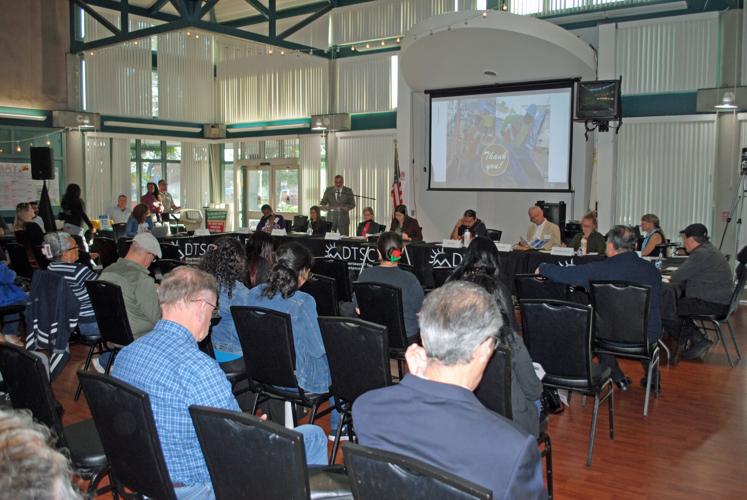



Panelists from the California Department of Toxic Substances Control, and the Exide Technologies Advisory Group are shown before attendants at a public meeting held in the City of Commerce’s Seniors Center on May 13.
The sluggish process to designate the shuttered Exide battery plant in Vernon a Superfund stays its course, despite an apparent delay caused by two opposing technical comments submitted in 2024, said a top administrator with the Environmental Protection Agency (EPA).
However, the slow pace for enlisting the plant to the EPA’s National Priority List (NPL), which would allocate federal funds to treat the presence of Trichloroethylene (TCE) on groundwater, has sown distrust among residents and organizers in Southeast Los Angeles communities impacted by Exide lead before the site closed in 2015.
Edwin “Chip” Poalinelli, EPA’s Region 9 assistant director, sought to reassure skeptical attendants to a May 13 public meeting in City of Commerce that the Superfund designation is on track, and said the agency expects to issue its final rulemaking later this year.
The meeting, sponsored by the state’s Department of Toxic Substances Control (DTSC), was held to provide updates on residential lead cleanups and efforts to add the plant to the NPL.
“We are currently in the final process of responding to those comments and compiling the response to the summary,” said Poalinelli in reference to 35 public comments made during a 60-day period.
He underscored that 33 comments were logged in favor of adding the plant to the NPL, and two sets with lengthy technical arguments were filed against the Superfund designation.
The first opposing comment was submitted by the law firm Beveridge & Diamond on behalf of Clarios LLC, a global manufacturer of batteries headquartered in Glendale, Wisconsin.
The second was filed by Gould Electronics Inc., whose predecessor Gould Inc. owned the plant before Exide Technologies purchased it in 2000.
Both filings allege that TCE presence in the underground aquifer located below the smelter may originate from industrial neighbors Honeywell and Univar, and the agency should desist on his proposed listing.
In the filings, the parties suggested that the EPA should conduct an expanded site investigation to “better define the original sources of TCE groundwater contamination to the regional plume.” The designation, they wrote, should be based on the extent of contamination, not the facilities’ boundaries.

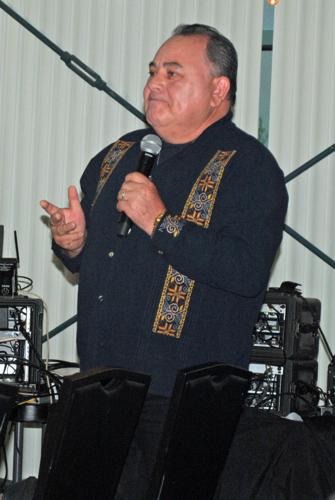
Fernando Cabrera, a Huntington Park resident who is a lead cleanup crew member in the Exide residential remediation project, speaks to the California Department of Toxic Substances Control and other panelists at the May 13 meeting in City of Commerce. He said community members expect the Exide plant’s Superfund designation would broaden the scope and area of cleanups.
Responding to criticism for the apparent decision holdout, Poalineli said the agency has been diligent in evaluating data to ensure its upcoming presentation in Washington, D.C. is successful.
“EPA anticipates that we will be making the final rule decision later this year,” Poalinelli said.
Mark Lopez, a member of the Exide Technologies Advisory Group who works as special projects coordinator with East Yard Communities for Environmental Justice, said he fears the process to make the Exide plant a Superfund has become a political victim of President Donald Trump’s callousness.
“Under the Trump administration, there is no such thing as going on track. The Trump administration has shown it is petty and vindictive,” said Lopez. “Given the relationship he has with California, I don’t expect this (process) to move quickly.”
Fernando Cabrera, a Huntington Park resident and cleanup worker, told the panelists that residents expect the Superfund designation to broaden the 1.7-mile lead cleanup radius from the plant, and help control foul vapors coming from chemical-laced lots.
“We have placed high hopes on the Superfund. The EPA talks about cleaning (underground) water, and we have emanating vapors,” said Cabrera.
Julia Giarmoleo, Region 9 EPA press officer, said the Exide plant is following the same procedural steps applied at other sites nationwide.
“Superfund designations are not broadly delayed. The NPL listing process involves multiple required steps–proposal, public comment, review and response to comments, and the final rulemaking,” said Giarmoleo in an email. “Working through each of those steps thoroughly takes time, but that thoroughness is built into the process, not a departure from it.”
In a related matter, DTSC officials said that they have finished analyzing re-sampled data from 70 of 1,375 properties already cleaned, following criticism for defective remediations, and independent studies documenting dangerous lead levels surpassing the state’s threshold of 80 ppm.

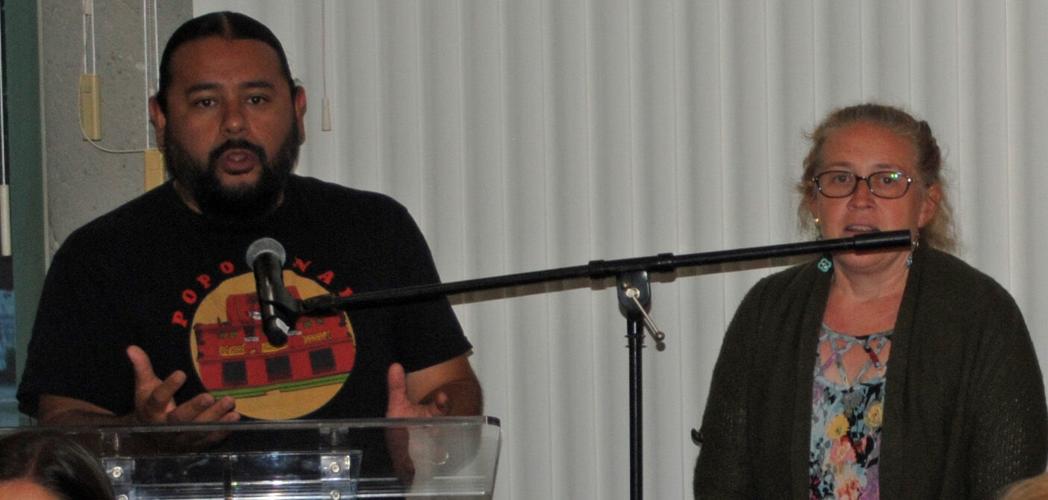
Mark Lopez, a member of the Exide Technologies Advisory Group who works as special projects coordinator with East Yard Communities for Environmental Justice (left), addressed the audience at a California Department of Toxic Substances Control meeting on May 13, along with Jill Johnston, professor of population and public health at UC Irvine. They discussed findings of the independent study “Get the Lead Out!”
Final results from the 70 lots would be released after personal data identifying residents is deleted in a few weeks, said DTSC director Katherine Butler.
Lopez was joined by Jill Johnston, professor of population and public health at UC Irvine, to present results from a recently published study that investigated soil samples from 373 lots within and outside the official cleanup perimeter smeared by Exide lead.
Data from the “Get the Lead Out!” study, conducted from 2021 to 2024, revealed that only 39 of 143 remediated homes inside the cleanup zone met the 80 ppm state target.
Soil samples from 209 properties located outside the cleanup area show that all have lead quantities above the state’s limits. Most lots are located north and northeast of the plant, and were picked following predominant wind patterns.
Three soil samples were taken at various spots from each parcel.
Overall, seven in 10 homes had one sample higher than 200 ppm.
Johnston said the study numbers had been out for years. Their focus, she said, was to collect soil from yard surfaces, where most lead is lodged.
“We learned that there is a lot of potential for contamination around the [preliminary investigation area],” said Johnston.
In April 2024, DTSC personnel began retesting parcels that failed to meet the state’s cleanup goals due to the presence of pipes and cisterns, walls, property fences and weak structures, and to preserve roots from trees.
Some properties with elevated lead levels have not been fully detoxified because their owners had instructed cleanup field supervisors not to disturb plants or keep fixed objects intact.
As of May 8, the DTSC has conducted 6,196 residential cleanups with $772 million from California’s taxpayers in the communities of Boyle Heights, Huntington Park, Commerce, Vernon, Maywood, East Los Angeles and Bell.
On its website, the DTSC said that about 10,638 parcels would require soil removal and replenishment to bring lead particles at or below the state’s permitted levels.








(0) comments
Welcome to the discussion.
Log In
Keep it Clean. Please avoid obscene, vulgar, lewd, racist or sexually-oriented language.
PLEASE TURN OFF YOUR CAPS LOCK.
Don't Threaten. Threats of harming another person will not be tolerated.
Be Truthful. Don't knowingly lie about anyone or anything.
Be Nice. No racism, sexism or any sort of -ism that is degrading to another person.
Be Proactive. Use the 'Report' link on each comment to let us know of abusive posts.
Share with Us. We'd love to hear eyewitness accounts, the history behind an article.