
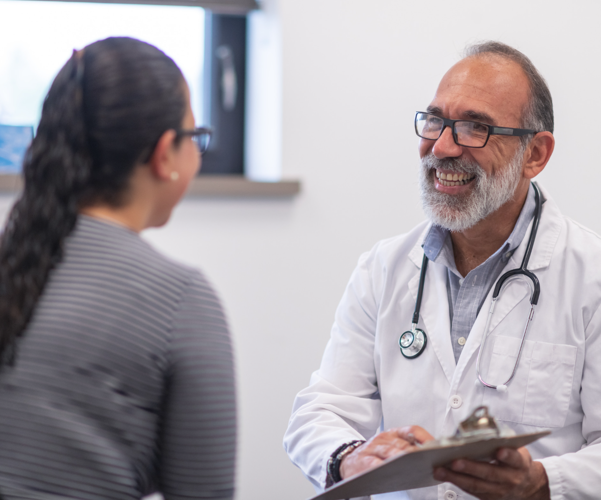



A doctor talking to a patient. (Photo from Canva library.)
A new report finds that Los Angeles residents are increasingly developing new skills, with Spanish ranking eighth on the list. And despite a growing number of people learning the language, its demand in healthcare continues to outpace this interest, highlighting a widening gap between learning Spanish and using it where it matters most.
CALÓ News spoke with Dr. Reza Babapour, a physician practicing in South Los Angeles, who has been a dedicated advocate for addressing public health disparities and expanding access to care for more than a decade. He is also the founder of Reform LA Health.
According to Dr. Babapour the data reveals that approximately 3,702,746 people in Los Angeles County live in areas that have a shortage of primary care providers. Even though the Latino community is already harmed by the underrepresentation of Latino physicians, out of the 6%, only 2.4% are actually Latina doctors.
In 2023, the UCLA Latino Policy and Politics Institute published a report authored in part by Dr. Yohualli B. Anaya providing the current status of Latina physician representation and its conclusions for health equity. It also highlights the significant disparity between the Latino population and the number of Latino physicians. Currently, California has a high Latino population, reaching 40%, with further increases projected to 50% by the year 2050.
Dr. Babapour said the shortage of Spanish-speaking Latino physicians is impacting patients with limited English proficiency, something he says he is witnessing firsthand at UCLA Medical Center.
“I have tried very hard to learn some Spanish, but it's not easy. So what we do, we call somebody that can translate and it's really robotic,” he said. “You also don't get to the depth of the issues that you have to help with these patients. It is beyond acceptable and I want that to change.”
He added that it’s time to build a workforce capable of caring for communities in their own language and cultural context, noting that shared experiences can make care more effective and impactful.
Reform LA Health is attempting to address the deficiencies facing the Los Angeles county public health system. (Photo courtesy of Reform LA health.)
In 2023, the U.S. The Supreme Court ruled against using the affirmative action approach at private, public colleges and universities. With a 6-3 ruling, the court decided that the race of a student applying for college will not play a factor in deciding whether they are admitted or not.
The decision came from the Students for Fair Admissions, Inc. v. President and Fellows of Harvard College case and the Students for Fair Admissions, Inc. v. University of North Carolina case. The Court ruled that both institutions’ affirmative action programs are race-conscious and violate the Constitution.
Data from the Association of American Medical Colleges (AAMC) confirms that the number of Latino matriculants (newly enrolled students) at U.S. medical schools dropped by 10.8% in the 2024 academic year compared to the previous year. Over the past 20 years, Dr. Babapour said he has also observed a recurring issue while mentoring students pursuing medicine, many are not being accepted into local medical schools in LA.
A second challenge they face is debt. According to the Association of American Medical Colleges, 75% of medical students leave school with education debt of $196,000.“I have a few of them that I was able to support and mentor. They are out of the state, and by the time they finish medical school, they are so much in debt,” he said.
In January of 2025, Diversity, Equity, and Inclusion (DEI) initiatives in the federal government were formally eliminated through a series of executive orders signed by President Trump immediately upon taking office. These actions dismantled DEI offices, fired related staff and canceled training and grants across federal agencies.
Dr. Babapour emphasized that these barriers are limiting opportunities for Latino and Black students to enter the field of medicine. He also noted that the government is no longer releasing diversity-related data following the rollback of DEI initiatives, in which the current percentage for students enrolling in medical school can be lower than 10.8%.
“Even those that do end up going into medical school, by the time they finish, they are at such a high disadvantage to be able to help their own communities. So that's very discouraging. These students were passionate to go to medical school and help their own communities, but the support is not there,” he said.
He also believes that increasing the number of Latino physicians would benefit underserved communities in L.A., as patients are more likely to connect with providers and build trust and comfort. “They understand what it means to face these disparities and can recognize the disease itself, but they’re also able to deliver the level of care patients deserve, which is often missing,” Dr. Babapour said. “If you have people who have the same community, they can advocate a lot more knowing where these people come from.”
Although Spanish ranks eighth in L.A. compared to fifteenth nationally, many individuals are approaching language learning as a skill but only about 10% pursue Spanish at a professional level for careers such as healthcare, translation or bilingual education.

The ratio of primary care physicians in Los Angeles county was 56 per 100,000 population, far below the recommendation of 60-80 physicians per 100,000. (Photo courtesy of Reform LA Health.)
Dr. Babapour gave CALÓ News insight on what would happen if the gap between Latino patient needs and Latino physician representation continues to grow. “It actually gets worse and worse. In fact, some studies show that the current trend comes before [the] 2023 Supreme Court [decision] reversing affirmative action. If the current trend continues, it would take more than 500 years before you see the same parity between physicians ratio of Latino and white. It just doesn't make sense. Latino people contribute to the growth and economic development of the city, this county, but the opportunity is not there for them,” he said.
Dr. Babapour said there are strategies that can be implemented to address the shortage over the next decade. Through his organization, he has been pushing for L.A. County to establish a new medical school to train residents across specialties while also preparing a new generation of physicians to help meet the growing demand. He also suggested that the tuition for those graduates who commit to servicing in underserved communities with a shortage of physicians should be waived. “This model, which has been successful elsewhere, offers a viable, long-term solution to the chronic physician shortage in marginalized areas,” he said.
He explained that ongoing health inequities have made low-income communities more vulnerable to conditions such as infections, cancer, diabetes and heart disease, as well as higher rates of infant and maternal mortality. Additionally, they also face significant disadvantages for early detection.
“We are not prepared. We do not have the same culturally competent physicians to provide care for the Latino population,” Dr. Babapour said. “The geriatric population would be in deep trouble, and lawmakers, unfortunately, are missing in action.”







(0) comments
Welcome to the discussion.
Log In
Keep it Clean. Please avoid obscene, vulgar, lewd, racist or sexually-oriented language.
PLEASE TURN OFF YOUR CAPS LOCK.
Don't Threaten. Threats of harming another person will not be tolerated.
Be Truthful. Don't knowingly lie about anyone or anything.
Be Nice. No racism, sexism or any sort of -ism that is degrading to another person.
Be Proactive. Use the 'Report' link on each comment to let us know of abusive posts.
Share with Us. We'd love to hear eyewitness accounts, the history behind an article.