
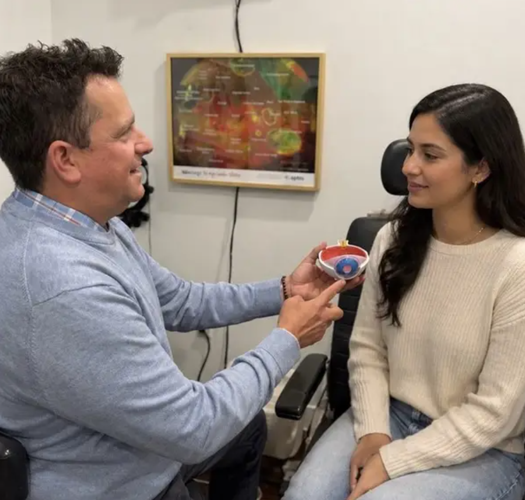


Dr. Corey Hodes with a patient. (Photo courtesy of Dr. Hodes.)
With the start of the school year just around the corner, Dr. Corey Hodes, a Los Angeles VSP network optometrist, discussed with CALÓ News the important role eye health plays in overall well-being for Latino families in Southern California and the key signs that indicate a need for an eye exam.
Dr. Hodes holds 22 years of experience and has a special interest in pediatrics, contact lenses and ocular disease eye care. He is also a member of the American Optometric Association and the California Optometric Association.
Early detection
As the new school year approaches, Dr. Hodes shared that one out of four children struggle with reading and learning because of undiagnosed vision problems. Dr. Hodes treats patients as young as six months old, emphasizing that early detection of vision problems is essential, as eyesight is a key component of a child's learning and development.
“In fact, 80% of what a child learns during the first 12 years of life is obtained through vision, so it's extremely important for the parents to bring their child in for a routine eye exam to make sure that they're maximizing their potential in school,” he said. “It's critical for eye exams to be part of a yearly wellness routine, just like an annual physical.”
Dr. Hodes recommends that children between the ages of three and five get a comprehensive eye exam to check for any conditions that may have long-term effects on learning, and then another eye exam before the child starts kindergarten. “Even if a child's not complaining of vision problems, we want to make sure that their eyes are working well together and that their eye muscles are tracking things well,” he said.
Signs to look out for
He emphasized the importance of early eye exams in preventing amblyopia, commonly known as lazy eye. The condition can often go unnoticed because many children do not complain about vision problems, especially when one eye has normal 20/20 vision and compensates for the weaker eye. He said that early detection of a lazy eye is crucial before the age of nine in order to treat it and correct it.
Dr. Hodes said that another indication that a child is struggling with their poor eyesight is not reading to grade level. “Something may be off in their visual system or how their eyes are working together or their visual acuity,” he said.
Parents may also want to watch for their child squinting their eyes when looking at things close or far. “When a child squints, they are squinting to help focus through an undiagnosed refractive error or prescription,” Dr. Hodes said. Other subtle signs that he also shared are the rubbing of the eyes, looking at things with just one eye or a head tilt.
He also emphasized that not everyone develops vision problems at a young age. "There are a lot of vision conditions that are developed later in life, one of the most common being myopia, or near-sightedness. Oftentimes it develops as the child's eyes grow or elongate so that the prescription starts to get a bit larger and larger,” he said. “A lot of parents don't realize that there are now techniques and options to be able to decrease the progression of myopia or near-sightedness.”
In order to help the progression of those conditions, Dr. Hodes said that patients are treated with specialty lenses and a pair of glasses or contact lenses and eye drops. “This is particularly important for children that have a family history of high myopia, where the parents may have thick glasses or high prescriptions. There's a lot of genetic component to it,” he said. He also noted that in the long-term they can also prevent retina detachments and glaucoma from happening in the future.
Eye strain due to technology
Dr. Hodes shared that eye strain is very common right now in this generation as individuals of different ages are attached to phones and other types of devices. He said that the most common signs of digital eye strain people should not ignore are blurry vision, dryness, headaches and fatigue.
He noted that while computers can be valuable tools for children’s learning and academic development, parents should also encourage at least two hours of outdoor play each day to help limit extended screen time.
Dr. Hodes shared the 20/20 rule for those individuals using devices for long periods of time. “For every 20 minutes you're on a device, take a 20-second break and look 20 feet away; this will help stretch the eye muscles and decrease the fatigue and the eye strain. Other suggestions in order to help with eye strain are also lowering the brightness or using blue-light glasses.

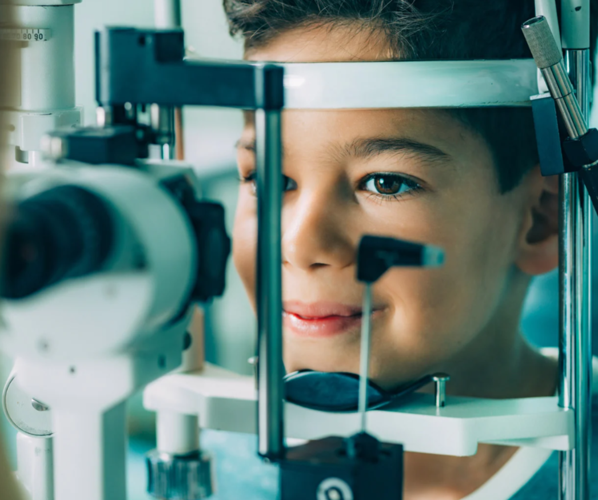
A child getting an eye exam. (Photo /Canva library.)
Comprehensive eye exam and chronic health conditions
The Latino community is disproportionately affected by chronic conditions, including diabetes and high blood pressure. Dr. Hodes shared that a comprehensive eye exam can help detect those early on along with 270 other systemic chronic health conditions.
“Those things can show up in the eye, and oftentimes, a diabetic patient is first diagnosed with diabetes because of a comprehensive eye exam. The doctor can see actual retinal changes in the back of the eye to alert patients,” he said. “A comprehensive eye exam can also help diagnose diabetes at an earlier stage and help treat it.”
According to the National Eye Institute, the Latino population in the U.S. has some of the highest rates of vision loss and blindness caused by eye diseases such as diabetic retinopathy and glaucoma. Almost eight out of 10 Latinos with glaucoma don’t know they have it, and many of them aren’t getting regular dilated eye exams.
Eye health is often overlooked
Dr. Hodes shared that not only does the Latino community often overlook eye health but many other health conditions as well. “I feel like a lot of communities overlook the importance of eye care because we take it for granted,” he said. “Just because we see OK, that doesn’t mean everything in the back of the eye is healthy.”
He shared that another reason why eye care is overlooked in younger kids is because they don't realize or recognize that they don't see well. “When you grow up, you just get used to seeing how you see and you don't really compare with your classmates or your friends until you get a full eye exam and you realize you can't even see 20/20,” Dr. Hodes said. “And so we put a pair of glasses onto a child and their world lights up.”
Language barriers
The Urban Institute reports that one in four Spanish-speaking Latino adults struggle to find health care providers who speak their language, a challenge that can prevent many from accessing needed medical services.
Dr. Hodes said that breaking this barrier requires more health care providers who speak patients’ languages. At his practice, he often speaks Spanish with patients and, on occasion, relies on staff members to assist with translation when needed.
He also encouraged patients to seek clinics with Spanish-speaking doctors and staff. He added that regardless of whether individuals have insurance, they can use the VSP Vision Care website as a resource to help find Spanish-speaking optometrists and narrow their search for providers.






(0) comments
Welcome to the discussion.
Log In
Keep it Clean. Please avoid obscene, vulgar, lewd, racist or sexually-oriented language.
PLEASE TURN OFF YOUR CAPS LOCK.
Don't Threaten. Threats of harming another person will not be tolerated.
Be Truthful. Don't knowingly lie about anyone or anything.
Be Nice. No racism, sexism or any sort of -ism that is degrading to another person.
Be Proactive. Use the 'Report' link on each comment to let us know of abusive posts.
Share with Us. We'd love to hear eyewitness accounts, the history behind an article.