
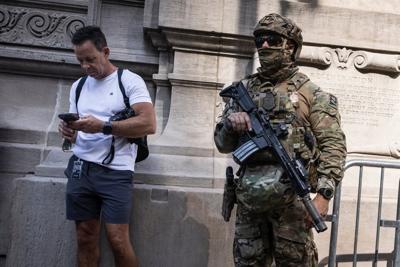

A federal immigration agent in downtown Chicago on September 28, 2025. (Ashlee Rezin/Chicago Sun-Times via AP)
One afternoon in early October, a 30-year-old teaching assistant named Marimar Martinez was driving around Chicago’s majority-Latino Brighton Park neighborhood warning people that federal immigration agents were coming. U.S. Customs and Border Protection agents were riding in a car behind her. One of them aimed an assault rifle at her and shouted “do something, bitch” before opening fire, video of the incident shows.
Martinez, an American citizen, was hit five times, and miraculously survived. The agents claimed she rammed their car and arrested her. Martinez’s lawyers unearthed video footage contradicting that claim, showing agents ramming her car, and prosecutors dropped the charges. The court case produced text messages from the agent who shot her, bragging about his feat: “I fired 5 rounds and she had 7 holes. Put that in your book boys.”
Martinez’s shooting is one of the most high-profile cases connected to President Donald Trump’s immigration crackdown, which began in Los Angeles in June and has since spread to Washington, D.C.; Chicago; Memphis, Tennessee; Portland, Oregon; Charlotte, North Carolina; and, most recently, New Orleans and Minneapolis. And where immigration agents have gone, gun-fueled chaos has usually followed.
Using Gun Violence Archive data and news clips, The Trace is tracking incidents in which federal agents shoot someone or hold them at gunpoint during an immigration enforcement action under Trump’s crackdown. We’ve identified 22 such incidents, including nine shootings, as of December 12. They include the shootings of three people observing or documenting ICE raids; the shootings of three people driving away from traffic stops or evading an enforcement action; and the September 30 raid on a Chicago apartment building, during which half-asleep tenants and their children were held at gunpoint. At least one person has been killed and four others have been injured.
Our numbers are likely an undercount, as shootings involving immigration agents are not always publicly reported.
Experts say the number of gun-related incidents underscores the excessive use of force being applied by agents. “Everything about these incidents indicates that these are probably shootings that did not need to happen,” Christy Lopez, a former senior civil rights litigator at the Justice Department who now teaches at Georgetown Law, said after examining The Trace’s list. ICE agents “can’t prevent everything, but they have the ability to de-escalate situations. Instead, we see the opposite. They’re actually stoking this inordinate amount of fear and this hypervigilance, and they should be trying to tamp it down — but they’re not.”
While Trump gave immigration enforcement agencies the justification to act on their worst impulses, Lopez said the crackdown has exacerbated a preexisting culture of impunity. A Trace analysis from last year found that immigration agents recklessly fire their weapons and are rarely prosecuted for it. The Supreme Court “has been narrowing the situations under which you can sue federal law enforcement officers, including immigration enforcement, for many years,” Lopez said. “These are federal agencies that have not been constrained by the law sufficiently for quite a while, and now they’ve been given free rein by their management structure.” But their tactics are being seen by more people in more places, with more cameras recording. As a result, their methods are being scrutinized.
The Trace has also identified 13 incidents in which immigration agents fired less-lethal munitions, like rubber bullets and pepper balls, at suspects or members of the public. Ten of those incidents occurred during protests. Among the victims were two pastors who were shot with pepper balls while leading prayers at demonstrations in California and Illinois.
César Cuauhtémoc García Hernández, an Ohio State University law professor, said it is unusual for immigration enforcement agencies to use less-lethal munitions. Rubber bullets and pepper balls, which can cause welts and burning in the lungs and eyes, are more often deployed by local police during protests and civil unrest. But since Trump’s crackdown began, federal agents have used them against swarms of bystanders that formed when ICE tried to apprehend someone.
Hernández believes the aggression is a direct result of the messaging emanating from the White House. “They’re describing what’s happening to cities across the United States as an invasion and using language and imagery that’s evocative of war,” he said. “The fact that immigration agents are responding in a way that is more aggressive than what is customary cannot be divorced from the fact that the rhetoric that leading figures in the Trump administration, including the president himself, are using is far more aggressive than what is customary.”
The Trump administration has said that federal immigration agents have the right to defend themselves when cornered by an angry crowd. “Our officers are facing terrorist attacks, being shot at, having cars being used as weapons against them, bomb threats, assaults, doxxing,” Department of Homeland Security spokesperson Tricia McLaughlin told the Los Angeles Times, which reported a 26 percent rise in assaults against ICE agents between January and November compared to the same period last year. Many of those assaults involved people shoving agents or throwing objects at them.
The Trace has identified two incidents in which immigration agents were shot or shot at. A sniper opened fire on an ICE field office in Dallas in September, missing agents but hitting three detainees, killing two of them. Less than two months later, someone fired shots at Homeland Security agents carrying out an immigration enforcement operation in Chicago’s Little Village neighborhood. No one was injured.
While violence against anyone — law enforcement or civilians — is unacceptable, Hernández, the Ohio State University professor, said there’s a reason these immigration actions are provoking anger among residents. “The Trump administration is deploying immigration agents into communities in such an over-the-top manner that they are being perceived as invading forces,” he said. “As a result, ordinary people are organizing themselves to respond as they can to the threat that they are perceiving.”
ICE and CBP “are not invested in these communities,” he said. “They are on a mission. They are being used in a way that resembles the military.” Beat cops avoid using such aggressive tactics because “they are invested in creating and maintaining solid working relationships with the people who live in the neighborhoods that they’re charged with protecting.” Criminal cases are built on witness cooperation — and residents are less likely to cooperate with an invading force.
The situation is not irreversible, experts say, but it will take political will to change the culture within ICE and CPB, something unlikely to happen until a new administration takes office. But even that’s not guaranteed. Lopez recalled how the Biden administration had hired Chris Magnus, an ostensible reformer, to head CBP, but “he got chased out.” Magnus — who served in the post for less than a year before resigning — was reportedly more preoccupied with the concerns of the rank-and-file than addressing the influx of migrants at the border.
“There wasn’t the willpower within the Democratic administration to support someone who really wanted to change the CBP,” Lopez said. “We absolutely know that this can be done. The question is whether we have the willpower to do it.”






(0) comments
Welcome to the discussion.
Log In
Keep it Clean. Please avoid obscene, vulgar, lewd, racist or sexually-oriented language.
PLEASE TURN OFF YOUR CAPS LOCK.
Don't Threaten. Threats of harming another person will not be tolerated.
Be Truthful. Don't knowingly lie about anyone or anything.
Be Nice. No racism, sexism or any sort of -ism that is degrading to another person.
Be Proactive. Use the 'Report' link on each comment to let us know of abusive posts.
Share with Us. We'd love to hear eyewitness accounts, the history behind an article.