
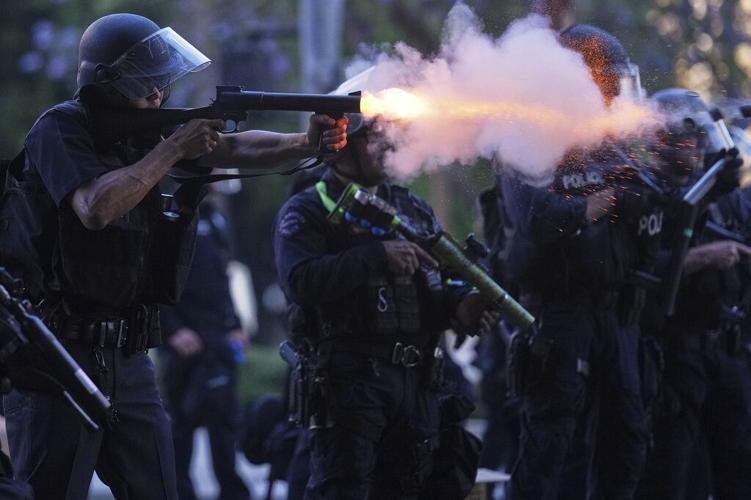
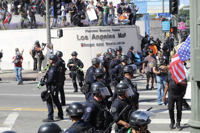


A police officer fires a soft round near the Metropolitan Detention Center in downtown Los Angeles, Sunday, June 8, 2025, following last night's immigration raid protest. (AP Photo/Eric Thayer, File)
When Angelenos took to the streets in protest of President Donald Trump's mass deportation agenda over the past year, they were met with flash-bangs, projectiles and chemical irritants — all crowd-control weapons law enforcement typically deploys at protests.
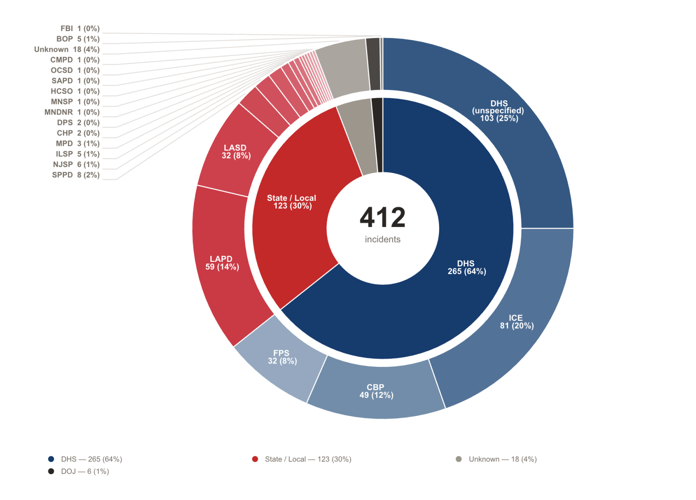
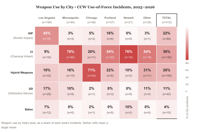
The weapons, however, were largely not used as officers are trained to use them or even as manufacturers intended. They were widely misused, resulting in at least 169 injuries in Los Angeles County, according to a report from the UC Berkeley School of Law Human Rights Center. The report, released July 13, found 412 nationwide cases of weapon misuse between June 2025 and May 2026. Over 40% of these incidents occurred in L.A. County.
The report, titled Charting the Crackdown, searched for digital records of documented force against civilians during the immigration protests over the last year. After analyzing phone videos, news reporting and even police cameras, researchers created a dataset of 412 verified cases of misused force.
The report found that in these documented incidents, local, state and federal law enforcement targeted journalists and vulnerable groups, improperly used crowd control weapons and did not adhere to their own policies or guidelines.

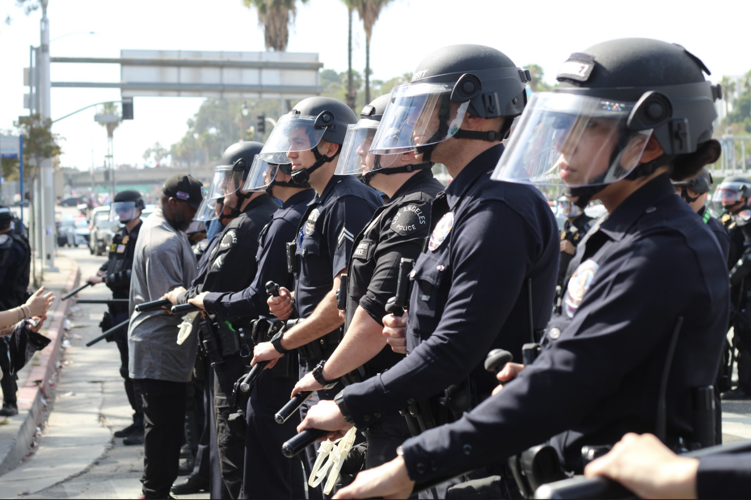
LAPD forms a line of scrimmage before deploying crowd-control measures on Sunday June 14, 2025 (Image credit: Michelle Zacarias/CALÓ News).
For this report, Berkeley researchers partnered with Physicians for Human Rights, an organization that uses scientific and legal expertise to document human rights violations across the world.
The Investigations Lab at the UC Berkeley center works on the Defense of Democracy Initiative, which they see as a pathway to further enforce human rights laws, according to Investigations Lab Director Alexa Koenig.
“It's one that we've really doubled down on in the past two years, thinking about some of the ways that the rule of law and democracy more generally appears to be under threat,” Koenig said.
What happened in Los Angeles?
L.A. County stands out in the report as the region with the most documented cases of misused force. The Los Angeles Police Department (LAPD), in particular, misused force more than any local or federal agency in any city, according to the report.
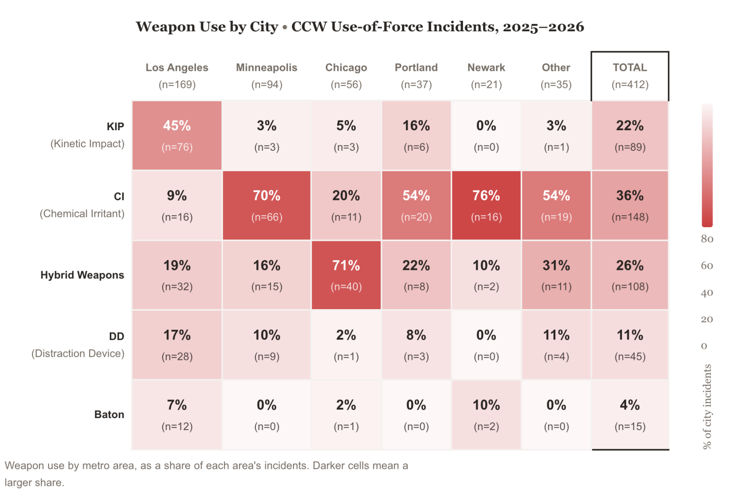
Of the 412 nationwide cases, 169 occurred in L.A. County. Unlike the four other major cities in the dataset, violence documented and analyzed in L.A. was largely at the hands of local and state law enforcement, particularly the LAPD and the Los Angeles County Sheriff's Department (LASD).

Physicians for Human Rights and UC Berkeley Human Rights Center. Charting the Crackdown: The Dangerous and Disproportionate Use of Force Against Protesters Across the United States, 2025-2026. July 2026. Available at: https://phr.org/charting-the-crackdown.
In the other four major cities — Minneapolis, Chicago, Portland and Newark — agents with the Department of Homeland Security (DHS) were responsible for the majority of weapon misuse. But in L.A., 56% of the incidents were carried out by local law enforcement.
L.A.’s proximity to the southern border, its large Latino population and the region’s overall disapproval of the Trump administration are all factors that could have contributed to the uptick in aggression compared to other major cities, Koenig explained.
“I think it creates a context where things may get heated quite quickly relative to some other parts of the country,” Koenig said. “The other thing that really jumped out though was just the engagement of local law enforcement… L.A. is the place where we saw the most federal agencies working with local law enforcement.”
Impact of less-lethals
Of the various crowd control weapons officers use, L.A. protesters were met most with kinetic impact projectiles (KIPs).
Also known as “less lethals,” KIPs are typically rubber and plastic bullets and bean bag rounds, launched from a wide range of guns. California restricted the use of KIPs in 2021, though law enforcement still uses them.

Physicians for Human Rights and UC Berkeley Human Rights Center. Charting the Crackdown: The Dangerous and Disproportionate Use of Force Against Protesters Across the United States, 2025-2026. July 2026. Available at: https://phr.org/charting-the-crackdown.
While labeled as “less lethal,” these weapons have been known to cause blunt trauma to the brain, internal bleeding and in severe cases, death, according to the American Civil Liberties Union.
KIPs were the cause of some of the most serious injuries reported in this dataset, including traumatic brain injuries, fractures, eye injuries and hearing loss, the report shows. The LAPD and LASD drove the misuse of KIPs in the city.
“The Department would not characterize any use of force as excessive based solely on the findings of a third-party report,” the LAPD said in a statement to CALÓ News.
Researchers further found that LASD’s direct firing of aerial warning munitions at demonstrators not only caused some of the most serious injuries, but also violated the weapon manufacturer’s protocols.
The L.A. Sheriff's Department told CALÓ News in a statement that it prepares for large protests through “comprehensive training that emphasizes de-escalation,” and that “less-lethal tools are intended to address specific threats to public safety, not peaceful protest activity.”
LASD did not respond to a question about why weapons were used against manufacturer protocols, as the report states.
Policy vs. practice
“The question would be, if this really is robust training, why are we seeing these particular behaviors?” Koenig asked.
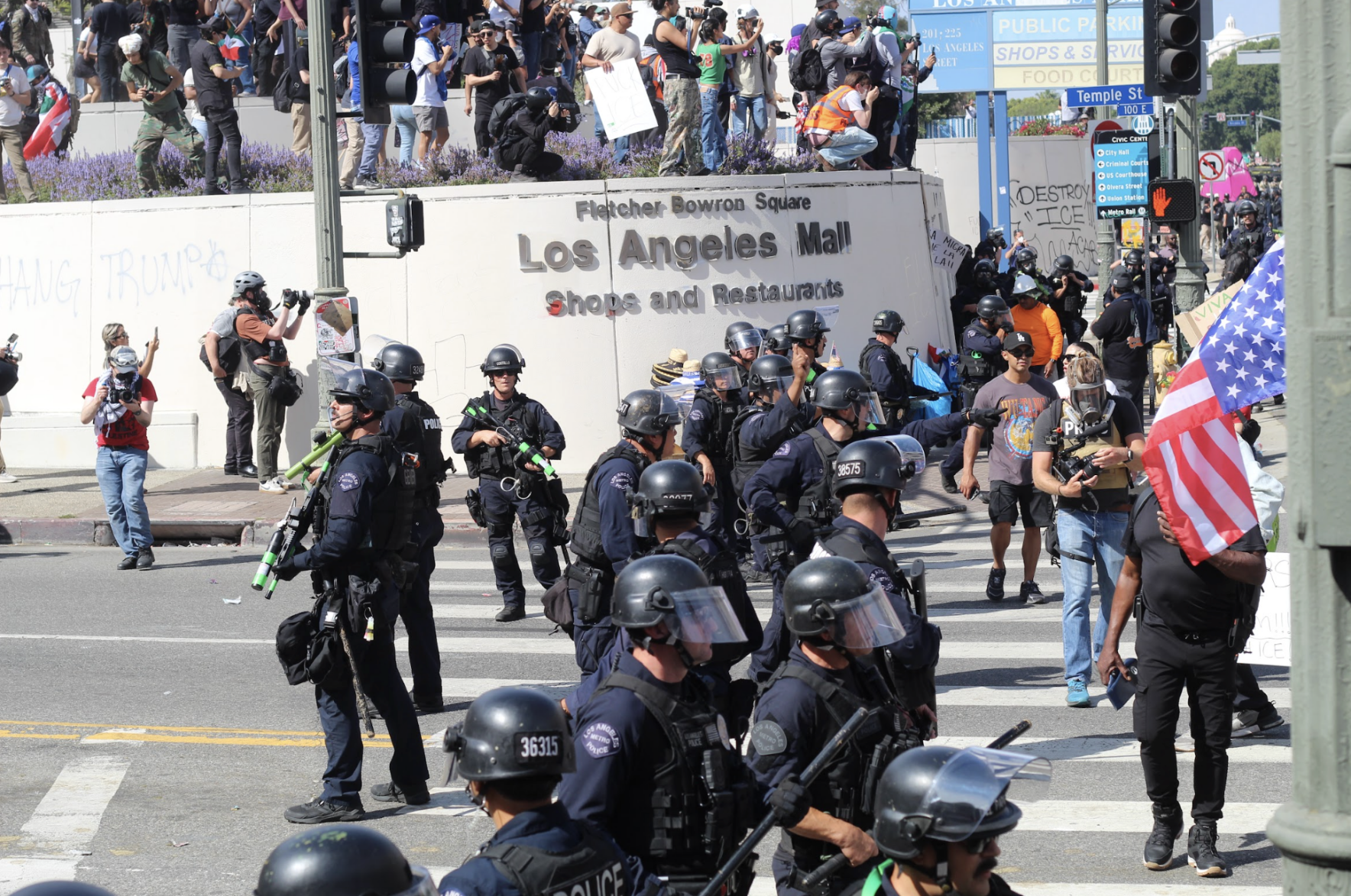
LAPD minutes before shooting "less-lethals" and tear gas into the crowd at 'No Kings' protest, June 14 2025. (Photo by Michelle Zacarias/CALÓ News)
She pointed to an incident where a weapon that was intended to be deployed from 10 yards away was deployed targeting an individual's face just a few feet away. Another instance researchers verified was the use of a chemical irritant, meant to be dispersed toward a crowd, being thrown at an individual.
“None of those kinds of behaviors would suggest that they're being used properly,” Koenig said. “And so I do think it's in the best interest of the L.A. County Sheriff's Department and others to look at the incidents that we identified and to figure out how they can prevent further misuse going forward and add that to the training that they may already have in place.”
DHS told CALÓ News the “pattern is NOT of law enforcement using force. It’s a pattern of violent agitators attacking our law enforcement.” The Department also said its officers are highly trained in de-escalation tactics and receive ongoing training to use the “minimum amount of force necessary.”
But Koenig said based on what researchers analyzed, officers were not displaying the level of training DHS described.
Journalists accounted for 43% of the injured individuals in the dataset, while minors made up 2.9%. There were eight cases of injured pregnant and elderly people as well as three individuals with disabilities who were harmed.
“I'd be surprised if those were seen as legitimate threats to law enforcement officers who are highly trained and also are carrying weapons,” Koenig said. “So [given] the deployment of these weapons in ways that clearly violate policies and norms, their quote becomes really problematic, given that disjunct.”
Report recommendations
Researchers recommend a review of the weapons that are causing immense injury, followed by a swap for weapons that are less harmful to the public. Clearer use-of-force policies are needed, as well as making it easier for the public to access reports of misused force.
California does have some of the strictest crowd control laws, with more in the works.
The California Senate recently passed SB 937, a bill meant to further restrict tear gas, flash-bangs and other less-lethal devices. The bill has been referred to the Assembly Appropriations Committee; if the bill passes all policy committees, it will head to the Assembly floor for a final vote.
“I authored SB 937 because these weapons have been repeatedly misused at the local, state and federal level, especially as federal immigration enforcement has escalated,” said Sen. Lena Gonzalez (D-Los Angeles). “This report makes clear it is urgently needed ... these military-style tactics have no place in our communities.”
Making sure crowd control weapons are used safely even when tensions are heightened is a long process, Koenig explained. States and municipalities first need strong policies in place, robust training for law enforcement and consistent accountability for not adhering to those policies.
“What seems to be evident from at least our initial review of the data is that there may be gaps in all three of those links in the chain toward making sure that the public is as protected as it needs to be to uphold people's constitutional rights to protest and freedom of assembly,” Koenig said.






(0) comments
Welcome to the discussion.
Log In
Keep it Clean. Please avoid obscene, vulgar, lewd, racist or sexually-oriented language.
PLEASE TURN OFF YOUR CAPS LOCK.
Don't Threaten. Threats of harming another person will not be tolerated.
Be Truthful. Don't knowingly lie about anyone or anything.
Be Nice. No racism, sexism or any sort of -ism that is degrading to another person.
Be Proactive. Use the 'Report' link on each comment to let us know of abusive posts.
Share with Us. We'd love to hear eyewitness accounts, the history behind an article.