
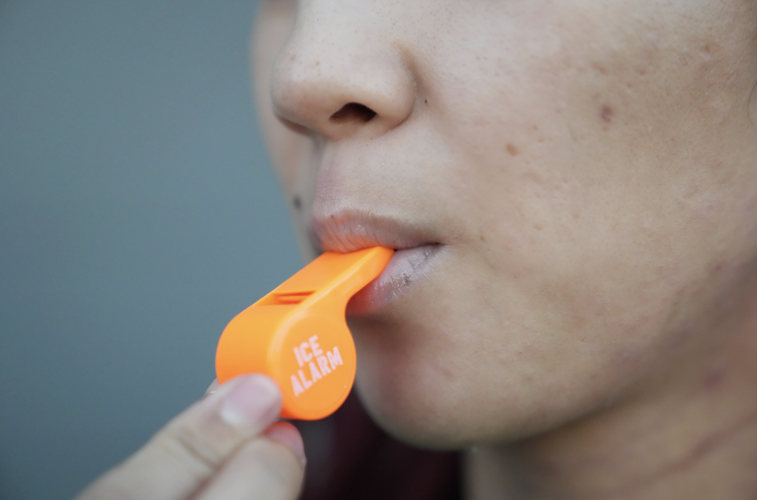



Using whistles, a very tiny tool, community organizers hope to make a big noise in the streets of L.A. Photo courtesy of Jay Garcia
In Los Angeles, community members and rapid response teams are finding new and effective ways to protect and warn neighbors when Immigration and Customs Enforcement (ICE) is in the area.
The latest practices have taken the form of non-verbal ways of communication that could protect the immigrant and undocumented community from raids and kidnappings.
Using whistles, a very tiny tool, community organizers hope to make a big noise in the streets of L.A., a place that has been the most targeted during the Trump administration's anti-immigration rhetoric and raids.
The ICE Alert Whistle Program is a new initiative looking to educate communities on the power behind blowing a whistle and making sure Angelinos have a whistle at hand in case they come face-to-face with federal immigration agents' arrests.
According to a report by the Department of Homeland Security released earlier this month, since June, ICE has detained over 10,000 people in L.A., many of whom did not have any criminal convictions.

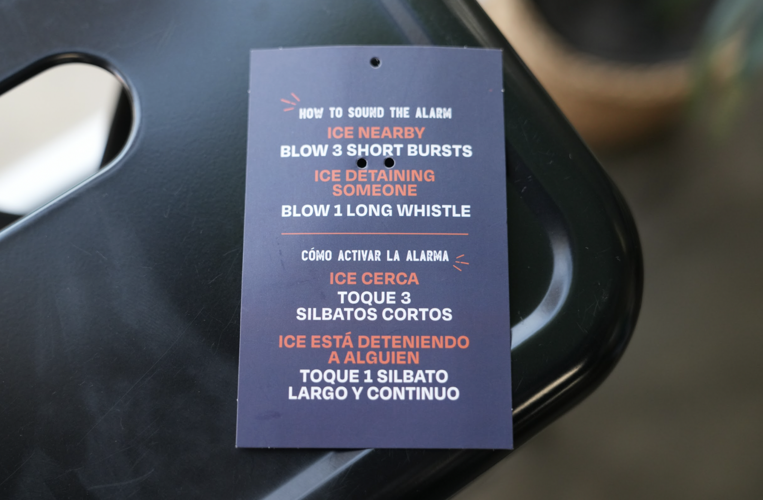
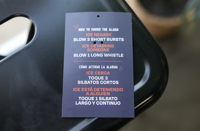
Instructions on how to use the whistles. Photo courtesy of Jay Garcia
In response to these alarming numbers and the violation of human rights occurring in the raids, about 10,000 whistles will be distributed to residents, local organizations and small businesses across L.A.County.
The hope is not to reinvent any new systems with the whistles but instead to incorporate them with the ongoing and already established community-led efforts and the tactics of many of the rapid response networks.
TaskForce, a cultural agency made up of artists, strategists and organizers, will facilitate the distribution to dozens of L.A.-based groups and organizations like CHIRLA, GroundGame LA, TransLatin@ Coalition, Meztli Projects and Inland Empire Immigrant Youth Collective, who received the first batch of whistles last week.
The idea is that these trusted community organizations will make sure their members and the community they serve all receive a whistle and learn how to properly use it.
As part of the initiative, three short whistle blows would signal that ICE has been spotted nearby and one long whistle blow signals that ICE is detaining someone.
Joel Garcia, director of Meztli Projects, an Indigenous arts and culture collaborative centering on Indigeneity advocacy through art-based healing, community organizing and violence prevention, said the first batch of whistles they received was gone within two hours.
“There’s a big need in communities when it comes to feeling safe and protected,” he told CALÓ News.
Garcia said that although a big focus of the organization is the arts and youth development, they have also pivoted to the local needs of the community, like joining rapid response networks, supporting youth in executing their Second Amendment rights to protest against the raids and using art for movement building.
“I think the whistles, although they might feel small, are an empowering tool,” he said.
The organization has and hopes to continue to distribute the whistles to the students, parents and community members it works closely with.
Garcia also said that the whistles bring a type of universal language useful for anyone in the community to understand, including Angelenos who speak native dialects or different languages.
“Finding the words to intervene [during an ICE raid] might be very difficult, but the simple act of blowing a whistle is a lot easier for folks. At some point, it can also become muscle memory,” he said. “It represents a different form of language that is being developed to be able to communicate with one another, which is especially important with the level of surveillance that many people face today.”
Other places in the U.S. are also using whistles to alert people of ICE, including cities like Chicago and New York.

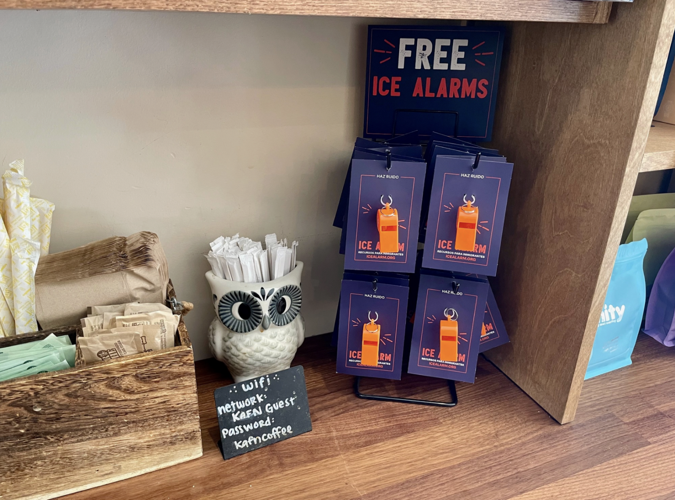
Whistles set up in Kafn Coffee. Photo courtesy of Jay Garcia
“We’re seeing whistle-alert strategies take hold in communities nationwide. Our goal is to help scale this effort by using our capabilities as a production and creative agency to support the groups leading the work, so they can reach even more neighbors,” Simon Isaacs, chief executive officer of TaskForce, said in a statement. “The real leadership always belongs to immigrant-defense organizations, mutual aid networks and local organizers on the ground. By expanding access to this simple tool, we hope to inspire allies everywhere to step up and protect their communities.”
Local businesses and coffee shops will also serve as distribution points for free whistles across L.A., including South LA Cafe, Walk Good LA, Kafn Coffee, and Village Well Books and Coffee, as well as Delicias Bakery, with more joining soon.
"At a time when our communities are under attack, we have to find a way to fight back. Whistles are an incredibly harmless but effective tool that can help create preventive measures to protect our communities,” Bamby Salcedo, president of the TransLatin@ Coalition, said. “It is our responsibility as trusted partners to disseminate these measures to protect the most vulnerable people from these horrific attacks."
Residents and community groups can access resources and guides, as well as order whistles for free at www.icealarm.org.






(0) comments
Welcome to the discussion.
Log In
Keep it Clean. Please avoid obscene, vulgar, lewd, racist or sexually-oriented language.
PLEASE TURN OFF YOUR CAPS LOCK.
Don't Threaten. Threats of harming another person will not be tolerated.
Be Truthful. Don't knowingly lie about anyone or anything.
Be Nice. No racism, sexism or any sort of -ism that is degrading to another person.
Be Proactive. Use the 'Report' link on each comment to let us know of abusive posts.
Share with Us. We'd love to hear eyewitness accounts, the history behind an article.