
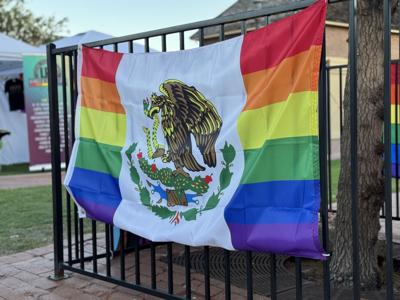

A Mexican LGBTQ+ flag hangs on a fence inside Heritage Square during the Latino Pride Festival on Oct. 4, 2025, in downtown Phoenix. (Nicole Macías Garibay/CALÓ News)
When LGBTQ+ youth arrive at One∙n∙ten’s Phoenix youth center after school, they’re usually looking for a place to exhale. Their CEO, Nate Rhoton, says it’s a place where they can brush off the headlines and the growing hostility that has seeped into their schools and homes. But this year, he shared, something feels different.
“This may be the only place they come during their day where they feel truly safe,” Rhoton told CALÓ News. “They don't even wear the t-shirts and pins they used to, that celebrate their identities, because they're afraid they're going to be, at minimum, harassed and possibly assaulted.”
Across Arizona, LGBTQ+ organizations say demand for services is rising while funding is depleting. They point to a combination of factors: a national rollback of Diversity, Equity, Inclusion and Accessibility (DEIA) programs, corporations quietly stepping away from queer partnerships and a political climate that community leaders describe as the most hostile in decades.
In one of his first major moves after returning to office, President Donald Trump signed Executive Order 14173, rescinding decades of federal diversity and equal opportunity directives and directing agencies, contractors and grant recipients to eliminate DEI-related programs from their operations.
The administration called the initiatives “illegal and immoral discrimination programs.” The order reshaped federal funding rules and sent a chilling signal through nonprofits and corporations that historically supported LGBTQ+ and marginalized communities.
A recent ProPublica investigation found that over 1,000 nonprofits removed DEIA-related language from their mission statements when filing taxes with the IRS this year.
In November, Phoenix Pride announced it was suspending its 2025-26 Community Grants program after reporting significant financial losses. According to the press release, losses included a $186,000 loss in admissions, $124,000 loss in beverage sales and a combined $147,500 shortfall in festival and parade sponsorships. The losses come after a 22% cut to their annual budget the year prior.
It attributes the downturn in part to the current administration’s crackdown on DEIA initiatives nationwide. The campaign led corporations and foundations to reduce or eliminate funding to organizations that serve LGBTQ+ communities.
Phoenix Pride spokesperson Jeremy Helfgot said they’ve felt this change even before the festival losses were made public.
“It hasn’t been partners abandoning us,” Helfgot said. “Because of the current political climate nationally, a lot of our partners have seen cuts to their own budgets.”
Criticisms have also circulated among some community members questioning Phoenix Pride’s event costs and communication or marketing strategy. Phoenix Pride leadership announced that it will launch a community survey and town hall in January, allowing residents to voice their concerns directly.
Despite the challenges, Phoenix Pride emphasized that scholarships would continue. The group awarded $119,000 this year, bringing its total since 2005 to more than $737,500, Helfgot said.
“Pride has weathered challenges for more than 40 years,” he said. “If pride is about anything, it’s about resilience.”
At One∙n∙ten — one of the state’s largest LGBTQ+ youth organizations — the needs are expanding faster than their budget lines.
The nonprofit offers identity-affirming youth programs, workforce development, housing support, satellite groups in rural areas and a microschool operated in collaboration with Goodwill. Its reach spans from Phoenix to Show Low, Yuma and tribal communities.
Rhoton said nearly 10,000 young people attended One∙n∙ten programs or digital services last year. That number is expected to rise again in 2026. However, he said the emotional toll of anti-LGBTQ+ rhetoric, particularly targeting trans youth, is becoming harder to quantify.
“The true impacts of these executive orders are on the social and emotional health of the young people we serve,” Rhoton told CALÓ news. “Words do hurt. Especially when they’re coming from the leader of our country to a 15-year-old.”
In rural communities, he said, the shift is even more pronounced with funding instability magnifying the impact.
“We’re seeing youth going back into the closet because they don’t feel safe to be who they are,” he said. “The worst thing that could happen right now is for young people to hide again.”
For organizations like the Latino Pride Alliance, DEIA cuts affect both parts of its identity.
“It’s not just the LGBTQ community being hit. It’s the Latino community too,” said Maricopa County Supervisor and Latino Pride Alliance co-founder Steve Gallardo. “Anything dealing with diversity and inclusion has dried up.”
He said the organization, which hosts Arizona’s largest LGBTQ+ event centered on Latino and Spanish-speaking communities, has seen the impact in its sponsorships. He said it started with unanswered calls and emails, followed by worries that partners who previously supported the event would now avoid public association.
“Businesses will say, ‘We want to help, but don’t put our logo anywhere,’” he said. “They’re terrified.”
Still, their annual Latino Pride Festival saw its largest post-COVID-19 attendance this year, despite industry-wide declines. Steve attributes this not just to celebration, but to survival.
“The worst thing we can do is go back into the closet. We’re not going away,” he said. “There’s a purpose to pride beyond the party, and if there was ever a time for these celebrations, it’s now.”
While the next year remains uncertain, leaders across all three organizations say their mission won’t change. What will change, they agree, is how they fund it.
“We need the community’s help and support right now,” Helfgot said. “We’re still here. We’re still on mission. We’re still showing up.”
For Rhoton, the stakes are far higher than budget lines.
“No matter what our federal government or an executive order says about who they are, they know they have a village of people around them that support them 100%,” he said.
Gallardo put it bluntly.
“We’re continuing to thrive and live the American dream,” he said. “No one is going to shut us down.”
Lorenzo Gomez is a multimedia journalist and master’s graduate at Arizona State University’s Walter Cronkite School of Journalism and Mass Communication. His reporting focuses on Indigenous communities, immigration, politics and culture. His work has been featured in CALÓ News, Navajo Times, Arizona Daily Sun, Cronkite News and News21.









(0) comments
Welcome to the discussion.
Log In
Keep it Clean. Please avoid obscene, vulgar, lewd, racist or sexually-oriented language.
PLEASE TURN OFF YOUR CAPS LOCK.
Don't Threaten. Threats of harming another person will not be tolerated.
Be Truthful. Don't knowingly lie about anyone or anything.
Be Nice. No racism, sexism or any sort of -ism that is degrading to another person.
Be Proactive. Use the 'Report' link on each comment to let us know of abusive posts.
Share with Us. We'd love to hear eyewitness accounts, the history behind an article.