
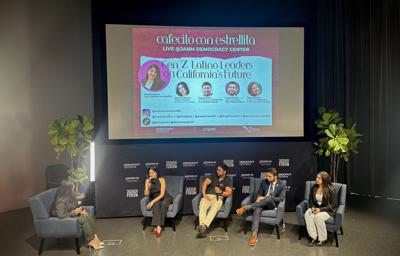


(left to right) Estrella Serrato, Marlene Ramirez, José Quintero, Jorgel Chavez and Selina Mendez. Photo by Brenda Verano
As the 2026 elections approach and we are less than a week from when active registered California voters begin receiving their ballots for the June 2 primary election, local Gen Z leaders organized a panel discussion and live podcast recording where they talked about civic engagement, voting in the Latino community and what’s at stake for young people living in the Golden State.
Just when county elections offices get ready to begin mailing ballots on Monday, May 4, “Cafecito con Estrellita,” a first-generation Latina podcast, in partnership with Unseen, a non-profit organization focusing on policy advocacy, brought together numerous panelists and a live audience of civic-minded Gen Z Latinos to talk openly about the ways younger generations are essential to building a just and thriving future in politics.
The podcast episode titled “Gen Z Latino Leaders on California’s Future” was recorded at the Democracy Center at the Japanese American National Museum in Little Tokyo on Tuesday, April 28.
“Cafecito con Estrellita,” hosted by Estrella Serrato, began six years ago in April 2020, designed to guide first-generation scholars through higher education and post-grad life, as well as tackle cultural stigmas and offer a safe online space for first-generation Latinos.
Serrato said part of that first-generation experience for many Latinos also includes being civically engaged and navigating local and international politics for the first time.
Approximately 50 million Gen Zers will be eligible to vote in 2026, according to a study by the Center for Information and Research on Civic Learning and Engagement.
"Gen Z are the future leaders of our society right now, and they have so much power within their voice and the knowledge that they obtain,” she told CALÒ News. “Being able to do this panel specifically catered to Gen Z individuals is such an honor because safe spaces like this aren't always accessible. I hope many leave feeling empowered so that they can take this conversation with them as they leave this room, especially as election season approaches.”
To welcome the live audience, Sonja Diaz, founder and managing director of Unseen, told attendees that the event was not organized to tell people who to vote for.
“This [event] is not asking you to vote; this is not telling you to vote for somebody. This is a space to talk about what it's like to be an individual in this society and what your ambitions are and what meaningful opportunity looks like,” she told the audience.
Diaz said the upcoming election cycle will determine things like who will lead the fourth-largest economy in the world, who's in charge of our public schools, who controls the local economy and “who is fighting against the Trump administration when he seeks to encroach on our state constitution and our American constitution.”
The panelists for the podcast episode included Jorgel Chavez, a City of Bell Gardens councilmember. Chavez first ran when he was still in college and has been an elected official in a majority-Latino and working-class city in Southeast L.A. since 2020. Another panelist was Marlene Ramirez, a content creator who focuses on civic policy and is a first-generation Mexican American trained at the London School of Economics.
Selina Mendez brought student insight and perspective to the panel. She is a UC Berkeley student and a senator for the Associated Students of the University of California (ASUC), which is the official, autonomous student government at UC Berkeley.
José Quintero, a radio host, podcaster and executive producer for La Vale Show on Cali 93.9, was also a panelist. He said that through his “Échale” podcast, he aims to celebrate Latino culture, uplift authentic voices and inspire the next generation of media creators.
The panelist talked about how the message of “Go Vote!” is not enough. Quintero said that although voting is important, simply directing someone to cast their vote is only the start.
“When you tell people to just vote and not give them the foundation or the tools for them to do the investigation that they need, I think that's where a lot of people fail,” he said. “I know for radio, we tell a lot of people where to vote and give them resources such as their local polling places. I really encourage people to take a look and see what is in those ballots and what propositions they will be eligible to vote for, depending on their district and their community.
Mendez touched on the importance of elected officials or campaigns to advocate alongside a community, rather than on their behalf.
“Through a student lens, there are a lot of student representatives and even in local and federal representation, where [candidates] try to speak on behalf of communities without having taken the time and consideration to truly meet with them,” she said. “We elect our representatives to advocate on behalf of us, but if our representatives aren't actively meeting with us and understanding our perspective, our lived experiences, they aren't accurately representing what we truly want and expect.”
Mendez said in local, federal, or international races and campaigns, it is important for representatives to meet with young leaders who have lived experiences on things like housing insecurity, immigration and economic disadvantages. “If I don't have that lived experience or that background, how am I going to accurately represent and communicate that when it comes to advocating for policy and legislation that impacts these certain communities?” she said.
Chávez said the key thing that differentiates Gen Z from previous generations when it comes to voting is the way many can “see right through" a candidate or campaign who he said “isn't genuine.”
“Gen Z grew up on social media. Millennials, and I'm a millennial myself, will probably believe a lot of stuff on social media. Gen-Z has had more access to social connections, and it's easier [for them] to see somebody who's just being very political versus (being) genuine,” he said.
According to the same study by the Center for Information and Research on Civic Learning and Engagement, Gen Z’s top issues are the economy, housing and healthcare, with the economy dominating across demographics and political beliefs.
Access to information is a key barrier between what Gen Z cares about and how they show up at the ballot box.
Ramirez talked about the power of social media to reach Gen Z individuals and the ways she uses her platform to break down how systems of power operate in practice, making complex policy issues legible and accessible.
“There's been a big buzzword called affordability that's been really popular since last year, since [Zohran] Mamdani won in New York. The Democratic Party is slowly catching wind of this and they're seeing people respond more to affordability issues. For Latinos in this upcoming election, we really shouldn't underestimate their ability to see through the smoke and mirrors. We need a party that can really reflect that, that urgency,” she said.
This “Cafecito con Estrellita” episode is scheduled to be released early next month.
May 18 will be the last day to register to vote in the primary election. To find a voting center in L.A. County, click here.






(0) comments
Welcome to the discussion.
Log In
Keep it Clean. Please avoid obscene, vulgar, lewd, racist or sexually-oriented language.
PLEASE TURN OFF YOUR CAPS LOCK.
Don't Threaten. Threats of harming another person will not be tolerated.
Be Truthful. Don't knowingly lie about anyone or anything.
Be Nice. No racism, sexism or any sort of -ism that is degrading to another person.
Be Proactive. Use the 'Report' link on each comment to let us know of abusive posts.
Share with Us. We'd love to hear eyewitness accounts, the history behind an article.