
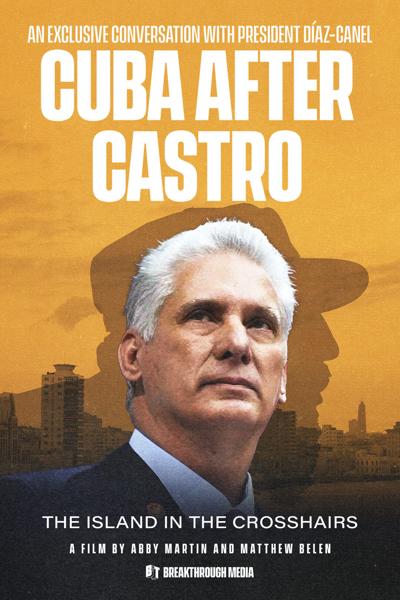



On a spring evening in West Los Angeles, the Laemmle Royal Theater is sold out with the audience in anticipation. Inside, people gather not just for a film debut but for what many see as a rare political and journalistic event: a documentary sit-down interview that bridges decades of tension between a global superpower, the United States, and a small island ninety miles away from Florida, the Republic of Cuba.
The film “Cuba After Castro” had its West Coast premiere Wednesday night amid renewed tension on the island and offers something few Americans have ever witnessed: a direct, unfiltered interview with Cuba’s President Miguel Díaz-Canel.
The screening is part of a broader national rollout of the documentary, which has already generated discussion for its access and timing. Trump threatened military action on Cuba in January, issued escalated warnings in March and April, and stated “Cuba is next” after bombing Iran and Venezuela, prompting the Pentagon to ramp up its planning.
The film, directed by journalist and filmmaker Abby Martin alongside Matthew Belen, centers on Martin’s unprecedented sitdown with Miguel Díaz-Canel, the first such interview granted to a U.S. journalist.
For the audience in Los Angeles, the event was more than a premiere; it was an encounter with a country often talked about but rarely heard from directly. The documentary positions itself as a corrective to decades of negative political narratives, largely shaped by U.S. corporate media outlets that provide no context for the real situation on the island.
Martin’s interview revives a tradition of immersive, firsthand reporting, one that recalls the late John Pilger, who produced long-form documentaries with historical context, or Jon Alpert, who spent decades documenting Cuba and even interviewed Fidel Castro during earlier eras of tension with the United States.
But “Cuba After Castro” is rooted in the present day, under the shadow of the Trump Administration, with Marco Rubio as the Secretary of State. The island is facing severe economic strain, ongoing blackouts, and intensifying geopolitical pressure due to the U.S. embargo that has lasted for decades.
The film shows that U.S. policy since the triumphant socialist revolution of 1959 has always been to strangle the Cuban economy. Today, the island is struggling to survive under the U.S. oil blockade and the country’s listing on the State-Sponsored Terrorism list, which makes it much more difficult for the country to trade with others. In addition, the film shows how the U.S. blocked Cuba from accessing life-saving vaccines during the COVID-19 pandemic and told neighboring countries not to sell oxygen tanks to Cuba. President Díaz-Canel met with the country's top scientist to develop a plan, and together they created homegrown vaccines to save lives.
“Our scientist saved millions of lives,” said Díaz-Canel.
Against this backdrop, Martin’s interview with Díaz-Canel becomes not just a journalistic milestone but a historical moment amid the volatility between the U.S. and Cuba. For the first time, people in the U.S. will hear and see firsthand what the Cuban people face under the embargo, rather than hearing it as a corporate media talking point, which always blames mismanagement on the Cuban government.
Inside the venue, students, activists, journalists, and community members fill the seats. Many arrive with preconceived notions shaped by decades of U.S. propaganda about Cuba, while others come looking to learn more about the island.
“The documentary was great and perfect for those looking to learn the truth about Cuba,” said Jose Barrera, from El Salvador, who attended the screening.
The documentary did not shy away from controversy. Martin addressed the domestic protests, economic hardship, and Cubans’ criticisms of their government, while also highlighting the role of U.S. foreign policy in shaping those conditions.
Martin’s approach is direct. In the interview, she questions Díaz-Canel about the government’s response to dissent, the realities of daily life in Cuba, and the prospects for future relations with the United States.
Díaz-Canel centers on the actions of Israel against Palestinians, the actions of the U.S. in Iraq, Afghanistan, Libya, and Iran, and the fact that the U.S. and Israel are not listed as state sponsors of terrorism while they bomb the Middle East, whereas Cuba has not bombed anyone.
In addition, the documentary didn’t shy away from depicting the counterrevolutionary forces in Miami that are pressuring the White House to sever ties with the island and further drive the country toward collapse.
The president, an engineer by training and the first Cuban leader born after the 1959 revolution, offers answers likely to provoke debate among American audiences. The camera focuses on Díaz-Canel, and the answers come from him, not from a government official or a Cuban living in Miami. The exchange between Díaz-Canel and Martin unfolds without rapid cuts or editorial interruptions, giving the American people answers they won’t hear in the U.S. corporate media. Díaz-Canel lets the audience know how Cuba navigates these difficult times and how the Communist Party mobilizes its members to attend to the needs of the people.
“In Cuba, we know all too well the objectives of the empire,” said Díaz-Canel.
For decades, the Cuban presidency has been largely inaccessible to American journalists, making this interview a significant departure from the norm. In addition, Martin has been traveling the world to showcase her latest documentary, “Earth’s Greatest Enemy,” which premiered in October 2025. Without any trailers or sneak peeks, Martin releases “Cuba After Castro” at a critical moment for people to learn about Cuba.
The timing of the film adds another layer of relevance as U.S.-Cuba relations once again enter a period of uncertainty, underscoring the need to inform the public about the truth about Cuba, its history, and how the U.S. embargo has made life on the island difficult to navigate. The documentary positions itself as a tool for that discourse, offering a perspective that is both rare and immediate.





(0) comments
Welcome to the discussion.
Log In
Keep it Clean. Please avoid obscene, vulgar, lewd, racist or sexually-oriented language.
PLEASE TURN OFF YOUR CAPS LOCK.
Don't Threaten. Threats of harming another person will not be tolerated.
Be Truthful. Don't knowingly lie about anyone or anything.
Be Nice. No racism, sexism or any sort of -ism that is degrading to another person.
Be Proactive. Use the 'Report' link on each comment to let us know of abusive posts.
Share with Us. We'd love to hear eyewitness accounts, the history behind an article.