
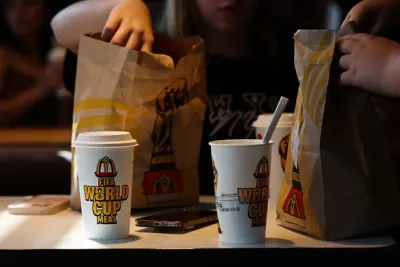


FIFA World Cup meal is seen at a McDonald’s, on June 20, 2026. Credit: Jakub Porzycki/NurPhoto via Getty Images
This story was originally published by Prism.
Jeanette Driskell said she “was born with a silver spoon” in her mouth. She grew up in San Francisco’s Presidio, one of the most affluent neighborhoods in the Bay Area.
Her upbringing was a stark contrast to her 20s, when she became a single mother living in subsidized housing in the inner city’s Filmore District, about four miles away from her coastal childhood home.
At that time, Driskell relied on public assistance while taking care of her young daughter, working, and going to school full time. She didn’t have a car, so she took the bus to attend college classes and walked five blocks to the closest full-service supermarket.
“There were liquor stores and fast-food chains on every corner. To go buy real food for me and my daughter was a chore. McDonald’s was my go-to place,” said Driskell, 57. “It was quick. It was easy. It was cheap. My daughter loved the chicken nuggets. She’d always say, ‘I want a kids meal!’ You know, with the toys and everything?”
Rooted in a capitalist system that prioritizes profit over public health, those seemingly harmless toys play a significant role in the multibillion-dollar fast-food industry that markets unhealthy food to children, particularly those who are Black and Latino. The broader food industry also profits from exploiting systemic inequalities to target vulnerable communities, who have little access to healthy foods due to limited income, redlined neighborhoods, or food apartheid.
Food systems under capitalism have always targeted BIPOC communities and their children, according to the health- and food-focused nonprofit organization Food Empowerment Project (F.E.P.).
“Advertising has always been used as a tool of colonization, teaching BIPOC and low-income communities to view certain products as necessary for health, even when those products may harm their bodies,” explained Tyra Willis, F.E.P.’s communications team member, in an email.
“Corporations have the power to raise or lower prices, they choose not to. Corporations have the power to supply every community with affordable, healthy food choices. They choose not to. Corporations have the power to make harmful foods seem normal or necessary,” Willis added. “Profit and control continue to be the driving priority, not community, nor our well being.”
Disparity by design
The lack of access to healthy food choices enhances the effectiveness of marketing for highly processed, calorie-dense, and nutritionally deficient prepackaged foods. These cheaper, unhealthy options—often referred to as “junk food”—are more accessible and often more appealing. Fast food and similar items high in sugar, fat, and salt can be addictive because they trigger the brain’s pleasure centers. The food industry peddling these unhealthy options are overwhelmingly profit-driven. Corporations seek to maximize revenue by targeting the communities most vulnerable to exploitation and least protected by political power, including by tapping deeply into cultural identity and aspirations, experts told Prism.
Clay Venetis, a policy associate at the Center for Science in the Public Interest, advocates for better rules and practices for companies marketing food to kids. He told Prism that the industry often uses consumer culture as bait.
“They will use Bad Bunny for doing the Super Bowl halftime show or the World Cup. … It’s about tapping into a cultural moment to drive consumption,” Venetis said. “That is manipulative because culturally significant moments are emotional, which makes you a prime target for being influenced into doing something like making an impulse buy of an unhealthy product.”
Those unhealthy products, such as highly processed foods, are enormously profitable. Corn syrup, refined flour, oils, salt, and chemical additives are inexpensive to manufacture and have long shelf lives. Companies can produce them cheaply and sell them at huge markups. In contrast, fresh produce is perishable, labor intensive, and often less profitable. To maximize profits, corporations selling unhealthy products aggressively target lower-income households that frequently face time constraints, lack of money, or access to buy healthier foods.
Driskell, who now lives in Oakland, recalled her younger years living in an upscale, suburban neighborhood with a backyard garden full of produce. Her family also made weekly visits to the local butcher for freshly cut meats.
“I went from that to eating highly processed and fast foods with my young daughter on the regular,” she said. “It’s frustrating. Sometimes I feel angry because if I was living in a white neighborhood, it wouldn’t be like this. The quality of food is better in an upscale neighborhood than it is in the projects. And, you sure don’t see these fast-food advertisements everywhere you turn.”
In June 2021, the University of Connecticut’s Rudd Center for Food Policy and Health published its most recent study about food advertising to children. Researchers found that fast-food companies spent around $5 billion on advertising in the U.S. in 2019—an increase of more than $400 million since 2012. Those spending dollars are not uniformly distributed. The study found that advertising for unhealthy food products targeted Black and Hispanic youth significantly more than their white counterparts.
“Companies often put their money behind their least healthy products and target those to Black and Latino young consumers. We have evidence that there are disproportionate effects of diet-related disease among those groups. It’s higher,” said the Rudd Center’s Director of Marketing Initiatives Frances Fleming-Milici. “So when you target those groups with your least healthy products, you are making the problem worse.”
“It’s helping the bottom line, but it’s not helping the individuals who are consuming it,” she added.
Fleming-Milici has spent the last 15 years researching and analyzing race and ethnicity differences in the rates of exposure to unhealthy food and beverage advertising, and the impact of these practices on youth. Her current focus is to determine the effects of this marketing on parents.
“It’s really hard to have your children want to consume healthier foods. … It really saddens me when I step into communities and see the food environment, how it’s worse,” Fleming-Milici told Prism. “I think about the barriers people have to obtaining food, in terms of being accessible, affordable, and having the time.”
“Some parents are holding down a couple of different jobs and maybe have to have their kids be alone more often than other families,” Fleming-Milici added. “It’s just way, way, way harder in these communities. It doesn’t seem fair at all, really.”
Cradle-to-grave marketing
The Rudd Center also notes that food, beverage, and restaurant companies annually spend nearly $14 billion on advertising in the U.S.—80% of which promotes fast food, sugary drinks, candy, and unhealthy snacks. Corporations use a wide array of tactics to make unhealthy products irresistibly appealing to kids. Cartoons with colorful mascots, celebrity endorsements, and popular influencers all play a role.
Sports sponsorships link unhealthy products to excitement and team loyalty, while mobile gaming ads, social media campaigns, and YouTube influencers target kids online. The Coca-Cola Company, for instance, frequently promotes elite athletes by featuring them on limited-edition, collectible packaging such as cans and soccer ball-shaped bottles. These campaigns are often tied to global sponsorships for major events, such as the Olympics and Paralympic Games, NCAA Championships, and the FIFA World Cup. Another popular advertising tactic is to place QR codes on products so that fans can scan it to unlock digital content, interactive quizzes, and sweepstakes to win official merchandise or game tickets.
Venetis, of the Center for Science in the Public Interest, is also a dad. He said his young son, like many other kids, is “very into superheroes.” Coca-Cola has partnered with Marvel Entertainment, placing Marvel Universe heroes and villains on limited-edition bottles and cans that also feature QR codes to access augmented reality animations and sweepstakes.
“These are sugary drinks that have packaging that’s very attractive. … [My son] will see the superhero on the soda can and express a want in it. It becomes a whole conversation, a back-and-forth as a parent,” said Venetis. “It may be after work. You may be tired, and sometimes parents cave. It takes a lot out of you and feels very unfair because it’s purely driven by these companies wanting to profit and having no consideration for a parent’s attempts at raising a healthy kid.”
Coca-Cola does not publicly disclose its spending on advertising to children, but it does tout its “responsible marketing policy,” which claims not to market directly to children younger than 13. Community health advocates call the policy a public relations smokescreen, arguing that Coca-Cola and other corporations’ broad marketing tactics and sponsorships still reach and influence young kids.
The Coca-Cola Company did not respond to Prism’s requests for comment. Neither did McDonald’s Corporation.
Brands also partner with schools, placing their products and advertising directly into classrooms and cafeterias by way of vending machines, sponsored events, and other efforts. The omnipresence of this multiple-channel marketing ensures that children in targeted communities are bombarded with unhealthy food messages, the effects of which can last a lifetime. This is known as “cradle-to-grave” marketing.
Fleming-Milici explained corporations’ thinking behind the strategy. “‘Get them when they’re young, and they may stay with us for 10 to 20 years.’ The most egregious example from what I’ve looked at and studied is going into schools as partners and giving scholarships and things under the guise of good will. It’s profit over people.”
She also gave an example of food corporations pushing unhealthy products in “cause-related campaigns” that are important to Black and Latino neighborhoods, including donating money to childhood education, hunger relief, and equity initiatives.
“The perception is the company cares about the community and the young people in it and that they’re doing good things,” added Fleming-Milici. “It creates a positive corporate image that could last a long time. But the thing I think could be really helpful is if they created and marketed healthier food.”
Food corporations increasingly use sophisticated data analytics to micro-target children based on their ZIP codes, ethnicity, online behaviors, and purchasing patterns. In the digital age, precision advertising taps into how consumers use social networks, streaming platforms, and mobile games.
Children of color often face disproportionate exposure to this highly tailored marketing, particularly through platforms such as TikTok, YouTube, and Instagram, where influencer campaigns align junk food with cultural icons. This kind of algorithmic targeting amplifies disparities, creating a relentless presence of unhealthy food marketing in the daily lives of Black and Latino children in low-income communities.
“I think that we have a culture in this country that’s pretty accepting of advertising. There is potentially a lack of recognition or lack of caring of the biased intent of advertising—especially with online influencers who have branded content that’s embedded into what they’re doing,” said Venetis. “Many times kids have very strong parasocial relationships, not realizing they’re being paid to talk about these products or play video games in a certain way.”
Venetis added that better education to recognize this bias may help kids and their parents look at things more critically.
“These unhealthy food companies use cultural moments and important milestones or events in kids’ lives as Trojan horses to sneak in their advertising. The goal is to hit people at the exact moment they’re most likely to be moved emotionally,” said Venetis. “Right then, you get the person to consume more of your unhealthy product.”
Marion Nestle, a public health advocate and professor of nutrition and food studies at New York University, agreed.
“Of course it’s a Trojan horse. That’s the whole point of community support and funding community activities,” said Nestle. “If you get kids to like and want a product, they will pester their parents for it and consume it for life.”
Accountability gaps
Food and beverage giants spend millions of dollars lobbying to block regulations that would curb advertising to children, including state efforts to implement a soda tax, food warning labels, or advertising bans. This political influence allows corporations to shape public policy to protect profits at the expense of public health.
Driskell is now raising her 17-year-old grandson and 15-year-old granddaughter, both of whom are African American and Filipino. When Prism asked Driskell what she’d like food industry giants to know about how their targeted marketing strategies impact her family, she responded with questions of her own.
“How would they feel if these were the only food choices they had—eating the way lower-class citizens eat? How would they feel if the shoe was put on the other foot? Would they want to be eating McDonald’s every night? Would they want a fast-food restaurant and liquor store on every corner in their neighborhood? Hell no, they would not,” Driskell said.
“I don’t think it would make a difference, but it would get them thinking in different terms or a different way,” she added. “It would definitely start raising some type of awareness within their thinking.”
Federal agencies such as the Department of Health and Human Services (HHS), the Centers for Disease Control and Prevention (CDC), and the Federal Trade Commission (FTC) classify targeted food marketing as a significant public health concern. Data also confirms “racialized marketing” and the private sector’s profit-driven practices contribute directly to higher rates of diet-related diseases among Black and Hispanic youth, childhood obesity, type 2 diabetes, and cardiovascular disease being the top three.
Such practices exemplify negative commercial determinants of health (CDoH). In this case, “Big Food” influences public health through aggressive marketing, lobbying, and research manipulation. The term is widely recognized for how these profit-driven actions negatively impact public health and reinforce inequities.
HHS does not specifically mention CDoH in its Healthy People 2030 initiative to “set data-driven, national objectives to improve health and well-being over the next decade.” Instead, its focus is on the social determinants of health (SDoH), environmental conditions that impact peoples’ health and contribute to disparities and inequities. Access to nutritious foods is listed as an SDoH, giving the example that people without “access to grocery stores with healthy foods are less likely to have good nutrition.” HHS’ stated plan of action not only includes setting data-driven objectives, but also providing tools for evidence-based interventions and tracking progress across local and national levels.
Food justice advocates argue that these measures don’t go far enough, pointing to HHS Secretary Robert F. Kennedy Jr. and the agency focusing on personal behavioral changes and not adequately confronting the corporate practices and systemic racism that underpin these issues.
“Children are raised inside a system of misinformation from the start, making them easy targets for future consumers rather than supporting them as a whole human, worthy of health and the tools to thrive,” Willis of F.E.P. explained. “Parents and our youth are blamed for food choices that they were groomed to make through corporate manipulation, colonialism, and racism. Real collective change requires us to confront systems, corporations, and organizations that prioritize profit over the people.”
That’s why advocates are calling for more robust regulations, including stringent limits on child-targeted advertising, better support for food sovereignty, and policies directly addressing economic inequality.
Venetis said more federal intervention is necessary to hold food and beverage companies’ “feet to the fire” for using deceptive marketing practices to manipulate kids.
Nestle also believes it’s the government’s responsibility to ban the advertising and marketing of unhealthy foods to children, put warning labels on these foods, and prevent them from being offered or sold in schools or supplied to their sports teams, as well as to “put far greater resources into improving school breakfasts and lunches, where many children get most of their daily calories.”
A recent survey of 1,226 school districts across eight states found that the majority of schools regularly served convenience foods and/or quick preparation foods, which primarily consisted of processed and ultraprocessed foods.
Fleming-Milici said clear initiatives and plans are what’s needed for true change.
“Getting the food industry to change is really hard. … There’s discussion of the importance of it. But without putting the supports in place to make it happen, how is it going to happen?” she said. “The proof is where you put the money and where you put the policy. And, when you don’t put the money behind the marketing of your healthier products, having them really just appears to be a public relations stunt. … There needs to be government policies that go across the board.”
HHS and the CDC did not respond to Prism’s requests for comment. The FTC’s Office of Public Affairs declined to comment.
Reclaiming health and justice
Food justice activists say real progress requires coordinated action: stronger policies restricting child-directed marketing, investment in equitable food access, community-led solutions rooted in food justice, and an unwavering demand for corporate accountability.
“In addition to trying to get laws passed, it’s organizing. It’s coalition building. It’s pressuring,” explained Venetis. “It’s making sure these companies recognize that they have their own responsibility to do something here—to check and see whether they’re overleveraged on unhealthy products and how they can shift their growth strategy toward healthier products.”
To address some of these issues, the Center for Science in the Public Interest is rolling out a consumer advocacy campaign called “Flatten Big Soda.” The effort combines public pressure and policy to end aggressive advertising and marketing for sugary, sweetened beverages—demanding that companies reduce their multibillion-dollar budgets for these drinks and instead focus on marketing unsweetened alternatives.
“It will change. I do stand by that. It will change with a change in demand,” Venetis said. “A corporation is obligated to increase shareholder value. If the demand drops, then they have to accommodate. They have to shift their strategy.”
F.E.P. is largely focused on leveraging education for change. The organization encourages BIPOC children and their communities to actively interrogate examples of targeted marketing and see it as “a local issue instead of something distant or out of sight, out of mind,” explained Willis.
“Our mission is to help consumers make healthy and compassionate choices—which is why it is essential to educate and empower youth,” she added. “Young people are directly affected by the food system and should absolutely have a seat at the table in shaping the future they will inherit.”


















(0) comments
Welcome to the discussion.
Log In
Keep it Clean. Please avoid obscene, vulgar, lewd, racist or sexually-oriented language.
PLEASE TURN OFF YOUR CAPS LOCK.
Don't Threaten. Threats of harming another person will not be tolerated.
Be Truthful. Don't knowingly lie about anyone or anything.
Be Nice. No racism, sexism or any sort of -ism that is degrading to another person.
Be Proactive. Use the 'Report' link on each comment to let us know of abusive posts.
Share with Us. We'd love to hear eyewitness accounts, the history behind an article.