
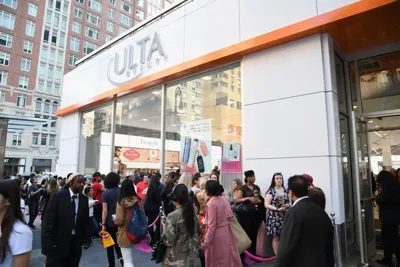


A crowd waits outside an Ulta Beauty store in New York City, on May 23, 2018. The cosmetic retailer uses automated license plate reader cameras made by Flock Safety. Credit: Dimitrios Kambouris/Getty Images for Flower Beauty
This story was originally published by Prism.
A national gender justice organization is escalating a campaign against Ulta Beauty over the cosmetics retailer’s use of automated license-plate reader (ALPR) cameras made by the surveillance company Flock Safety, arguing that it threatens customer privacy and could disproportionately harm women and gender-expansive people.
UltraViolet, a women-led gender justice organization, launched its “Drop Flock” campaign this month, calling on Ulta Beauty to terminate contracts with Flock Safety and other mass surveillance companies. The organization said its petition had surpassed 15,000 signatures as of Sept. 8.
“Ulta Beauty has built a multibillion-dollar business on women’s trust,” UltraViolet Campaign Director Jenna Sherman said in a statement accompanying the campaign’s launch. “Putting Flock, an invasive mass surveillance system, right outside its stores without customer knowledge or consent is a direct violation of that trust.”
When asked about the campaign’s privacy and gender justice concerns, a Flock spokesperson pointed to the company’s public media FAQ page outlining its data retention policies and security safeguards. According to the FAQ page, cameras collect vehicle and license-plate data for law enforcement investigations with access and retention controlled by the agencies that use the system. Flock’s website says the company does not sell the data or use facial recognition. Ulta Beauty did not respond to Prism’s request for comment.
The campaign grew out of UltraViolet’s broader work examining the intersection of technology, privacy, and gender-based violence. Sherman said the organization has spent years tracking technologies that can be used to surveil, stalk, or harass women and gender-expansive people, including facial recognition, connected vehicles, location tracking, and other emerging technologies.
UltraViolet became more directly involved in the campaign against Flock Safety after working with Fight for the Future, a digital rights organization that has organized campaigns against Flock’s contracts with major retailers and local governments.
Flock Safety manufactures ALPR cameras that capture license-plate information and other visual details around vehicles. The company has built a large network of cameras used by law enforcement agencies and private organizations. Flock told Axios in August that its network had grown to more than 120,000 cameras across the country.
UltraViolet’s campaign is part of a national backlash against Flock and other ALPR providers. Local governments across the country have faced pressure to reject or end contracts with surveillance companies, while digital rights and civil liberties groups have increasingly turned their attention toward private companies using similar technology. In Florida, for example, state officials recently moved to restrict ALPR cameras on state roads amid concerns about privacy and misuse.
UltraViolet argues that corporations should face the same scrutiny as government agencies when they deploy surveillance technologies capable of collecting sensitive information about the public.
Sherman said UltraViolet was surprised to discover that Ulta was identified by Flock as a retail partner in the company’s public materials. The organization had already seen strong public engagement around campaigns targeting Flock cameras at Lowe’s hardware stores and decided to bring the issue to Ulta.
“We knew that we owed it to them to campaign specifically about Ulta because it is a company with a majority-women shopper base,” Sherman told Prism.
Ulta’s privacy policy contains a dedicated section on “Automated License Plate Recognition Usage and Privacy Policy.”
The policy states that Ulta uses ALPR systems where they are not prohibited by law and that the systems are used for the security of its premises, employees, guests, and assets. It also says information from those systems can be disclosed to third parties, including law enforcement, for specified purposes such as safety, protecting property, and complying with the law.
Sherman argued that the larger concern is the normalization of surveillance technology in everyday spaces. Unlike conventional security cameras, ALPR systems can automatically collect and analyze vehicle information as cars enter and leave parking lots. Sherman said many shoppers may not realize they are being recorded or understand how the information collected could be used or shared.
“There is a consent problem here because people don’t actually fully understand what these cameras are doing,” she said.
The potential consequences, she argued, extend well beyond retail security. Independent reporting has documented cases in which law enforcement officers misused Flock systems to track women and former romantic partners. A Washington Post investigation identified at least 50 law enforcement officers who had been accused or charged with using license-plate readers for unauthorized purposes, including to stalk women. The Post also reported that a Wisconsin police officer allegedly used Flock to check whether his former girlfriend had gone to an abortion clinic.
UltraViolet’s press release cites estimates that Flock license-plate readers incorrectly identified the state on roughly 1 in 10 scanned plates. Sherman said such errors can lead to innocent people becoming involved in police investigations or other legal proceedings. The Institute for Justice reported in July that erroneous ALPR alerts have contributed to innocent motorists being pulled over, detained at gunpoint, and jailed. In one case cited by the organization, a Flock camera in Arkansas misread an SUV’s license plate, leading officers to detain an innocent couple at gunpoint while their 6-week-old baby remained in the vehicle.
“It’s like they’re casting this giant net, and everyone is getting caught up in it,” Sherman said.
Sherman also said that local law enforcement agencies and other camera users can potentially access broader networks, allowing information collected in one state to be utilized in investigations elsewhere.
That broader collection is particularly troubling, Sherman said, because cameras placed outside stores can capture images of people who are simply shopping, including women and children.
UltraViolet said it plans to continue seeking a meeting with Ulta leadership and is encouraging customers to contact the company through email and social media. The organization is also seeking support from other advocacy groups and considering outreach to major brands that sell products at Ulta.
Sherman said the goal is to grow the petition to 50,000 or even 100,000 signatures.
The organization is also looking to consumer loyalty programs as a potential source of pressure. Sherman said Ulta members, particularly its most frequent and loyal customers, could play an important role in convincing the company to respond.
For UltraViolet, the campaign represents an example of consumer power at a moment when individuals can feel increasingly powerless in the face of rapidly advancing technology.
“We want to be able to shop at retailers that we like,” Sherman said. “I think that this is a really good example of real consumer power.”





(0) comments
Welcome to the discussion.
Log In
Keep it Clean. Please avoid obscene, vulgar, lewd, racist or sexually-oriented language.
PLEASE TURN OFF YOUR CAPS LOCK.
Don't Threaten. Threats of harming another person will not be tolerated.
Be Truthful. Don't knowingly lie about anyone or anything.
Be Nice. No racism, sexism or any sort of -ism that is degrading to another person.
Be Proactive. Use the 'Report' link on each comment to let us know of abusive posts.
Share with Us. We'd love to hear eyewitness accounts, the history behind an article.