
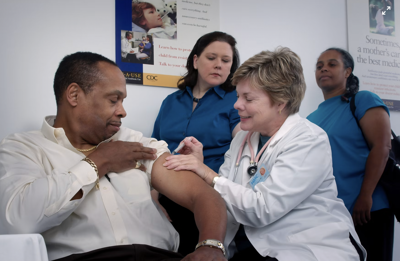



Medi-Cal program, which covers over 14 million residents in California. Photo by CDC.
The California Billionaire Tax Act has officially been certified for November’s election and will now have a ballot designation as Proposition 40.
In the general election, less than four months away, Californians will be able to vote on the proposition, which, if approved, would impose a one-time 5% tax on billionaires or people with a net worth of $1 billion or more.
As stated by the proposition, 90% of the collected revenue will be allocated to safeguard healthcare and the rest to food assistance and public education in the state.
Supporters argue the proposition comes at a time when the United States is undergoing a healthcare crisis centered on skyrocketing costs and declining medical access.
One example of this is the state’s Medi-Cal program, which covers over 14 million residents, the majority of whom are Latinos. Today, the program is facing a funding emergency driven by state budget cuts.
The proposition, which was initially drafted by SEIU-United Healthcare Workers West (SEIU-UHW), would tax the assets of the approximately 200 billionaires in annual installments of 1% over five years.
Billionaires do not have to own homes or real estate in California to be taxed.
The tax collection will be on things such as stocks, private businesses, investments, intellectual property, art and even collectibles. It explicitly excludes directly held real estate, as well as pensions.
“The people of California now have the opportunity to decide what kind of future they want,” said Debru Carthan, vice president of SEIU-UHW.
He said he expects the majority of Californians to vote in approval of the tax.
“Proposition 40 asks a simple question: at a time when hospitals are reducing services, working families are being squeezed and essential services are under attack, should a few hundred billionaires contribute their fair share to protect the state that helped make their extraordinary wealth possible?” he said. “We believe Californians will answer with a resounding yes.”
The qualification for the ballot was possible after supporters collected and submitted more than 1.6 million signatures. In California, 875,000 valid signatures are required to qualify a measure for the ballot. As Proposition 40 received nearly twice the number required to qualify, it is now considered to be one of the strongest and most anticipated items on the ballot.
One of the most significant oppositions comes from the state's top leader, Gavin Newsom, who, as previously reported by the Associated Press, has said the tax would drive billionaires out of California, the state with more billionaires in all of the U.S.
Newsom has also said he opposes Proposition 40 because of the allocation of the tax revenue.
He argues that the measure should not only allocate the collected revenue to healthcare, but also other critical funding areas like housing, public education and homelessness, among others.
But supporters of Proposition 40 say healthcare affordability and medical debts are often the leading causes of death and economic hardships among working-class families.
Michelle Martinelli, a resident physician at the University of California, San Francisco Medical Center, said the passing of Proposition 40 can save lives. She said she and her colleagues treat seniors and children at every stage of health and disease every day.
“What we are facing now is an onslaught of layoffs and service cuts across our healthcare system that will lead to needless patient deaths,” Martinelli said. “In order to stop this and keep California’s hospitals and emergency rooms open, we are taking action by backing the California Billionaire Tax.”
Earlier this year, the Los Angeles County Department of Public Health permanently ended clinical services at seven clinics due to more than $50 million in funding cuts.
The closures included the Curtis R. Tucker clinic in Inglewood, the Antelope Valley Public Health Clinic in Lancaster, the Center for Community Health in Downtown L.A., the Curtis R. Tucker Public Health Clinic in Inglewood and additional clinics in Pomona, Hollywood and Torrance.
At that time, Barbara Ferrer, director of the Los Angeles County Department of Public Health, said the serious funding challenges throughout the state were what had forced the department to close the clinics.
“Public health is facing serious funding challenges that are reducing our ability to continue all existing programs and forcing the closure of several public health clinics,” she said last February.
Over 200,000 Los Angeles County residents have lost full-scope Medi-Cal coverage as a result of federal funding cuts and state policy changes, as reported by the LA Times in June. Many of the people who have lost full-scope Medi-Cal coverage include immigrants.
The loss of full-scope Medi-Cal has left many with only emergency Medi-Cal, which only covers emergency visits, leaving many residents to use the ER as their primary care provider.
Just last month, emergency room visits increased in L.A. during the Lineage Fire. The Los Angeles County Department of Public Health data showed an increase in visits by people who lived within 10 miles of the cold storage warehouse fire. The data also showed that emergency room visits for throat pain were nearly twice as high on June 21, one of the days when the fire was still burning.
Despite the need for care and doctor visits, layoffs in healthcare have already impacted different locations throughout the state.
According to the California Employment Development Department data, more than 400 hospitals statewide have already laid off more than 3,400 health care workers as of March 2025. The department stated that the layoffs in 2025 often occurred at vulnerable hospitals caring for underserved populations, including rural hospitals, two children’s hospitals and hospitals serving a high proportion of patients with Medi-Cal.
As of today, the California Billionaire Tax Act has received endorsements from elected officials and community-based organizations, including Bernie Sanders, UNITE HERE Local 11, UNITE HERE Local 30, Disability Voices United, Our Revolution California, Oxfam America and Color of Change, among many others.
California voters will have the chance to vote in favor of or in opposition to Proposition 40. The general election will take place on Tuesday, November 3, 2026.







(0) comments
Welcome to the discussion.
Log In
Keep it Clean. Please avoid obscene, vulgar, lewd, racist or sexually-oriented language.
PLEASE TURN OFF YOUR CAPS LOCK.
Don't Threaten. Threats of harming another person will not be tolerated.
Be Truthful. Don't knowingly lie about anyone or anything.
Be Nice. No racism, sexism or any sort of -ism that is degrading to another person.
Be Proactive. Use the 'Report' link on each comment to let us know of abusive posts.
Share with Us. We'd love to hear eyewitness accounts, the history behind an article.