
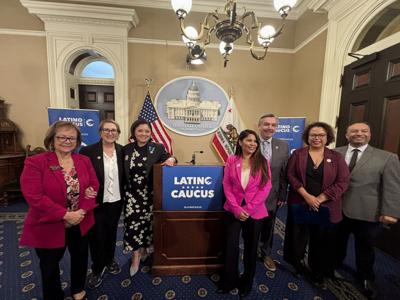


The Latino Legislative Caucus held a press conference April 14 to unveil its 2026 legislative package. (Andrea Valadez / CALÓ News)
The California Latino Legislative Caucus announced its 2026 legislative package, a series of 15 bills the group will prioritize through the rest of the legislative session and in the 2026-27 budget.
Created in 1973 with only five members, the then-Chicano Caucus was created to support the state's Latino communities through legislation. This year, the group has a record 38 members, with the majority being Latinas.
“Since the caucus was formed, California's demographics have shifted significantly. Our Latino population now nears 16 million residents, and it accounts for over 40% of the population in this golden state,” Sen. Lena Gonzalez (D-Long Beach), chair of the Caucus, said at a press conference this week. “And we are dreamers, business owners, educators, lawmakers, and we, too, strive for the American dream that gives every Latino an opportunity.”
Pointing to “adversarial” federal policies, Gonzalez said the 2026 legislative package has been structured to target key areas where Latinos face hardship. Data shows Latinos are the least likely demographic to have health insurance, they earn less, have the highest poverty rates and are less likely to own homes.
“This is all while we are some of the hardest working in our state, and this is all while we are making the state,” Gonzalez said.
The 15 priority bills are organized under a few key categories: protecting immigrant families, demanding accountability for the community, tackling the cost of living, meeting health care needs and standing with workers.
“It's tragic that at the national level, we are seeing deliberate efforts to crash our economy, divide and marginalize our communities, kidnap and tear apart our families,” Gonzalez said. “But these bills are meant to uplift and do the opposite, to protect and uplift our Latino communities every step of the way.
Protecting immigrant families
SB 873, authored by Sen. Eloise Gómez Reyes (D-San Bernardino), prohibits civil arrests at courthouses. The bill aims to curb an uptick of immigration enforcement operations that have been happening while individuals are attending routine immigration hearings at courthouses.
“Discouraging people from coming to court makes our community less safe,” Reyes said.
SB 942 would require all privately operated detention facilities in California to have a state license that is conditional based on “applicable standards of care.” Introduced by Sen. Anna Caballero (D-Merced), the bill would create civil penalties for non-compliance as well as protect whistleblowers who report violations.
Other bills under this category include requiring law enforcement to allow medical assistance on an active scene, protecting the privacy of immigrant service providers and restricting flashbang devices.
Accountability
AB 1896, the Get The Feds Out Act, introduced by Assemblymember Mark Gonzalez (D-Los Angeles), would disqualify any individual who has worked with a federal immigration enforcement agency from Jan. 2025 to Jan. 2029 from being employed at a state, county or local agency or as a peace officer.
“This bill is simple in its truth, and strong in its purpose,” Gonzalez said. “If you choose to participate in immigration enforcement in terrorized communities, if you violated civil rights, if you ignored due process, if you followed unlawful orders instead of your conscience, then you will not be awarded with a public paycheck in the state of California. Not here, not in our name.”
AB 2721 was introduced by Assemblymember Juan Carrillo (D-Palmdale) and would require hotels to publicly disclose contracts and reservations they have with federal agencies, including with Immigration and Customs Enforcement (ICE) agents. The bill serves to keep guests and especially hotel workers safe, Carrillo said.
“Not disclosing the presence on site of federal agencies is just unacceptable,” the assemblymember said. “They have made memes, videos, they have frankly disparaged and directed violence towards people doing essential work in this state.”
The accountability bills also include requiring non-profit health care plans in the state to disclose all investments, including those into detention centers, as well as a bill that would require the attorney general to submit a report of all immigration activities that occur in the state.
Cost of living
Introduced by Assemblymember Celeste Rodriguez (D-Arleta), AB 1049 would eliminate certain requirements from the California Food Assistance Program in an effort to ensure eligibility is based solely on an individual’s current financial situation.
Health care
SB 1422, introduced by Sen. María Elena Durazo (D-Los Angeles), would restore full MediCal access for eligible undocumented residents beginning Jan. 1, 2027. To deal with a state deficit, the Legislature last year cut access to MediCal for the state’s undocumented immigrants.
“We cut health care from the very people who literally put food on our tables, build our homes, power our economy and contribute billions in taxes every year,” Durazo said. “This is not a budget cut. It's a moral failure.”
Other health care priority bills include a bill to establish a nursing degree pilot program in the state’s community colleges, and a bill to extend the current Mexico Physicians Program to doctors from El Salvador.
Standing with our workers
AB 2379, introduced by Assemblymember José Luis Solache (D-Lakewood), would provide civil rights training to all licensed and license-exempt family childcare providers.
Rodriguez’ AB 2635 aims to support landscapers as they transition to using electric equipment by expanding rebate programs. The Legislature passed AB 1346 in 2024, which requires a transition to zero-emission landscaping tools including leaf blowers, lawn mowers and trimmers.






(0) comments
Welcome to the discussion.
Log In
Keep it Clean. Please avoid obscene, vulgar, lewd, racist or sexually-oriented language.
PLEASE TURN OFF YOUR CAPS LOCK.
Don't Threaten. Threats of harming another person will not be tolerated.
Be Truthful. Don't knowingly lie about anyone or anything.
Be Nice. No racism, sexism or any sort of -ism that is degrading to another person.
Be Proactive. Use the 'Report' link on each comment to let us know of abusive posts.
Share with Us. We'd love to hear eyewitness accounts, the history behind an article.