
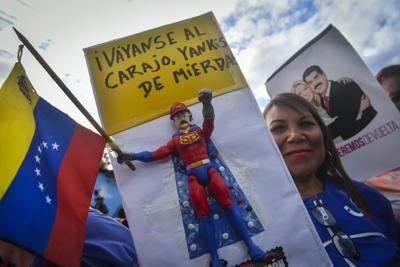

A woman holds up a banner which translates as “Go to hell, damn Yankees” and a doll depicting former Venezuelan President Nicolás Maduro, during a demonstration in support of him on Jan. 10, 2026 in Caracas, Venezuela. Credit: Carlos Becerra/Getty Images
In justifying the U.S. attack on Venezuela and the abduction of its president, the Trump administration took a slightly newer approach to age-old imperialism. Unlike other U.S. aggressions in Latin America and the world, the U.S. did not attempt to explain its motives as “bringing democracy to Venezuela” or “protecting Venezuela’s population.” Instead, President Donald Trump publicly prioritized access to Venezuela’s oil reserves, calling the country’s decades-old move to nationalize oil assets “the largest thefts of American property in the history of our country.” The government also posited that Venezuelan President Nicolás Maduro is a “narco-terrorist” who must be detained and brought before the American justice system.
Andy Thayer, co-founder of the Chicago Committee Against War and Racism, told Prism that the Trump administration’s offensive against Venezuela cannot be seen as an isolated episode, but as part of a long bipartisan tradition of U.S. interventionism. He argued that American democracy has been eroded by decades of unilateral attacks on sovereign nations, with both Republicans and Democrats complicit in coups, invasions, and sanctions.
“What little democracy we have in this country has been under attack by both sides,” Thayer said. The assault on Venezuela, he added, was “a more naked power grab for Venezuela’s resources,” but it also awakened many people to the true nature of U.S. imperialism.
Legal experts argue that Trump’s Venezuela operation violates congress’ war powers under Article I of the U.S. Constitution, which grant congress the sole authority to declare war. The president pursued an intervention and regime change operation in a foreign country without legislative authorization for the use of force, in contrast to Afghanistan and Iraq, where the authorization was formally approved. Consequently, any real limits on U.S. deployment, if they are to appear, would have to come from Congress, experts say.
“U.S. violations of other nations’ sovereignty are not only profoundly dangerous and unjust for people abroad, but they also fail to benefit citizens within the United States. On the contrary, such actions contribute to the erosion of democratic norms and rights at home,” said Khury Petersen-Smith, co-director of the New Internationalism Project at the Institute for Policy Studies.
The State Department asserted, “This is OUR hemisphere,” in a post on X, signaling ambitions beyond just Venezuela.
Washington’s approach to Venezuela illustrates the same logic, Petersen-Smith said. He said that U.S. sanctions against Venezuela—first imposed in 2005, with comprehensive measures expanded in 2015 and 2017 under the Obama and first Trump administrations—were the first stage of a broader campaign, followed by rhetorical and legal accusations portraying Venezuelans as criminals. Petersen-Smith noted that this discourse—illustrated by the focus on gangs such as Tren de Aragua—has coincided with intensified crackdowns on Venezuelan communities in the U.S., and reflects a wider demonization of Latin American immigrants, and Venezuelans in particular. The third stage was the invasion.
The U.S. media has also shaped the trajectory of this situation for decades, repeating the same storyline and influencing how people see Venezuela. “It’s been 26 years of a narrative that says there’s no democracy in Venezuela, that it has been taken over by criminal organizations,” said Leonardo Flores, a Venezuelan‑born analyst and activist who serves as the Latin America spokesperson and coalition organizer for the U.S. anti-war organization CODEPINK. “And that does not actually reflect the reality on the ground in Venezuela.”
In November, the State Department said that it intended to designate the so-called Cartel de los Soles as a terrorist organization, and asserted that Maduro was its leader. However, the existence of this group has never been proven. This month, The New York Times reported that the U.S. Department of Justice has withdrawn its earlier claim that it was a real criminal organization, redefining it instead as a loose network of corruption within Venezuela’s armed forces.
This week, Trump posted on his social network Truth Social a manipulated image in which he proclaimed himself “acting president of Venezuela.”
Thayer emphasized that resisting U.S. intervention requires not only a strong civilian anti-war movement, but also support for organizing within the military itself. “It was the efforts of the Vietnamese themselves and also of the anti-war movement within the U.S. military that forced the United States out of Vietnam, and it was only possible because of a very strong civilian anti-war movement that supported those efforts inside the military,” he said.
For his part, Flores said that the role anti-war organizations play is political education, helping the public understand what is actually happening, where tax dollars are being spent, and the harm being done to people overseas in the name of the U.S. “Even now in U.S. Congress, there’s people understanding that U.S. sanctions are killing people unnecessarily. I think a lot of that is due to the work being done by peace organizations and by some NGOs as well, including academics,” he said.







(0) comments
Welcome to the discussion.
Log In
Keep it Clean. Please avoid obscene, vulgar, lewd, racist or sexually-oriented language.
PLEASE TURN OFF YOUR CAPS LOCK.
Don't Threaten. Threats of harming another person will not be tolerated.
Be Truthful. Don't knowingly lie about anyone or anything.
Be Nice. No racism, sexism or any sort of -ism that is degrading to another person.
Be Proactive. Use the 'Report' link on each comment to let us know of abusive posts.
Share with Us. We'd love to hear eyewitness accounts, the history behind an article.