
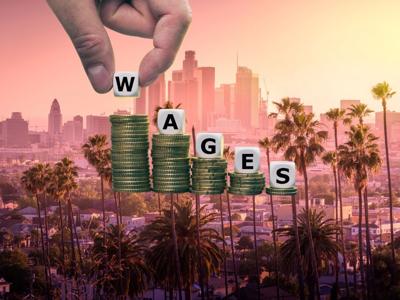


(Canva)
As Los Angeles prepares to host the 2026 FIFA World Cup, city leaders face a basic question with significant consequences: Can the city credibly present itself as a world-class city while its wage enforcement system remains underpowered and slow to respond to abuse in the many industries that will carry these events?
The answer will shape not only how Los Angeles is seen globally, but how effectively it protects the workers who make the city function. Wage theft is already a persistent problem in Los Angeles, particularly in hospitality, food service, construction, logistics and tourism, among many others. These are the same sectors expected to grow rapidly as the World Cup approaches. Wage theft refers to the illegal denial of wages that workers have legally earned, including unpaid overtime, minimum wage violations, off the clock work, withheld tips and failure to issue final pay. Without strong enforcement to prevent these violations, there will be an increase in the risk of exploitation, retaliation and unpaid labor. With effective enforcement, it creates an opportunity for the city to demonstrate that economic expansion and worker dignity are not mutually exclusive.
City Hall has acknowledged this risk. This past December, City Council committees advanced reforms to the Office of Wage Standards that strengthen investigations, prioritize low-wage worker claims, expand enforcement authority and formalize partnerships with community organizations. Those actions represent a clear policy judgment that the current system is not working as intended. What has not yet happened is full implementation.
Los Angeles enters 2026 under mounting pressure. The city is operating in a constrained budget environment. Public patience for process without results is thin. Voters are paying closer attention to whether the government delivers on its stated priorities. At the same time, the World Cup introduces a fixed deadline and a global spotlight that will magnify any visible failure.
This combination turns wage enforcement into more than a labor policy question; it becomes a test of governance. Large-scale global events are enforcement stress tests by nature. They accelerate hiring, rely heavily on subcontracting and concentrate risk in industries where workers are often immigrants and reluctant to report abuse. Weak enforcement in this context does not merely fail workers, It undermines the city’s credibility and creates downstream costs that far exceed the price of prevention.
Strong wage enforcement, by contrast, aligns with several of the city’s stated priorities. It functions as an affordability policy because stolen wages push families closer to eviction and homelessness. It operates as a public safety policy because income stability reduces crises and displacement. It serves as an immigrant protection policy because fear and weak enforcement suppress reporting and allow exploitation to persist. It is also an economic policy because responsible employers are undercut when enforcement fails. This is not an abstract argument. It reflects the reality already acknowledged by city leadership.
In two consecutive State of the City speeches, Mayor Karen Bass emphasized the need to fix broken systems, move with urgency, cut through bureaucracy and protect working people and immigrants when other levels of government fall short. Those commitments resonated precisely because they described lived experience in Los Angeles.
Wage enforcement is one of the most direct ways to translate those commitments into measurable outcomes. Importantly, strengthening enforcement does not require the city to chart a new course. The reforms have already been advanced. The policy framework exists. What remains is ensuring that the Office of Wage Standards has the capacity to carry out the work it has been directed to do.
That means staffing, investigative authority, and strategic enforcement. It means recognizing that enforcement is core infrastructure, not a discretionary add-on. It also means acknowledging that prevention is fiscally responsible. Recovering stolen wages, deterring bad actors and preventing housing instability costs less than responding to a crisis after the fact.
The World Cup does not create new problems. It amplifies existing ones. If Los Angeles enters 2026 with a broken wage enforcement system, the consequences will be visible, avoidable and damaging. If it enters with a functioning one, the city can demonstrate that global events do not have to rely on exploitation and that local government can deliver when it matters most.
The choice before the city is not whether it supports workers in principle. It is whether it will complete the work it has already begun. That means moving the December committee recommendations to full council adoption, codifying the enforcement reforms, protecting investigative staffing during the budget process and treating wage enforcement as essential infrastructure rather than a discretionary expense. At a moment of heightened scrutiny and global attention, finishing that work is not optional. It is a test of whether Los Angeles can govern effectively under pressure.








(0) comments
Welcome to the discussion.
Log In
Keep it Clean. Please avoid obscene, vulgar, lewd, racist or sexually-oriented language.
PLEASE TURN OFF YOUR CAPS LOCK.
Don't Threaten. Threats of harming another person will not be tolerated.
Be Truthful. Don't knowingly lie about anyone or anything.
Be Nice. No racism, sexism or any sort of -ism that is degrading to another person.
Be Proactive. Use the 'Report' link on each comment to let us know of abusive posts.
Share with Us. We'd love to hear eyewitness accounts, the history behind an article.