
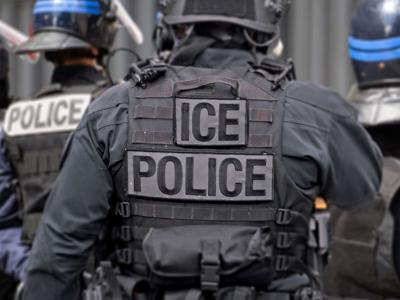


(Douglas Rissing/Getty Images)
Newly disclosed text messages and body-camera footage from federal immigration operations in Los Angeles contain slurs aimed at Latino immigrants. That alone deserves condemnation. But the more consequential question is not what agents said when they thought the public was not listening. It is whether their language reveals how they decided whom to stop.
In a July 27 motion for a preliminary injunction, Latino workers, U.S. citizens and immigrant-rights organizations asked a federal judge to prohibit immigration agents from conducting detentive stops without individualized suspicion. The plaintiffs argue that internal communications, sworn testimony and video show ICE and Border Patrol agents treating perceived Latino ethnicity, working-class occupations and locations such as Home Depot parking lots, car washes and bus stops as evidence that someone may be undocumented.
As the Los Angeles Times reported, the records described in the filing include agents using anti-Latino slurs and discussing “snatch & grabs.” The filing also quotes language suggesting an indiscriminate operating method: “See bodies, chase bodies.” Before officers detained a lawful permanent resident, one agent was recorded saying they should “get out and start grabbing people,” according to the plaintiffs.
These are allegations in ongoing litigation, not final judicial findings. The Department of Homeland Security has defended its operations and, according to coverage of its response, dismissed criticism of the disclosed language as performative outrage.
But treating the messages solely as offensive workplace speech misses their legal significance.
The slurs may be evidence of an operational mindset.
When an officer assumes that a man sitting in a minivan is undocumented, the issue is not merely vulgar language. When agents discuss Latino food vendors as possible immigration targets, the concern is not limited to professionalism. Their words may help explain who appeared suspicious, who was chased and who was placed in handcuffs.
That is precisely what the Constitution is supposed to constrain.
More than 50 years ago, the Supreme Court held in United States v. Brignoni-Ponce that apparent Mexican ancestry alone cannot justify an immigration stop. The principle is both constitutional and practical: Millions of U.S. citizens and lawful residents share the physical characteristics, languages and occupations that an officer may associate with undocumented immigration.
Yet in September 2025, the Supreme Court temporarily lifted a lower-court restriction on Los Angeles immigration stops. Justice Brett Kavanaugh wrote separately that “apparent ethnicity alone cannot furnish reasonable suspicion,” while concluding that ethnicity could remain relevant when considered with factors such as location, occupation and language.
The newly disclosed records put that distinction to the test.
A constitutional analysis cannot become an exercise in stacking stereotypes. Latino appearance plus Spanish speech plus low-wage employment does not necessarily become individualized suspicion merely because several broad generalizations are combined. As Justice Sonia Sotomayor warned in dissent, such an approach risks making Latino citizens who work low-wage jobs subject to detention until they can prove their status.
The question is whether officers were evaluating particular facts about particular people—or using ethnicity as the assumption organizing the entire operation.
The agents’ communications also did not emerge in a political vacuum.
President Donald Trump has repeatedly described immigrants as “poisoning the blood” of the country and used words such as “animals” and “vermin.” Reuters has documented how this rhetoric portrays immigrants as contamination, infestation or an invading force, rather than as individual human beings entitled to constitutional protection.
A president does not have to order racial profiling expressly to make it more likely. Language from the nation’s highest office establishes norms. When immigrants are repeatedly described as a threatening mass rather than as people, contempt begins to feel official. Stereotypes can begin to resemble intelligence. Cruelty can be mistaken for resolve.
It would be irresponsible to claim that Trump’s rhetoric caused any particular stop described in the litigation. It is entirely reasonable, however, to ask whether dehumanizing language from the top created a permission structure in which agents felt licensed to speak—and perhaps act—in the terms now revealed.
That danger does not fall only on undocumented immigrants. When perceived Latino identity becomes an enforcement proxy, citizens and lawful residents inevitably become targets.
According to reporting on the court filing, one U.S. citizen said agents chased and handcuffed him during a car-wash operation while lighter-skinned co-workers who also ran were not pursued. The filing also describes citizens who now carry passports or passport cards because they fear being detained again.
American citizens should not have to carry proof of citizenship to work, shop or wait for a bus simply because they look Latino.
Immigration agents may pursue identified targets, act on credible intelligence and make arrests when the law permits. What they cannot do is convert a racial and economic profile into a dragnet.
The federal court should require agents to document the particularized facts supporting every non-target stop. “Latino,” “speaks Spanish,” “works construction” or “stands near a day-labor site” should never be enough—alone or assembled into a demographic checklist.
DHS should also preserve operational messages and body-camera recordings, disclose how often non-target stops involve citizens or lawful residents and assign racial-profiling complaints to reviewers outside the officers’ direct chain of command. Supervisors should be evaluated not merely on arrest totals, but on whether those arrests were lawful.
None of these safeguards prevents legitimate immigration enforcement. They distinguish law enforcement from demographic hunting.
Justice Kavanaugh was right about one essential principle: Ethnicity alone cannot furnish reasonable suspicion. The government’s own records now raise the question of whether ethnicity was, in practice, doing nearly all the work.
A badge does not convert an ethnic stereotype into reasonable suspicion. And presidential contempt must never become an officer’s license to decide that someone looks deportable.






(0) comments
Welcome to the discussion.
Log In
Keep it Clean. Please avoid obscene, vulgar, lewd, racist or sexually-oriented language.
PLEASE TURN OFF YOUR CAPS LOCK.
Don't Threaten. Threats of harming another person will not be tolerated.
Be Truthful. Don't knowingly lie about anyone or anything.
Be Nice. No racism, sexism or any sort of -ism that is degrading to another person.
Be Proactive. Use the 'Report' link on each comment to let us know of abusive posts.
Share with Us. We'd love to hear eyewitness accounts, the history behind an article.