
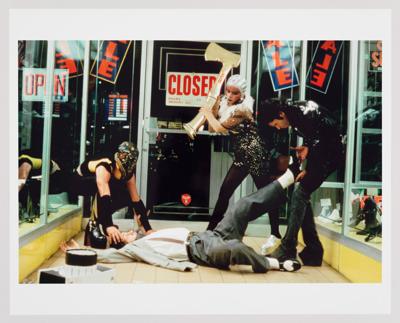

Gores (Whittier Bl + Axe), 1974, from the Asco era. (Harry Gamboa Jr.)
Correction: A previous version of this story misspelled the film "Señor Tereshkova."
I walked into the theater at the Philosophical Research Society with no idea what I was about to see. That is the correct way to arrive at an Asco event. It always has been. With Asco, anything can happen, and it usually does.
Humberto Sandoval, the sometimes fifth member of Asco, the Chicano art group that went off like a flare over East Los Angeles in the 1970s and '80s, began shooting “Señor Tereshkova” in 1974. He finished it in 2026. Fifty years. He told me that after a severe medical crisis he finally found the creative energy to complete it, which is its own kind of Asco joke: the thing that nearly ended him is the thing that let him finish.
Consider what Sandoval was doing the year he started rolling film. In 1974 Asco sat down to dinner on a traffic island in the middle of East Los Angeles, cars going both directions, and called it “First Supper After a Major Riot.” Sandoval was at that table. That same year the group arrived at Evergreen Cemetery inside a giant special-delivery envelope, postage due: Valdez as the Universe in gold sequins, Herrón as a Triplane, Gamboa as the Archangel Blackcloud, Gronk as the Documenteur with an oversized cardboard camera and Sandoval as the Asco Tank, gun turret operable, rolling in on knee-high leather platform boots. It was also the year they took the name Asco. Spanish for nausea, as in “me da asco,” it makes me sick. They used it for a show at Self Help Graphics that they billed as an exhibition of their worst work.
That is the year “Señor Tereshkova” comes from. Somewhere in the middle of all that, someone was running a camera.
Here is what lifts this film above curiosity. Asco's signature invention was the No Movie: movies made without celluloid, single frames from films that never existed, press kits and production stills mailed out for pictures no one would ever screen. Gronk described the premise to me years ago. The idea, he said, was to "reject the reel by projecting the real." The No Movie was Asco's answer to a Hollywood that would not open the gate — an entire cinema conjured out of exclusion, a body of work built from the refusal itself.
And all the while, in the same city, in the same years, Sandoval was shooting an actual movie. On actual film. It has taken half a century to arrive. “Señor Tereshkova” is the No Movie's shadow. The real reel. The thing itself, developed at last.
What he has made is a surreal short that would not embarrass Buñuel. It is silent and it is black and white, and it moves with the logic of “Un Chien Andalou” — one image displacing another by dream law, not story law. At moments Sandoval's timing is pure Keaton, the deadpan man in a world that has quietly stopped obeying physics.
I want to be precise about that lineage, because I am not importing it from outside. When I interviewed Harry Gamboa Jr. for the L.A. Weekly in 1986, he gave me his A-list of influences: Daffy Duck, Buster Keaton, Jean Cocteau, Luis Buñuel, Frida Kahlo. Buñuel and Keaton were in the room from the beginning. Sandoval is not quoting the avant-garde. He was raised inside it, in a garage in East L.A.
Tereshkova is a shopkeeper. Sandoval plays him. Willie Herrón is the mannequin in his window. The shopkeeper sleeps, and dreams, and in the dream the mannequin comes loose from the glass and Tereshkova is chasing him through Los Angeles, through the Third Street tunnel, through a city that has been emptied of everyone but the two of them. This is dream as nightmare. Gregor Samsa went to sleep a man and woke up an insect. Tereshkova goes to sleep a shopkeeper and wakes up as prey.
Sandoval's performance is the film's engine. He works his lips in his sleep like a man enjoying an invisible ice cream cone. His eyes carry wonderment and confusion in the same frame, which is harder than it looks. Herrón, an avant-garde Alain Delon, offers mystery and dread and almost nothing else, and that is exactly right. A mannequin should not act. He should be looked at, and he should be terrifying about it.
The name is not innocent either. Valentina Tereshkova went into orbit in 1963, the first woman in space, a Soviet hero manufactured for the century's biggest propaganda machine. Asco takes her, changes the gender, bolts on a Spanish honorific and installs her behind a counter in East Los Angeles. The first woman in orbit becomes a man who cannot get out of his own dream. That is the whole Asco method in one word: seize the icon, invert it, strand it in the barrio, film what happens.
The film ends at a dinner table. The members of Asco, as The Gores, are eating Tereshkova. Greenaway would arrive fifteen years later with the same appetite in “The Cook, the Thief, His Wife & Her Lover,” and he would have a budget, a cast and a crew. Sandoval had a table, a camera and his friends.
And there it is, the joke that needed fifty years to land. A group that named itself nausea ends its lost film with a meal. Asco eats Asco. Disgust and appetite turn out to be the same reflex running in opposite directions, which anyone who grew up between two cultures could have told you.
Which brings me to the argument I have been making for most of my working life, and which this film closes.
Asco has never been counted. Mike Davis wrote “City of Quartz” and walked us through every avant-garde wave this city ever threw — Ferus, the Black Arts Movement, the Los Angeles School, even the intellectuals of gangster rap — and Asco is not there. Not a line. Peter Plagens looked at Gronk and saw borrowed Warhol, secondhand Brecht and Sunset Strip self-regard. A LACMA curator once explained to Gamboa that Chicanos were in gangs, and that when they made things it was folk art, certainly not fine art. Asco spray-painted their names on the building and declared the whole museum their work. The gatekeepers had a rule, and the rule was simple: when a Chicano makes conceptual art it is folk art, and when Chris Burden makes it, it is fine art.
Now a silent black-and-white film shot in East Los Angeles in 1974-75 surfaces in 2026 and sits down next to “Un Chien Andalou” without apologizing. Not as an homage. Not as an influence received. As a member of the same family, arriving late to a dinner it was never invited to and eating anyway.
The last time I wrote about Gronk at length, he told me his work mirrors the brevity of life. His instant murals lasted five or ten minutes. "Things don't last that long," he said. "We don't last that long."
Sandoval took fifty years. Same group, opposite pole. The instant mural and the fifty-year film are the same gesture at different speeds — art made without permission, on no schedule but its own, by people who were never asked and never waited to be.
“Señor Tereshkova” waited half a century for an audience. It was worth the wait. Asco is not finished with us yet.






(0) comments
Welcome to the discussion.
Log In
Keep it Clean. Please avoid obscene, vulgar, lewd, racist or sexually-oriented language.
PLEASE TURN OFF YOUR CAPS LOCK.
Don't Threaten. Threats of harming another person will not be tolerated.
Be Truthful. Don't knowingly lie about anyone or anything.
Be Nice. No racism, sexism or any sort of -ism that is degrading to another person.
Be Proactive. Use the 'Report' link on each comment to let us know of abusive posts.
Share with Us. We'd love to hear eyewitness accounts, the history behind an article.