


On the anniversary of Donald Trump's second inauguration, Arizona residents marched near the Arizona State Capitol to demand an end to ICE raids across the country.
As the sun rose over Phoenix on Jan. 20, 2025, flags lined the streets, and television screens showed images from Washington, where Donald Trump was being sworn in for a second term as president.
Across the country, supporters celebrated. In Phoenix, Dania Duran woke with a sense of dread.
Duran said she felt consumed by fear and uncertainty, fueled by concern for undocumented family members and friends, many of whom also identify as LGBTQ+.

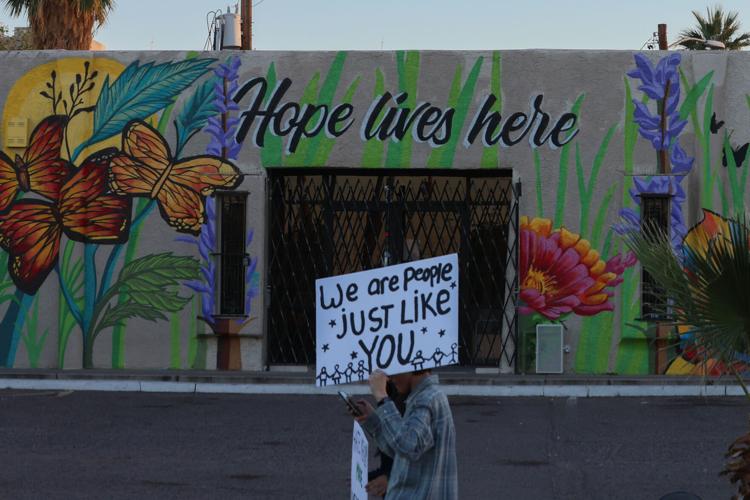
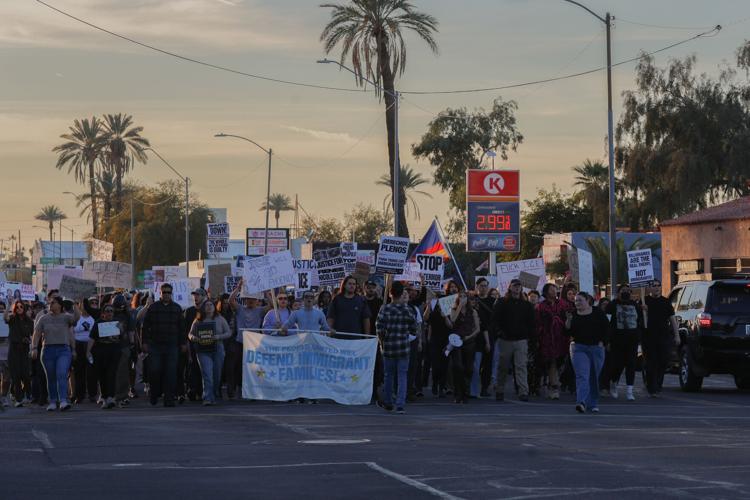
Phoenix residents march near the Arizona State Capitol on Tuesday, Jan. 20, 2026, on the anniversary of Donald Trump's second inauguration, demanding an end to the escalation of immigration enforcement nationwide. (Lorenzo Gomez/CALÓ News)
“It felt like it was the end of the world for everyone that I cared about and I loved,” she said.
One year later, she said her mindset had undergone a complete 180-degree turn — feelings of sadness transformed into hope.
Duran, who is an organizer with the Phoenix branch of the Party for Socialism and Liberation (PSL), spoke to CALÓ News after leading her community’s energy into the streets near downtown Phoenix in protest on the first anniversary of Trump’s second inauguration.

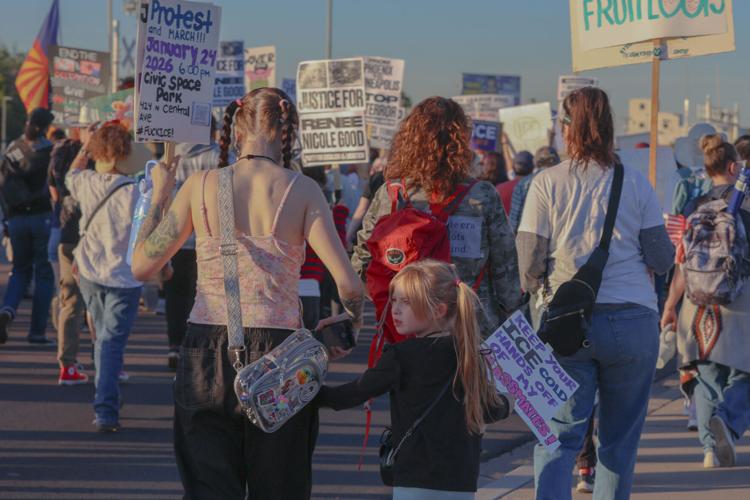
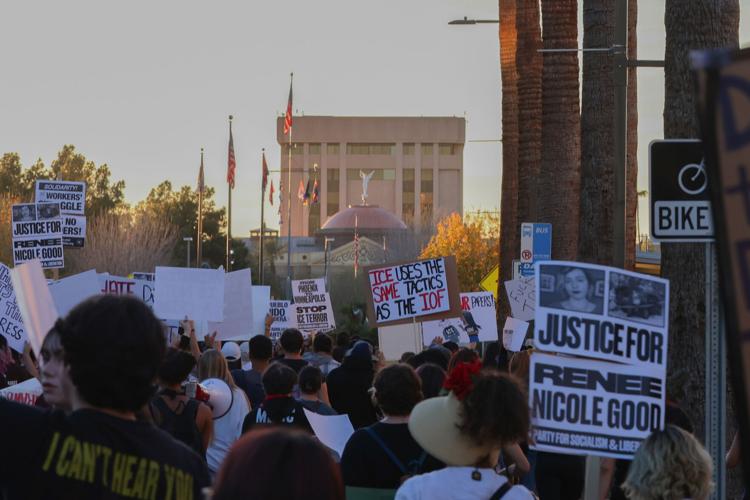
Phoenix residents march near the Arizona State Capitol on Tuesday, Jan. 20, 2026, on the anniversary of Donald Trump's second inauguration, demanding an end to the escalation of immigration enforcement nationwide. (Lorenzo Gomez/CALÓ News)
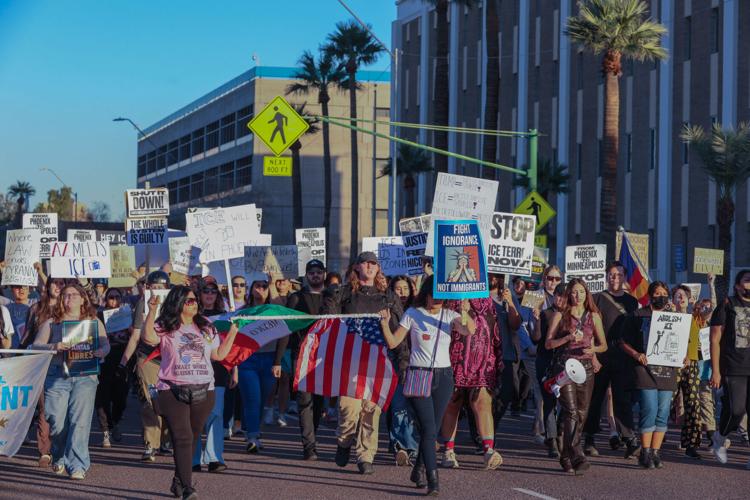
Hundreds of people of all ages marched near the Arizona State Capitol with signs reading “Abolish ICE” and “AZ melts ICE.” One child’s sign said, “Keep your ICE cold hands off of my classmates,” referencing concerns of federal agents detaining students outside of schools.
“While we still have three more years of intense obstacles and battles, what we saw today is just another example that we've been seeing in the past couple of months,” Duran said. “People are realizing that there is a lot of power here within everyday people.”
As demonstrators gathered in the streets, Trump and top White House officials spoke from Washington, detailing policies the administration said defined its first year.

Phoenix residents march near the Arizona State Capitol on Tuesday, Jan. 20, 2026, on the anniversary of Donald Trump's second inauguration, demanding an end to the escalation of immigration enforcement nationwide. (Lorenzo Gomez/CALÓ News)
He spent more than 100 minutes listing accomplishments — from touted economic gains and tariff successes to aggressive immigration actions. Fact-checkers from PolitiFact disputed several claims, highlighting a year of repeated exchanges between independent media and the administration.
One of Trump’s claims, “We have no inflation,” overlooked broader price increases even as some commodities fell. He touted $18 trillion in investment commitments, far exceeding the $9.6 trillion figure on the administration’s own website. Experts also warned that much of it may never come to fruition.
His speech also focused on large-scale immigration enforcement. Trump insisted the administration is focused on deporting criminals.
As of Jan. 8, operations resulted in the detention of nearly 69,000 people, according to internal ICE data organized by NBC News. Of those detained, about 74% have no criminal convictions, according to PolitiFact. There have also been documented instances of U.S. citizens being detained and held by Immigration and Customs Enforcement (ICE), including several registered Native American tribal members.
The administration has yet to publish detailed deportation data, leaving some claims unverifiable.

Phoenix residents march near the Arizona State Capitol on Tuesday, Jan. 20, 2026, on the anniversary of Donald Trump's second inauguration, demanding an end to the escalation of immigration enforcement nationwide. (Lorenzo Gomez/CALÓ News)
Large-scale operations such as Operation Metro Surge sent thousands of federal agents into Minneapolis and surrounding areas in what officials called the largest immigration enforcement effort ever. Those efforts resulted in the death of 37-year-old Nicole Renee Good, a woman who was shot and killed by ICE agents while attempting to drive away as community members protested immigration enforcement.
The shooting came amid a series of similar encounters. Since September, ICE has shot 11 people, NBC News reported, three of whom died. Officials from the Department of Homeland Security claimed all agents were acting in self-defense.
With three more years of a Trump presidency, debates over enforcement, economic performance and rhetoric are fueling mobilization and opposition.
One of those activists is Daisy Vega-Monarrez. She has been with the PSL for just over a year and was one of the organizers leading the protest. She said the protest shows that the community is ready to come back stronger.
“People are really tired and agitated,” she said, “and they’re ready to mobilize.”

Phoenix residents march near the Arizona State Capitol on Tuesday, Jan. 20, 2026, on the anniversary of Donald Trump's second inauguration, demanding an end to the escalation of immigration enforcement nationwide. (Lorenzo Gomez/CALÓ News)
Vega-Monarrez spoke about how she went from a quiet volunteer to a full-fledged community leader, fueled by her personal connection to the issue. Coming from an immigrant family, much of her life since SB 1070 — known as the “show me your papers law” — has been filled with underlying fear. She said she’s turned that into determination.
“My family can’t be on the streets because they are scared, so we have to continue to be out here in the streets fighting for them. That's why I'm here,” she said.
As the crowd thinned and the last chants echoed off the Capitol grounds, organizers took turns addressing demonstrators beneath a darkening sky. They delivered fiery speeches calling on members from both major parties to stand firmly against the Trump administration. They also called on community members to keep showing up and not be deterred by feelings of doom.
“If I were to stay at home behind closed doors, the worst reality possible would become true,” Duran said. “Being out here, being visible, is the only way to make sure that doesn’t happen.”
Lorenzo Gomez is a multimedia journalist based in Phoenix, Arizona. He reports on politics, borderlands, culture and minority communities. He obtained a Master of Mass Communication from the Walter Cronkite School of Journalism and Mass Communication. His work has been featured in the Associated Press, CALÓ News, LOOKOUT, Phoenix New Times and Cronkite News.







(0) comments
Welcome to the discussion.
Log In
Keep it Clean. Please avoid obscene, vulgar, lewd, racist or sexually-oriented language.
PLEASE TURN OFF YOUR CAPS LOCK.
Don't Threaten. Threats of harming another person will not be tolerated.
Be Truthful. Don't knowingly lie about anyone or anything.
Be Nice. No racism, sexism or any sort of -ism that is degrading to another person.
Be Proactive. Use the 'Report' link on each comment to let us know of abusive posts.
Share with Us. We'd love to hear eyewitness accounts, the history behind an article.