
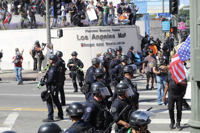
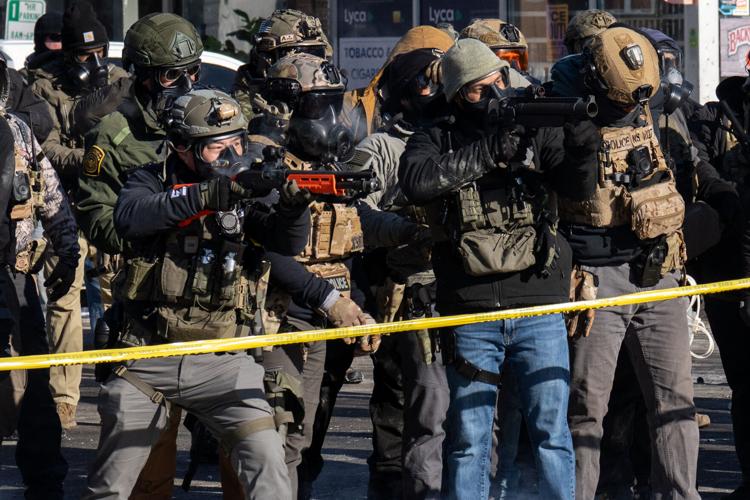


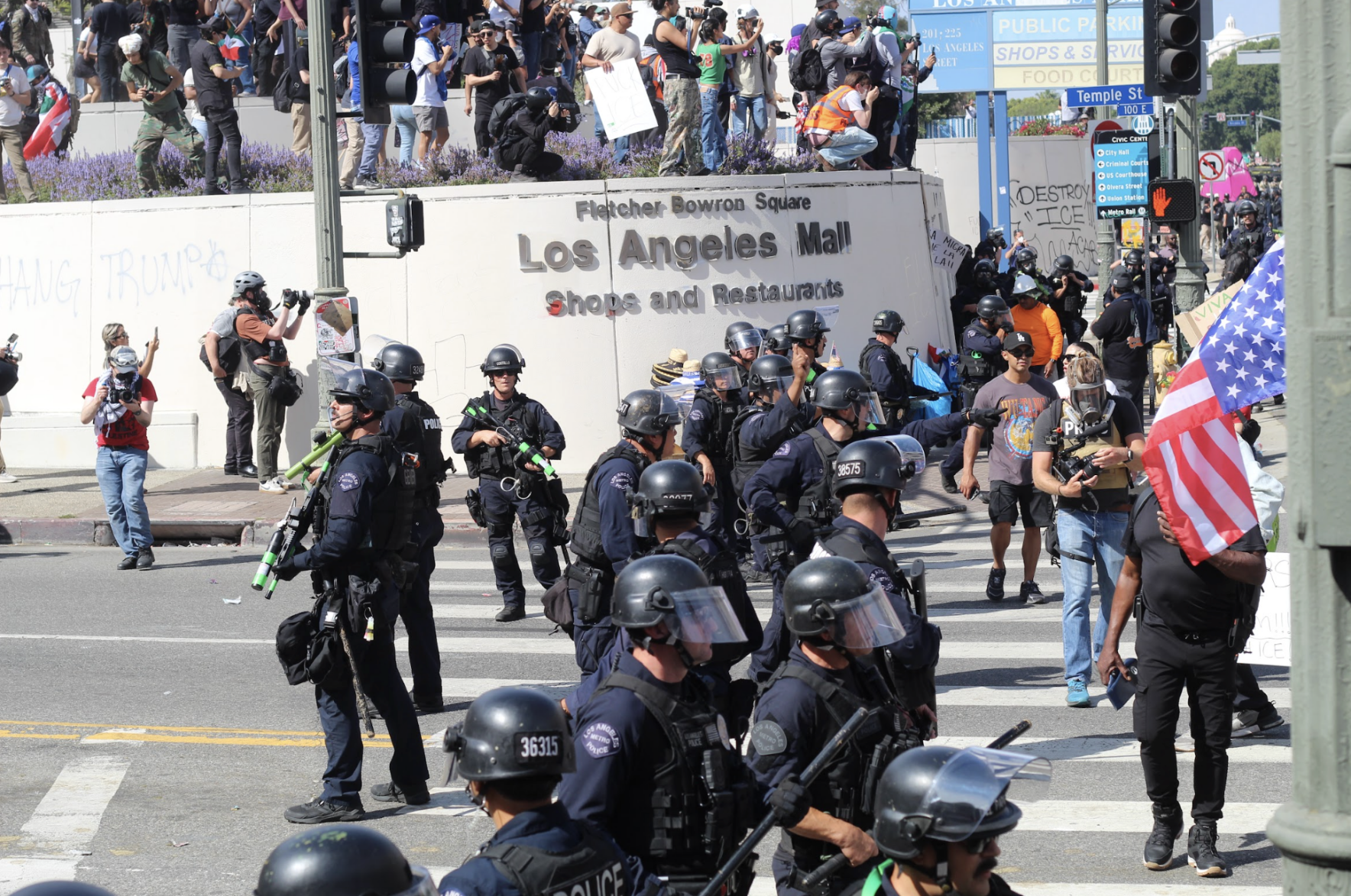
LAPD minutes before shooting "less-lethals" and tear gas into the crowd at 'No Kings' protest, June 14 2025. (Photo by Michelle Zacarias/CALÓ News)
U.S. founders felt a free press was so crucial to a successful democracy that they enshrined it in the First Amendment. Now, 250 years later, most journalists know intimidation and violence often come with the job.
This was especially true for reporters covering the immigration enforcement protests of 2025, a series of large demonstrations across the country where tens of thousands took to the streets in opposition to President Donald Trump’s mass deportation agenda — and journalists, as expected, were on the front lines documenting it all.
Many of these protests turned violent after local, state and federal law enforcement deployed crowd-control weapons hundreds if not thousands of times. Charting the Crackdown, a joint report by the UC Berkeley Human Rights Center and Physicians for Human Rights, found 412 nationwide incidents of misuse of these crowd-control weapons.
Journalists made up 43% of the individuals targeted and injured by law enforcement in those incidents.
Los Angeles County stands out in the report as the region with not only the most incidents of misused weapons, but as the only area in which local and state law enforcement actually drove that misuse.
L.A. was even home to the first documented misuse incident in the report’s dataset and it involved a journalist. On June 6, 2025, a journalist was hit by shrapnel from a flashbang grenade thrown into the crowd while covering a protest in downtown L.A.
This incident was only the first in a long list of injuries sustained by journalists. The Freedom of the Press Foundation (FPF) U.S. Press Freedom Tracker has documented 151 incidents of journalists being either detained or assaulted by law enforcement in Los Angeles over the past year.
Violence against journalists has emerged as a pattern over the past five years, amplified during immigration enforcement protests throughout the second Trump administration, press freedom experts say.
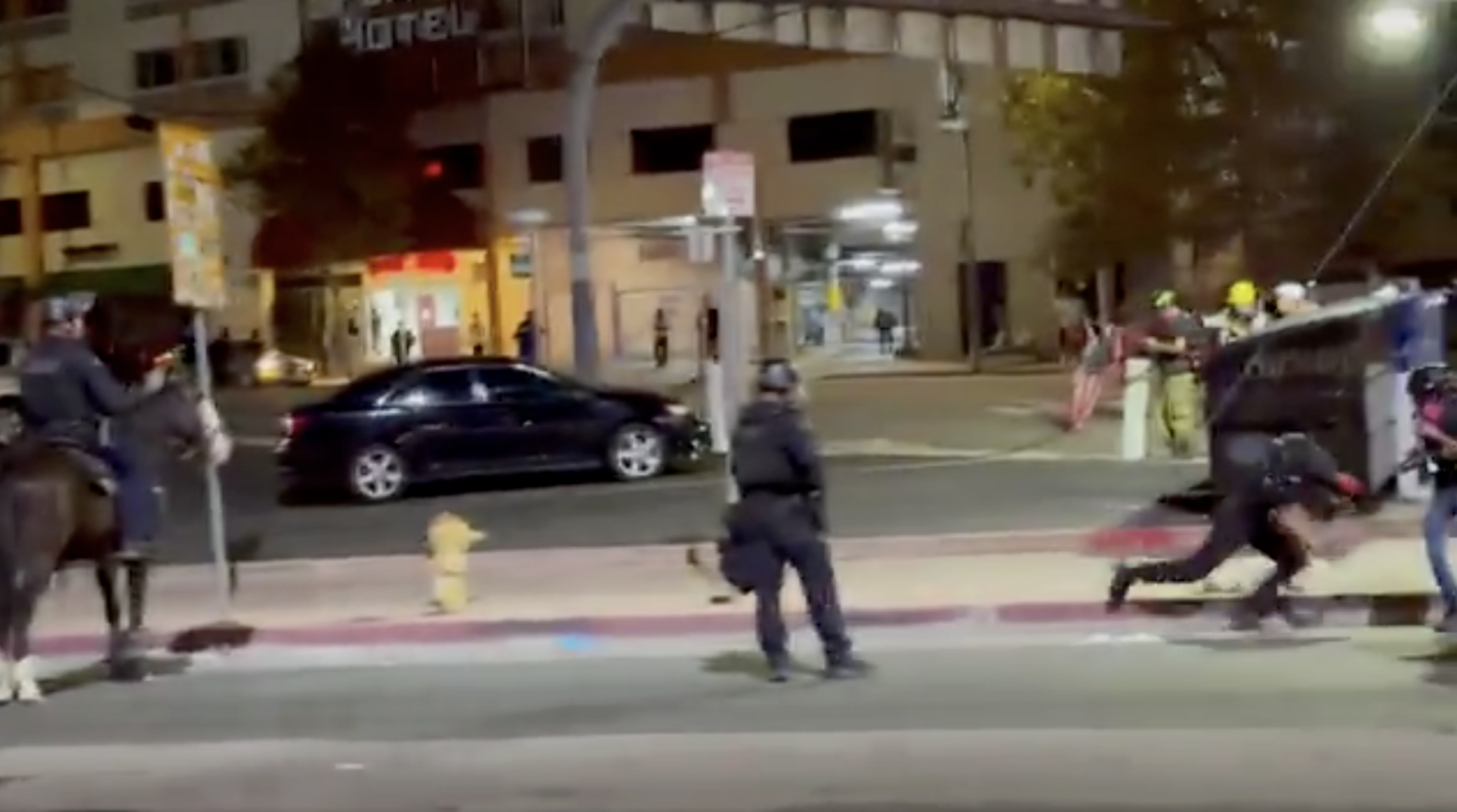
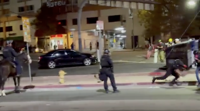
Screen grab of video captured by @filmthepolicela showing reporter Lexis-Oliver Ray being shot by a 'less lethal' while reporting.
Despite existing guidelines, advocates say there are still gaps that need to be addressed through stricter training and stronger accountability mechanisms.
Standing protections
Following pressure from press freedom groups over First Amendment rights violations during the 2020 Black Lives Matter protests, the state Legislature amended the California penal code in 2021, strengthening protections for journalists covering protests. The penal code originally only applied to journalists covering disasters.
SB 98 made it so reporters could access areas past police lines to conduct their reporting. Under the law, journalists were also made exempt from dispersal orders — reporters cannot be cited, detained or arrested for staying behind after police order demonstrators to leave.
Law enforcement is also prohibited from intentionally injuring or obstructing a journalist doing their job.
California law also restricts the use of kinetic impact projectiles (KIPs) for crowd control, but Charting the Crackdown highlights California’s local and state law enforcement’s preference for these weapons. Though they are known as less-lethals, KIPs can cause serious harm and were deployed in every serious injury reported in the dataset.
Despite the protections in place, numerous journalists in California and across the country who covered the immigration enforcement protests over the past year and a half were harassed, targeted and injured at the hands of law enforcement, according to Adam Rose, deputy director of advocacy at the Freedom of the Press Foundation (FPF).
“At least two young photographers lost their eyes, one eye each, during coverage,” Rose said. “We've had people with traumatic brain injuries. We've had people with concussions … We've had people who couldn't go home because they're covered in pepper spray and tear gas powder and couldn't expose their children or their kids or their pets to this.”

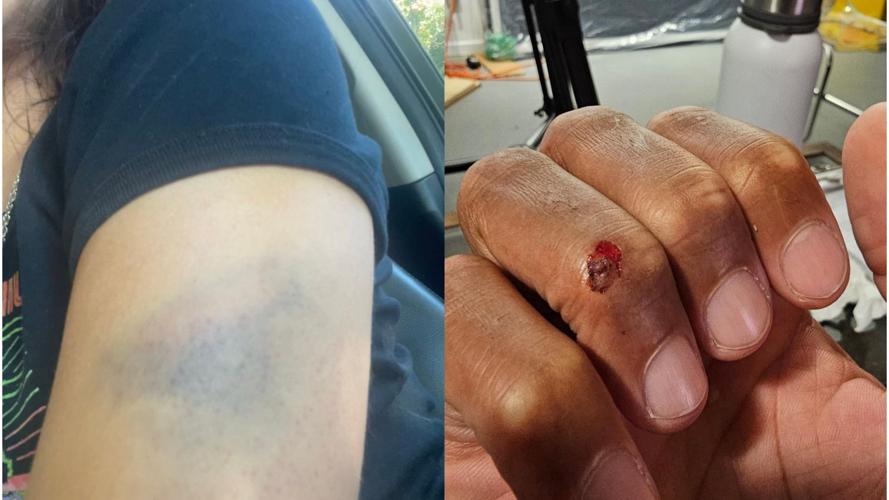
Ryanne Mena (left) shows her bruised arm in the days following the No Kings protest. Lexis-Olivier Ray (right) shared photo of injuries sustained while reporting. (Image credit: Ryanne Mena, Lexis-Olivier Ray).
Behavior starts at the top
The report brings into question how the Department of Homeland Security (DHS) leadership has been encouraging its officers to interact with protestors and journalists alike. Notably, incidents in each city rose dramatically when then-Commander-at-large of Border Patrol Greg Bovino was on site, according to Charting the Crackdown.
In L.A., 46 misuse-of-force incidents occurred on the day Bovino arrived in the city and 68 incidents occurred in the following week. In the seven days prior to Bovino’s presence, only nine incidents were recorded.
“What we clearly saw was a pattern of escalation of violence when he was present,” UC Berkeley Investigations Lab Director Alexa Koenig said of Bovino. “I think what we have seen consistently is a sowing of fear across populations that's designed to discourage people's effectuating their First Amendment rights to freedom of speech.”
Bovino was later demoted back to his post at the El Centro Border Patrol Office in California after the killings of Renee Good and Alex Pretti in Minneapolis. He announced his retirement in March 2026.

ICE and Border Patrol agents on Nicollet Avenue on January 24, 2026. This follows the shooting death of Minneapolis resident Alex Pretti. Pretti is the second person killed and third person shot by federal agents in Minneapolis this month. (Chad Davis / Wikimedia Commons)
The LA Press Club filed a separate but similar lawsuit against DHS for its force against journalists, in which Vera also sided with the journalists and that a federal appeals panel upheld in April 2026.
DHS acknowledged the dangers to journalists in a statement saying “being near unlawful activities in the field does come with risks — though our officers take every reasonable precaution to mitigate dangers to those exercising their protected First Amendment rights.”
The broader context, however, paints a picture of ongoing attempts to disrupt journalists in the course of their work, starting at the White House.
“It's hard to speculate about what any one person or one government's motivation is, but what can be drawn from it is that there's at a minimum sort of an opposition by governments at every level to transparency, to allowing the press to document what's going on and to monitor the activity of public officials, which is something that is important to the functioning of democracy overall and keeping the public informed about what the officials they elect are doing,” said Renee Griffin, staff attorney at the Reporters Committee for Freedom of the Press (RCFP).
When the Associated Press refused to refer to the Gulf of Mexico as the Gulf of America, like the president wanted, they were barred from the White House Press Corps. The AP is still fighting to be reinstated in the press corps.
Most recently, the Department of Justice subpoenaed New York Times journalists for grand jury testimony and phone records over a story on Trump’s new Air Force One jet. After a judge raised First Amendment concerns, the DOJ pulled back.
“Whether that's a trickle-down effect, whether it's starting at the highest levels of federal government, and spreading to even local police departments or other government entities … it's certainly something that appears at every level of government and is problematic whenever it does appear,” Griffin said.
L.A. journalists push back
On June 16, 2025, the Los Angeles Press Club (LAPC), a nonprofit organization supporting Southern California journalists, filed a lawsuit against the L.A. Police Department (LAPD) following multiple documented instances of force against reporters covering immigration protests.
The lawsuit details an alleged pattern of “using force to obstruct freedom of the press,” dating back to 2000.
The suit details nine documented instances of journalists being injured, at times specifically targeted, by LAPD despite protections in place by state law.
A viral social media video showed an Australian reporter being shot in the leg by an LAPD officer with a less-lethal round while she was on-air. A reporter for Capital & Main, who was wearing a “press” sign on his helmet and had a visible press pass, was shot in the abdomen with a less-lethal projectile. A photojournalist, also wearing a press helmet, was hit in the head with a less-lethal weapon, a practice that is universally condemned by international human rights law.
Dozens of reporters from various outlets were even held by police in a separate “press area” on June 8, around 150 feet away from the protest they were covering, according to District Judge Hernán Vera.
“You look at the narrow window of the first few weeks of last summer and you combine the totals of LAPD and L.A. Sheriff's Department and it was over 10,000 rounds (shot),” Rose, who is also the press rights chair for LAPC and lead organizer of the lawsuits, said. “It's inexcusable. It is wholesale violence against overwhelmingly innocent, peaceful civilians. So the need for (the lawsuit) was very much driven by the grotesque violence by our local law enforcement.”
The LAPD told CALÓ News in a statement that it “remains committed to protecting individuals’ First Amendment rights while maintaining public safety,” adding that officers receive training in crowd management, deescalation and use of force.
“I think it's not only false, but shameful and they know better,” Rose said of LAPD’s statement.
Though LAPD requires more hours than the state minimum and some officers opt for additional training, the past year shows that “by and large, they're sending out people who are wholly unprepared for these situations,” Rose said.
On July 10, Vera ruled the LA Press Club had sufficiently proved through 35 documented instances that their First Amendment rights had been violated and would likely be violated again, and granted a temporary restraining order prohibiting LAPD from harming journalists with less-lethal weapons and interfering with their reporting.
Less than a month later, LAPD officers shoved journalists to the ground, assaulted them with batons and detained them, according to a subsequent filing from the FPF.
“It is not a new phenomenon that journalists are either targeted or at least swept up in law enforcement's responses to protests, and it's something that's really concerning because, of course, journalists are there not to protest or cause any public disturbance, but to document what's going on and in doing so they pose no risk to public safety or to the safety of law enforcement,” Griffin said.
What does the public lose?
When journalists are injured, intimidated or blocked from doing their jobs, the harm is more than just to the individual — the public is set to lose out, too.
“They can't continue to record what's going on and document it to make it known to people who aren't on the ground … (it) harms all of us because it makes it harder for the public to stay informed about what's going on, what their public officials are doing and what protesters are doing as well,” Griffin said.
Attacks on journalists have continued to rise since 2020, according to FPF’s Press Freedom Tracker. In the first eight months of 2026 alone, there have already been 157 instances of assaults on journalists and 42 arrests or criminal charges filed.
Journalists are consistently facing increased threats from those they are tasked with holding accountable, experts say.
From Koenig and the Charting the Crackdown researchers to the RCFP and FPF, the main call to action is the same: local, state and federal law enforcement must do more work to adequately train their officers to properly use dangerous crowd control weapons and take care to not injure or impede on journalists’ ability to do their job.
Beyond that, there must be strict, enforceable mechanisms in place to hold officers who fail to follow their training accountable.
Top-down, there must also be an understanding that impeding journalists’ reporting will water down democracy, Rose said.
“You do not have an informed public without a free press,” Rose said. “And so the intention of limiting and curtailing press freedom is to allow the manipulation that can happen on all sorts of levels, whether this is jobs reports, or immigration enforcement, or natural disasters, or healthcare. The impingement on this allows for false narratives to take hold.
“Only with the spotlight of the press do we have an opportunity to have a functioning democracy,” Rose added. “So that is why it's in the First Amendment, right? That is why it takes such a prime position.”





(0) comments
Welcome to the discussion.
Log In
Keep it Clean. Please avoid obscene, vulgar, lewd, racist or sexually-oriented language.
PLEASE TURN OFF YOUR CAPS LOCK.
Don't Threaten. Threats of harming another person will not be tolerated.
Be Truthful. Don't knowingly lie about anyone or anything.
Be Nice. No racism, sexism or any sort of -ism that is degrading to another person.
Be Proactive. Use the 'Report' link on each comment to let us know of abusive posts.
Share with Us. We'd love to hear eyewitness accounts, the history behind an article.