


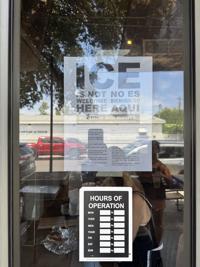
A sign posted outside of Huarachis restaurant in downtown Phoenix. (Joanna Jacobo Rivera/CALÓ News)
As the Trump administration continues its aggressive immigration enforcement tactics, communities across the country have seen an increase in workplace immigration raids.
An American Immigration Council report says “worksite raids have proliferated” during President Donald Trump’s second term “to increase detention and deportation.”
“In the first seven months of the second Trump administration, Immigration and Customs Enforcement (ICE) has publicly reported at least 40 worksite enforcement actions resulting in over 1,100 arrests,” the report says. “Local news and other media have identified dozens of additional worksite raids resulting in more arrests.”
Last month, Homeland Security Investigations (HSI), ICE’s investigative division, raided more than a dozen Zipp’s Sports Grill locations around Phoenix and arrested 39 people. In December, a series of raids at Taco Giro locations in the Tucson area resulted in dozens of employees being detained. Both raids brought out observers and protesters to confront agents.
Faced with the uncertainty of experiencing a similar situation, how can business owners, managers and employees be better prepared in case ICE shows up at their door?
Community organizers are stepping up to help, offering clarity to how the federal government operates in those instances.
Jovana Renteria, a volunteer with the Coalicion de Derechos Humanos, manages a team of volunteers in Tucson that train owners, managers and employees on their rights and help them come up with a safety plan in the event of an ICE raid or an I-9 audit.
“We need to make sure that we protect our workers, protect ourselves. A lot of our moms, our dads, our tios, our tias are out there,” Renteria said. “And just making sure that they're protected, making sure they come home at the end of the night is my goal.”
Know the difference between an I-9 audit and an ICE raid
An I-9 Audit is when ICE or HSI agents show up at a business to check if they followed the rules when accepting I-9 forms, a document required for all hired employees that verifies their identity and authorization to work in the U.S. A business owner must keep an I-9 form on file for three years after an employee has left the job.
For I-9 audits, ICE serves the business a Notice of Inspection at least three days ahead of time, according to Renteria. ICE can ask for several documents, including “I-9 forms and supporting documents, payroll lists, tax forms, articles of incorporation and electronic I-9 documentation,” Renteria told CALÓ News. Noncompliance of an I-9 audit can lead to expensive fines of tens of thousands of dollars, she said.
If the Notice of Inspection doesn’t include an administrative subpoena specifying which documents ICE is requiring, a business owner can respond to ICE saying they will only release documents once ICE provides a subpoena, Renteria explains in her training documents. Doing this could buy the employer more time to gather documents, Renteria said.

A sign inside Dark Hall Coffee in Phoenix. (Joanna Jacobo Rivera/CALÓ News)
Renteria suggests that an employer work with legal counsel on an internal I-9 audit to make sure they don’t miss anything. An internal audit is when an employer reviews I-9 forms for each employee or for a random sample of employees to make sure the information on them is up to date.
The Department of Homeland Security recently updated the Form I-9, according to Legal Aid At Work, a California legal aid organization. Employers should make sure they have an up to date I-9 form for each of their current employees.
An immigration or ICE raid is a lot more sudden.
During a raid, ICE agents go to a workplace without warning as part of an investigation, according to the National Immigration Law Center. ICE agents can also show up at a business with the intent to detain a specific employee. There’s a lot a business owner can do to protect its employees from an ICE raid.
How can employers prepare for ICE raids?
There are several steps a business owner can take to prepare for this possible scenario.
Create a pre-raid safety plan. Find an example of one here created by the American Subcontractors Association. This includes assembling an “emergency response team”, Renteria said:
someone to record ICE agent actions,
someone to be the only person who talks to agents
and someone else who asks for a judicial warrant and reads it carefully to make sure agents are only entering the areas they are allowed to.
Identify a safe space where people can “seek refuge during an ICE raid.”
Direct employees not on the “emergency response team” to not talk to ICE agents, the National Immigration Law Center advises, or to say “I can’t give you permission to enter. You must speak with my employer.”
Have the number of a lawyer at the ready — memorized by the owner and by the employees — if a raid happens, Renteria said. The American Civil Liberties Union (ACLU) of Arizona recommends identifying an immigration and criminal defense attorney.
What should employers do during and after an ICE raid?
Understand which spaces in the business are considered private versus public, Renteria said. Agents can enter a restaurant’s lobby, but without a warrant, they can’t go behind the counter, into the kitchen or into any other area where the general public isn’t allowed.
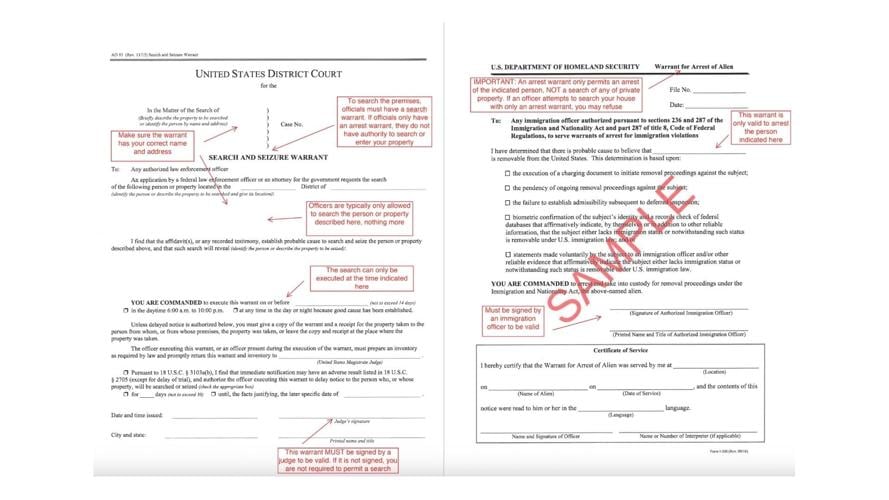
Direct employees to ask for a judicial warrant signed by a judge. According to Renteria, ICE agents can’t enter private business areas without a judicial warrant.

A judicial warrant should specify which areas of a business ICE agents are allowed to be in and which paperwork they are allowed to look through. Employees should make sure ICE does not access any areas not identified in the warrant. (American Civil Liberties Union)
What should employees do during and after an ICE raid?
The designated “emergency response team” members should begin their tasks of recording the agents and/or speaking with them. All employees should:
Remain calm. That’s where following the pre-raid safety plan comes into play.
Do not run away. This action may lead an agent to accuse you of violating immigration laws, Renteria says in her training documents.
Know your rights. You don’t have to answer the agents’ questions and can say you want to speak to your lawyer.
“Do not help ICE agents.” If an ICE agent has an administrative warrant with a specific employee’s name, you do not have to give the agent information about that person nor lead the agent to them, Renteria said.
Prepare the necessary documents ahead of time. Renteria encourages every employee to have a power of attorney form filed and a personal safety plan prepared. Proyecto Progreso’s website, tusderechos.us, offers advice in Spanish and English on how to prepare these.
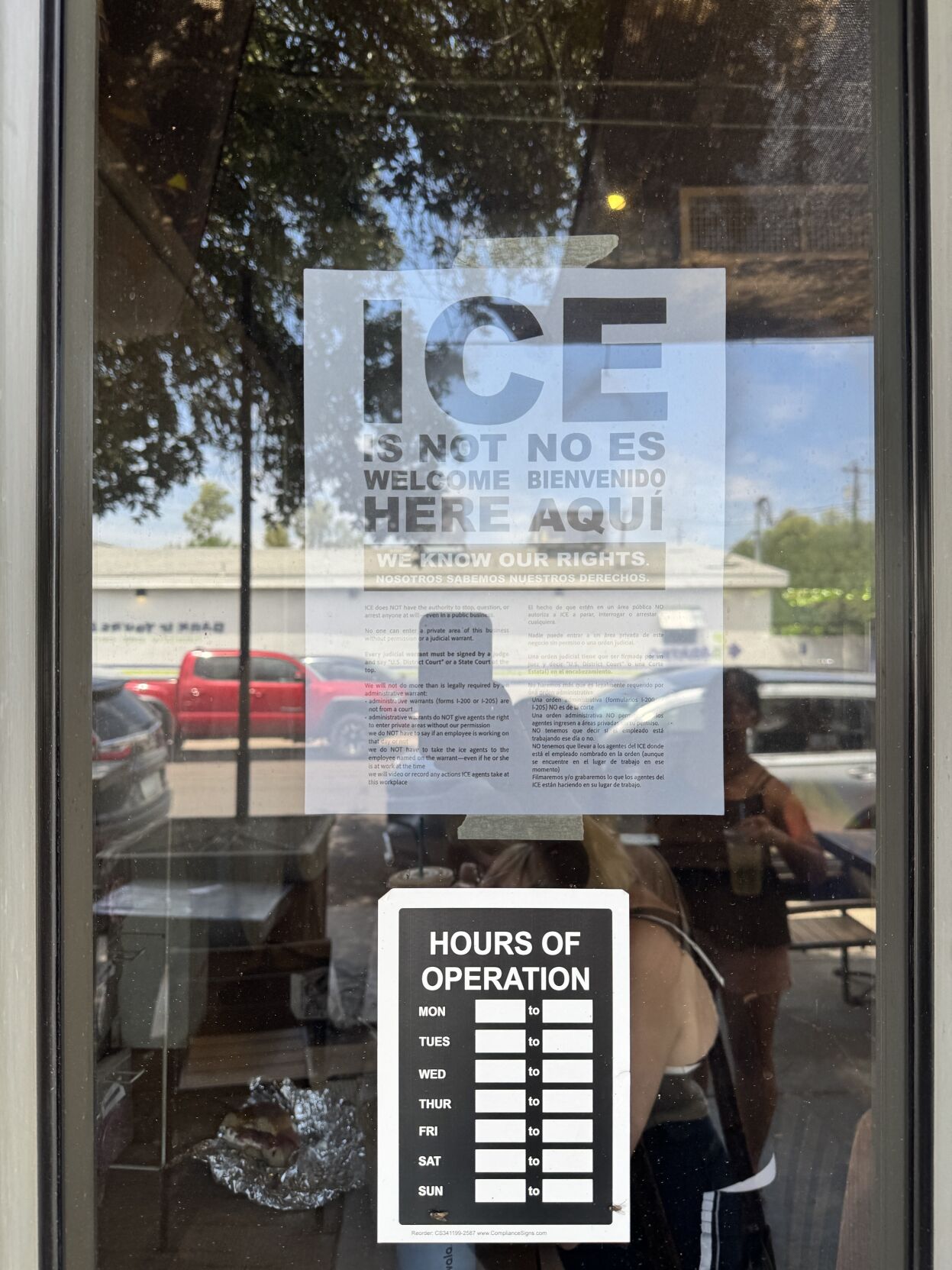
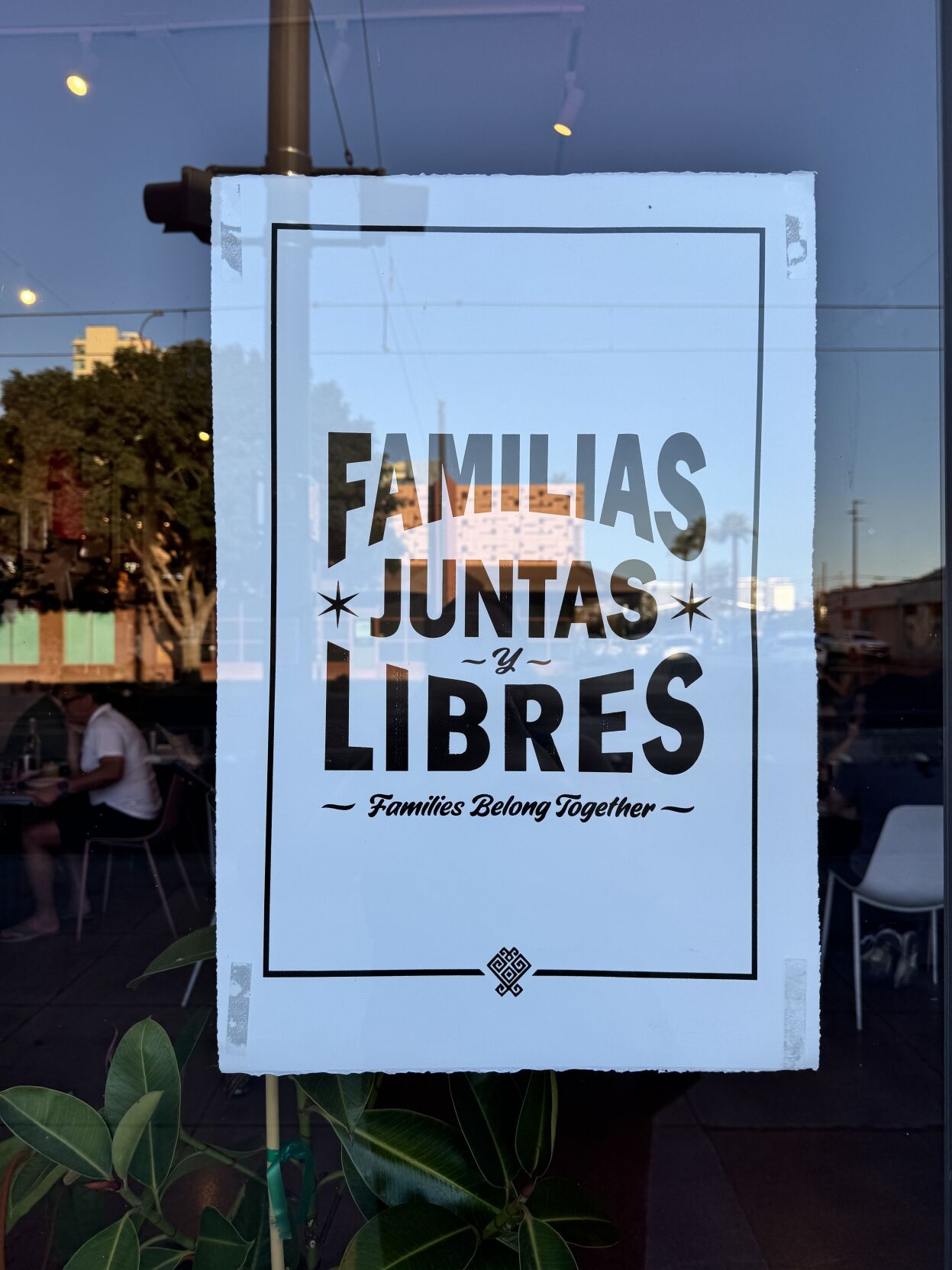
A sign posted outside of Copper Star Coffee in the Melrose neighborhood of Phoenix. (Joanna Jacobo Rivera/CALÓ News)
Where to find more information, advice and training
Renteria is hosting a business know your rights online workshop in early March. For information about the event and how to register, contact Jovana Renteria at 480-277-6467 or renteriajojo10@gmail.com. You can also request additional trainings by emailing her.
The National Immigration Law Center has created a guide with advice on what employers and employees should do if ICE agents go into their workplace. That guide is also available in Spanish. The center also organized a webinar series titled Worksite Raids Resistance and Response, with recorded links.
The ACLU of Arizona also has a “Know Your Rights Before, During and After a Workplace Raid” guide online. A button on the bottom right of the website translates the information to Spanish.
Stephanie Casanova is an independent, bilingual journalist from Tucson, Arizona, covering community stories for over 10 years. She is passionate about narrative, in-depth storytelling that is inclusive and reflects the diversity of the communities she covers.
This reporting was produced in partnership between CALÓ News and Chavez Media Foundation and La Campesina Radio with funding provided by the Latino Media Collaborative.










(0) comments
Welcome to the discussion.
Log In
Keep it Clean. Please avoid obscene, vulgar, lewd, racist or sexually-oriented language.
PLEASE TURN OFF YOUR CAPS LOCK.
Don't Threaten. Threats of harming another person will not be tolerated.
Be Truthful. Don't knowingly lie about anyone or anything.
Be Nice. No racism, sexism or any sort of -ism that is degrading to another person.
Be Proactive. Use the 'Report' link on each comment to let us know of abusive posts.
Share with Us. We'd love to hear eyewitness accounts, the history behind an article.