
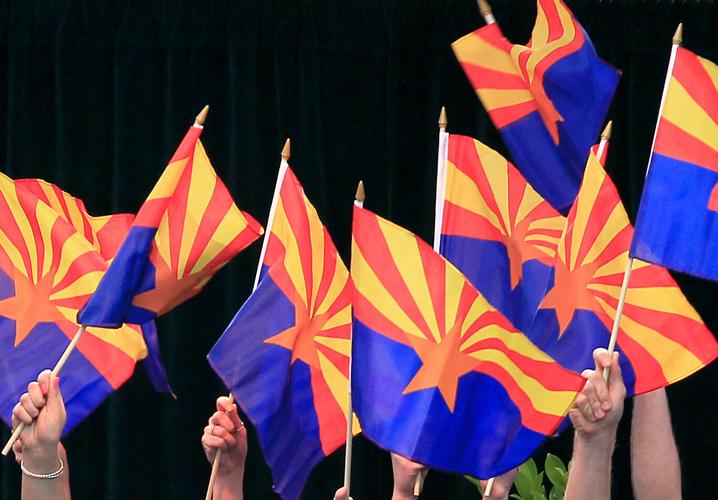


FILE - Members of the Arizona State University Barrett Choir wave Arizona state flags during the celebration of the 100th anniversary of Arizona's statehood, Feb. 14, 2012, in Phoenix.(AP Photo/Ross D. Franklin, File)
As early voting continues across Arizona, the state's highest court moved to settle who is likely to control key election responsibilities in Maricopa County, while voting rights advocates warned that months of public infighting have already begun to erode something harder to restore: voters' confidence in the democratic process.
On July 7, the Arizona Supreme Court issued an interim ruling clarifying who is likely to hold key election authority while the lawsuit continues. In a news release announcing the decision, the court said Maricopa County Recorder Justin Heap is likely to prevail on the central legal question over election authority.
The decision comes after a months-long dispute between Heap and the Maricopa County Board of Supervisors over who has authority to oversee portions of election administration.
In its official ruling, the court concluded that Arizona law likely places those responsibilities with the recorder rather than a board-appointed elections director and added that the board cannot use its budget authority to take over duties assigned to another independently elected official.
Heap's office did not directly respond to CALÓ News' request for comment, but in a statement following the ruling, he called the decision a “decisive victory for the rule of law.”
Still, the court declined to make sweeping operational changes while early voting for the Arizona Primary election — set to take place on July 21 — is already underway. It also emphasized that nothing in its order affects the public's ability to vote.
That concern was at the heart of a press conference last week held by Living United for Change in Arizona (LUCHA), where organizers urged voters not to be deterred by internal dramatics.
"Our vote is our voice. Our vote is our power," LUCHA Organizing Director Gina Mendez said. "Do not let anyone scare you away from your power.”
The event followed the Maricopa County Board of Supervisors' approval of an early voting plan expanding county-operated early voting locations from 12 to 16. LUCHA called the expansion a victory after weeks of organizing and public testimony, saying additional sites will improve access for working families, seniors, students, voters with disabilities and communities of color.
Mendez also pointed out that efforts to undermine confidence in elections and deter participation are not always obvious.
"Election subversion doesn't always look like one dramatic moment,” she said. “Sometimes it looks like delays or confusion. Sometimes it looks like fewer voting locations, longer lines or attacks on mail-in ballots."

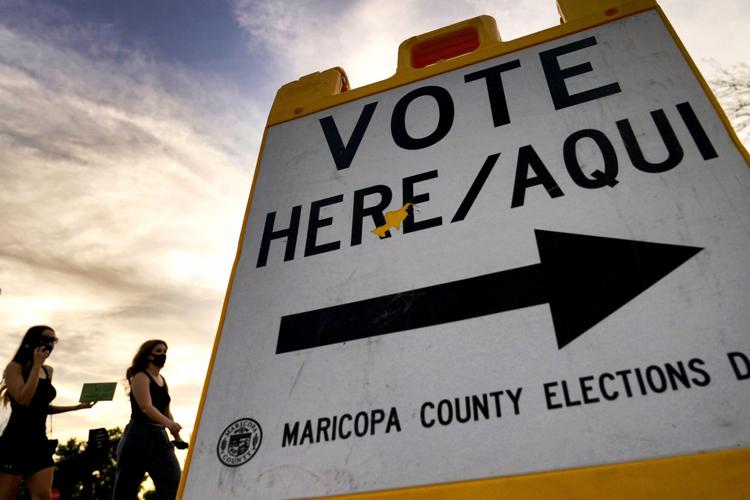
FILE - Voters deliver their ballot to a polling station in Tempe, Ariz., on Nov. 3, 2020. (AP Photo/Matt York, File)
Untangling a legal dispute over election oversight
Arizona divides election administration between the Recorder's Office and county boards of supervisors — each responsible for different aspects of the election process. The recorder oversees voter registration, maintains voter rolls and performs statutory duties related to early voting, while the board oversees county election operations, funding and election-day logistics.
Where those responsibilities begin and end have become the central legal question.
The board’s sole Democrat, Supervisor Steve Gallardo, said voters may mistakenly believe the recorder controls every aspect of elections.
"The voter registration and the voter rolls go hand in hand," Gallardo told CALÓ News following the press conference. "It's a partnership."
Gallardo accused Heap of failing to work collaboratively with county officials and argued that public disagreements have fueled unnecessary confusion during the start of early voting.
"For the first time, I've worked with a county recorder who is working so hard for us to fail," Gallardo said.
A Republican, this primary marks Heap’s first midterm election as recorder after beating out incumbent Stephen Richer in November 2024. Before taking office, the former state legislator supported sweeping changes to Arizona's election laws following unsubstantiated claims of widespread fraud in the 2020 presidential election.
However, Heap has consistently argued that the dispute is about legal authority rather than politics. In a May letter to the board regarding ballot drop box locations, Heap’s attorney, James Rogers from Trump-aligned America First Legal Foundation, argued that Arizona law gives the recorder authority over early voting functions assigned by statute and warned that the board's proposed actions exceeded its legal authority.
That position largely mirrors the statutory interpretation the Arizona Supreme Court concluded is likely to prevail while the appeal continues.
Advocates urge Arizonans to cast their ballots
For community members like Albert Rivera, though, the legal arguments ultimately come back to something much simpler: whether people still believe their participation matters.
Rivera, a first-generation Mexican American who said he attended numerous board meetings over the past several months, said that growing up in Phoenix shaped his views on civic participation and government accountability.
"Using your voice, just like casting your ballot, is the single most significant way you can make a difference and advocate for a truly representative government," Rivera said.
Although the legal battle over election authority is far from over, both the Court and voting advocates delivered similar messages this week.
In its news release, the Arizona Supreme Court encouraged cooperation, transparency, lawful administration and public confidence in Arizona's elections. The official order similarly encouraged "full access to information and transparency in all aspects of the election process to ensure public confidence in the electoral process."
For LUCHA organizers, preserving that confidence may prove just as important as winning any legal dispute.
“Do not let anyone make you believe your vote doesn't matter,” Mendez said. "They want us tired. They want us afraid. They want us to give up on democracy, but we are going to do the opposite."
Board of Supervisors Chair Katy Brophy McGee and Vice Chair Debbie Lesko, both Republicans, said they were “disappointed” with the court’s decision. The statement also said the two supervisors reached a consensus with Heap on Monday evening following two days of mediation.
For a comprehensive list of early voting locations, ballot drop boxes, important dates and candidate information, visit https://www.azcleanelections.gov/july-21-2026/maricopa.
Lorenzo Gomez is a multimedia journalist based in Phoenix, Arizona. He reports on politics, borderlands, culture and minority communities. He obtained a Master of Mass Communication from the Walter Cronkite School of Journalism and Mass Communication. His work has been featured in the Associated Press, CALÓ News, LOOKOUT, Phoenix New Times and Cronkite News.









(0) comments
Welcome to the discussion.
Log In
Keep it Clean. Please avoid obscene, vulgar, lewd, racist or sexually-oriented language.
PLEASE TURN OFF YOUR CAPS LOCK.
Don't Threaten. Threats of harming another person will not be tolerated.
Be Truthful. Don't knowingly lie about anyone or anything.
Be Nice. No racism, sexism or any sort of -ism that is degrading to another person.
Be Proactive. Use the 'Report' link on each comment to let us know of abusive posts.
Share with Us. We'd love to hear eyewitness accounts, the history behind an article.