
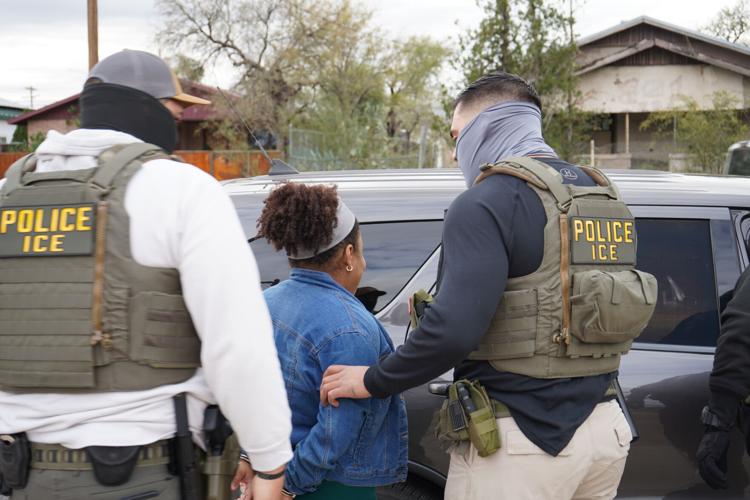




Immigration and Customs Enforcement (ICE) agents detain Tatiana Farias' sister-in-law during a traffic stop on Friday, Jan. 23, 2026, in Tucson, Arizona.
This story was originally published in Spanish by Conecta Arizona.
Tucson, Arizona. – Karla Toledo still has nightmares in which men force their way into her home to arrest her. It has been more than a month since agents from Immigration and Customs Enforcement (ICE) detained her at her home on May 18. Since then, she said, fear and uncertainty have remained constant.
“It's every day, I hear a door outside close and I ask my husband to look at the cameras, or I look at the cameras. I feel like I’m in survival mode,” Toledo told Conecta Arizona. “We actually set up more cameras just so we don’t feel unprotected, and it's not just because of ICE agents, this whole situation of people invading made us feel so violated.”
In a video of the operation, Toledo — a recipient of the Deferred Action for Childhood Arrivals (DACA) program — is seen asking the agents for a warrant, a reaction that reflects her awareness of her rights. She told Conecta Arizona that the agents did not show her a warrant before arresting her. She was taken to ICE headquarters in Tucson and, that same night, taken to Florence Detention Center and later to Eloy Detention Center.
Although Toledo’s case garnered national attention, her experience — being arrested by agents wearing face coverings and rapidly processed through the immigration detention system — reflects the reality faced by hundreds of immigrants in the United States. Many remain in custody for weeks or even months before learning the next step in their case, whether that be release or deportation.
Since Donald Trump’s return to the White House, Congress — with Republican majorities in both chambers — has approved tens of billions of dollars to bolster immigration enforcement, expand detention capacity and strengthen deportation operations. However, lawyers, immigrant rights advocates and individuals who have been detained maintain that the increased funding has not translated into better conditions within detention centers. On the contrary, they say that overcrowding, a lack of medical care and inadequate access to information and basic services persist in Arizona and elsewhere in the country.
“We’ve seen the way they have us — like we have a noose around our necks. Everything happens so fast that we can’t even process it. It’s fast, fast, fast — like machines, as if they were saying, ‘Next, next, next,’ just to get people out. It isn’t fair, and it isn’t right,” said Claudia Arévalo, a Tucson-based immigration attorney. “None of this is right. We know it and we are living in a completely different era — a deeply anti-immigrant era.”
The landscape of detention centers in Arizona
Immigrant detention has become a cornerstone of Trump’s immigration strategy. According to the federal government, the goal is to deter irregular immigration, accelerate deportations and encourage individuals living in the United States without legal authorization to leave the country voluntarily.
“Being in a detention center is a choice,” a Department of Homeland Security (DHS) spokesperson noted in a statement to Conecta Arizona. The official encouraged individuals without authorized immigration status to use the CBP Home app to self-deport, highlighting that the federal government offers $2,600 and a free flight to their country of origin. “We encourage anyone illegally in the country to take advantage of this opportunity and preserve the possibility of returning to the United States legally to live the American dream. Otherwise, they will be arrested and deported with no possibility of return,” the statement indicates.
Meanwhile, the number of people detained on immigration grounds remains at historically high levels. Currently, more than 60,000 people remain in ICE custody in detention centers across the country. In Arizona, nearly 2,800 people are held in five immigration detention centers, according to data from Syracuse University’s Transactional Records Access Clearinghouse (TRAC).
Although the population in ICE custody in Arizona has remained relatively stable since 2025, when around 2,600 detainees were reported, the increase in federal funding aimed at expanding detention capacity and strengthening immigration law enforcement could increase that figure in the coming months.
Most people detained in Arizona are held at the Eloy Detention Center and the Central Arizona Florence Correctional Complex, both operated by CoreCivic, a private, for-profit company that manages prisons and detention centers under contract with the federal government.
Arizona also has other immigration detention centers, including the Florence Processing Center — owned by the federal government and operated by private contractors — the San Luis Regional Detention Center, managed by the private company LaSalle Corrections, and the Florence Service Processing Center, a facility operated directly by ICE.
“This system didn’t just gradually arrive, it’s been building,” said Isabel García, co-chair of the Tucson-based Coalición de Derechos Humanos. Two decades ago she was already speaking out against the expansion of detention centers, yet, she asserted, that the problem is more serious today than ever.
““Forty years I've been saying, look at this is a violation of the Constitution. It doesn't matter that it's an immigrant. The law has stated forever that immigrants are entitled to those same rights,” she said.

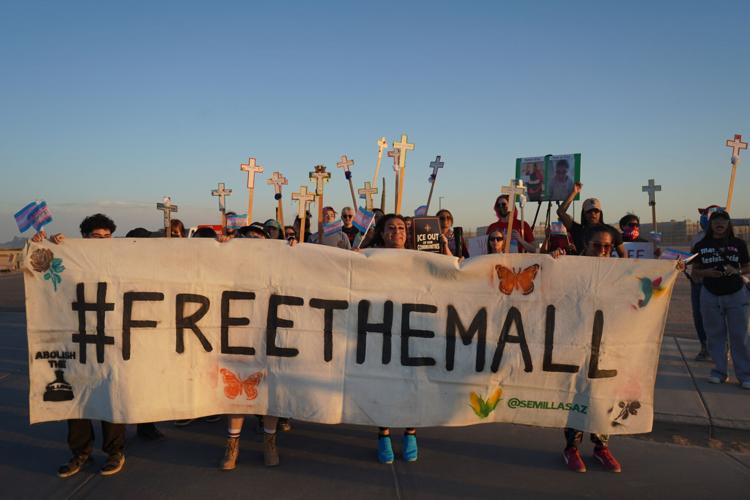
Participants in a vigil outside of Eloy Detention Center hold up crosses in protest of the human rights violations that occur inside ICE prisons, on Thursday, June 4, 2026, in Eloy, Ariz. (Susan Barnett/CALÓ News)
Conditions inside the detention centers
Despite the millions of dollars invested to bolster immigration enforcement, immigrant rights advocates, lawyers and former detainees question how those resources are being used. They report overcrowding, insufficient food, water quality issues and the spread of infectious diseases inside immigration prisons. Earlier this year, immigration facilities in Arizona reported cases of hepatitis A and B, as well as a measles outbreak at a detention center in Florence.
Overcrowding is among the primary concerns for those held in custody. “I was in Florence for one night,” Toledo recounted. “The conditions are horrible. The women’s section was like a trailer of sorts. There were only 11 beds, but there were 28 of us women. Many of us had to sleep on the floor. I slept under the dining tables.”
According to the Global Detention Project, the Central Arizona Florence Correctional Complex has an average daily population of 529 people and an average stay of 39 days. Meanwhile, the Florence Service Processing Center — a short-term processing facility operated by ICE — has a capacity of 392 people and maintains an average daily population of 335 detainees, with stays averaging around nine days.
Toledo’s last stop was at Eloy Detention Center, where she says she faced similar conditions. “Some slept on benches, others on the floor, and others while sitting up. I remember seeing all the women lying on the ground and thinking, ‘I wish I could take a picture of this.’ It was a very sad image that I will never forget.”
According to the Global Detention Project, Eloy Detention Center has a capacity of approximately 1,550 people. Although the population fluctuates throughout the year, TRAC data shows that the number of detainees frequently approaches the facility's operational capacity.
For Toledo, overcrowding is just one example of the flaws in the immigration detention system. “People need to know what is happening inside detention centers,” she said.
Conecta Arizona has documented conditions inside these centers on multiple occasions. These include the story of “José,” whose family navigated a confusing and harrowing process to locate him after his detention; the case of Carmen García, who reported a lack of communication and medical care for her husband while he was in ICE custody; and the surprise visit by Congresswoman Adelita Grijalva to the Florence Detention Center, where she publicly questioned the facility's conditions.
Another recurring concern is access to information in various languages. Although ICE states that it must provide interpretation and translation services when necessary, lawyers and individuals who have been in custody say that, in practice, many documents and proceedings are explained only in English or are not adequately translated. This, they claim, leaves many people without a full understanding of what they are signing — or afraid to sign — out of fear of unwittingly agreeing to a deportation order.
“There is a very serious problem with interpretation and translation. Many things are not translated correctly,” Toledo explained. “There are documents people have to sign, and the people instructing them on where to sign often don’t speak Spanish or the other languages spoken by the detainees.”
Adequate communication also poses a major challenge, Arévalo said. Many people enter detention centers without receiving clear information about the immigration process they will face, their rights, how to deposit money into their accounts or how to contact their country’s consulate, she said.
“So, they have to educate each other. ‘Look, I’ve been here a year and I have a little money you can use to call your family member.’ ‘Let me use your phone for a minute,’” Arévalo said. “As soon as they arrive, they learn about the system from other detainees... and that’s how they support one another.”
A serious concern is reported medical negligence. One of the most recent cases involves Emmanuel Damas, a 56-year-old Haitian immigrant who died while in ICE custody after suffering complications from a dental infection.
His passing marked the eleventh death in ICE custody recorded in 2026. Since then, seven other people have died while in detention, according to records released by the agency. According to ICE, Damas reported difficulty breathing on Feb. 17 and was taken to a hospital, where he died on March 2.
“They allowed his tooth to get septic. I mean, what kind of care is that?” said Garcia. “They don't want to give care because it cuts into their profits.”
“In Arizona and across the country, we continue to see a deeply disturbing pattern of medical neglect, delayed treatment, and systemic cruelty inside ICE detention centers,” Rep. Grijalva said in a statement following his death. “When the federal government detains someone, it assumes responsibility for their safety, health, and well-being. This is exactly why robust congressional oversight is necessary.”
Although ICE said that the agency took measures to save his life, a fellow detainee held with Damas said that other inmates repeatedly called for help without receiving a response. According to his account, the guards responded to the medical emergency only after three detainees blocked the cell entrance in protest.
A report produced by the Detention Watch Network and the Florence Immigrant & Refugee Rights Project documents issues such as substandard medical care, unsanitary dining conditions, inadequate laundry services, frequent lockdowns, misuse of solitary confinement and suicide-risk monitoring, violations of women's privacy and physical and verbal abuse by staff.
Despite these allegations, DHS rejected accusations of negligence. In a statement sent to Conecta Arizona, the agency said that all individuals in custody receive adequate food, drinking water, blankets, medical care and opportunities to communicate with family members and legal representatives. Furthermore, “ICE has higher detention standards than most U.S. prisons that hold actual U.S. citizens.”
“ICE is regularly audited and inspected by external agencies to ensure that all ICE facilities comply with performance-based national detention standards,” a DHS spokesperson said, referring Conecta Arizona to the 2025 National Detention Standards. According to the agency, the standards are intended to ensure that detainees are “treated humanely; protected from harm; provided appropriate medical and mental health care; and receive the rights and protections to which they are entitled.”
Among those who have been monitoring conditions inside immigration detention centers is Grijalva, who has conducted oversight visits to facilities in Arizona and Texas to hear firsthand the complaints of detainees and their families.
Grijalva explained that her office constantly receives calls from residents seeking help after a family member has been detained by immigration authorities. She noted that many people even approach her after press conferences to ask for guidance or support.
“They don't feel like they're being heard or helped in those cases,” she told Conecta Arizona. “And so that's really the situation that we're in where they're like, ‘oh, well, you can help’, and so they'll reach out.”
The congresswoman explained that her office has a caseworker who follows up on complaints involving federal agencies. Through this service, residents can voice their concerns and receive direct support from her team.
Concerns regarding conditions in detention centers have also reached the Senate. In April, Sen. Mark Kelly and Rubén Gallego sent a letter to the DHS requesting a halt to the expansion of ICE detention centers in Arizona, citing concerns about a lack of transparency and safety conditions.
A month later, Reps. Greg Stanton, Yassamin Ansari and Grijalva sent another letter to the DHS as part of their oversight duties. This followed an Arizona Mirror investigation revealing that ICE agents used pepper spray on approximately 47 detainees inside an overcrowded room at the Arizona Removal Operations Coordination Center (AROCC) in Mesa. The investigation — based on a recording of a 911 call obtained through a public records request — indicated that at least one person required medical attention following the incident.
Both Stanton and Ansari have also conducted oversight visits to immigration detention centers in Arizona, where they heard firsthand accounts from detainees reporting overcrowding, long wait times and a lack of access to information, among other conditions.
Following an unannounced visit to AROCC, located at Phoenix-Mesa Gateway Airport, Stanton introduced legislation to address overcrowding in short-term detention centers. During the inspection, the congressman said he found rooms intended for 21 people that were holding between 40 and 50 detainees.

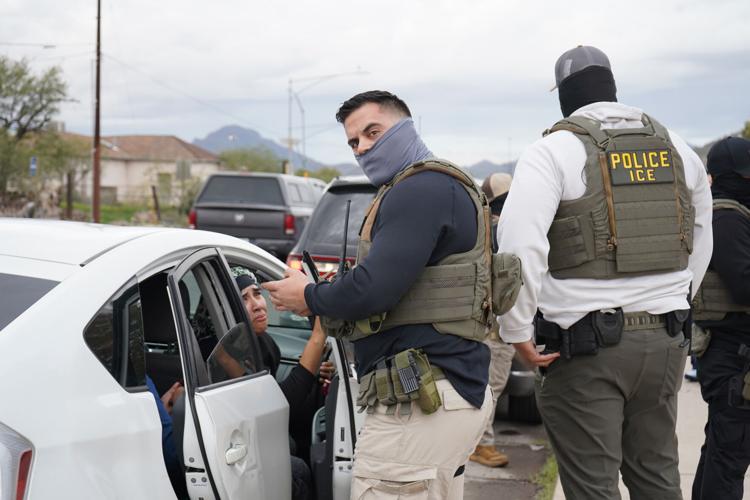
An Immigration and Customs Enforcement (ICE) agent stares at a CALÓ News reporter witnessing people being detained during a traffic stop on Friday, Jan. 23, 2026, in Tucson, Arizona.
Following the money
In 2025, Congress passed the budget legislation known as the “One Big Beautiful Bill Act,” which allocated more than $170 billion to bolster the federal government's immigration enforcement agenda. The funds were allocated to expand detention center capacity, strengthen the operations of ICE and Customs and Border Protection (CBP), finance deportations and reinforce border security through 2029.
As part of that package, $45 billion was earmarked to expand ICE detention center capacity, effectively tripling the agency's budget for immigrant detention and allowing for a significant increase in available beds.
In June 2026, Congress passed additional legislation allocating nearly $70 billion to reinforce that agenda for the remainder of Trump's term. The law allocated $38 billion to ICE, $26 billion to CBP and an additional $5 billion to DHS. Trump signed the legislation into law that same month. The funding comes from public resources contributed by U.S. taxpayers.
To carry out these operations, the federal government relies heavily on contracts with private companies that manage detention centers and prisons, such as CoreCivic and GEO Group. Historically, these contracts were awarded through competitive bidding processes. However, following the declaration of a national emergency at the southern border and the expansion of detention capacity, the federal government has increasingly turned to expedited contracting mechanisms and emergency procedures to reopen closed detention centers, expand existing facilities and set up new infrastructure.
"It is not in the government's interest to legalize or enact immigration reform if it has access to a cheap workforce. When it needs that labor, it accepts it, and when it no longer does, it simply tells the workers to return to their home countries," Arévalo said. "This has happened before with various communities, such as the Chinese, the Japanese, the “braceros” and many other nationalities. Historically, migration has been used to generate economic profit.”
According to ICE budget estimates, the average daily cost of holding a person in an immigration detention center is approximately $152. With more than 60,000 people in custody nationwide, the detention system represents an expense of millions of dollars funded by public resources, a portion of which goes to the private companies operating these centers.
One of the primary beneficiaries is CoreCivic, the company that manages Eloy Detention Center and Central Arizona Florence Correctional Complex. According to its financial report for the fourth quarter of 2025, the company recorded $2.2 billion in revenue, a 13% increase over the previous year. Its net income grew by 69%, reaching $116.5 million.
Contracts with ICE were a key driver of CoreCivic’s financial growth in 2025. During the fourth quarter, revenue from the agency rose from $120.3 million in the same period of 2024 to $244.7 million in 2025 — more than double the previous year's figure.
“We expect 2026 to be another year of strong growth as several of our previously idle facilities continue to receive additional populations during 2026, and as demand for our solutions persists,” CoreCivic President and CEO Patrick Swindle said in a statement accompanying the company’s 2025 financial results.
Although there is no detailed public breakdown regarding the allocation of all funds appropriated by Congress, the increase in federal funding coincides with the expansion of ICE’s detention capacity nationwide. Immigrant rights organizations say that a significant portion of these resources has been used to expand mandatory detention and keep individuals in custody who, under other circumstances, likely would not have been detained. According to TRAC data, nearly 70% of individuals in ICE custody have no criminal record, a figure cited by immigrant advocacy groups to question the scope of the Trump administration's detention policies.

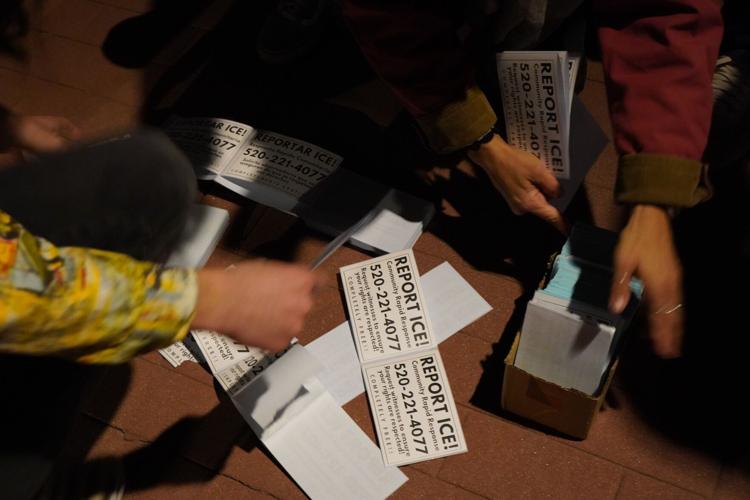
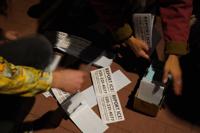
Organizers hand out stickers encouraging people to report ICE activity to the Community Rapid Response Team during a protest in downtown Tucson, on Friday, Dec. 5, 2025. (Susan Barnett/CALÓ News)
The future of detention centers in Arizona
As Trump’s administration pushes to expand immigrant detention infrastructure, this strategy will have a significant impact on Arizona.
There are currently at least two projects underway to increase immigrant detention capacity: one in Marana and another in Surprise.
In Marana, the private company Management & Training Corporation (MTC) acquired a former state prison with the intention of reopening it as an immigrant detention center. The facility currently has a capacity of 506 people, though a notice published by DHS in June indicates that, following renovations, it could be expanded to hold up to 1,300 people.
“I wish the state did not sell this to a private prison company that has lawsuits around the country for conditions facing detainees, the abuse of detainees and as well as conditions for workers,” Board of Supervisor Jennifer Allen told Conecta Arizona in December.
In Surprise, ICE purchased a former warehouse for $70 million to convert it into an immigration processing center with a 1,500-bed capacity. According to the agency's plans, operations would begin with approximately 50 detainees before gradually expanding capacity.
Regarding both projects, residents, community organizations and immigrant rights advocates have criticized the fact that information was made public only after negotiations, zoning changes and other key decisions were already well underway — a move they claim limited community participation during the early stages of the process.
In Marana and Tucson, neighbors and local leaders have held demonstrations against the new detention center. Their main concerns include the treatment of detainees, the impact on water resources and the increased presence of ICE agents in the region.
“Why are we building so many detention centers?” García asked. “This will only lead to massive incarceration.”
Marana municipal officials, however, have repeatedly pointed out that the local government has limited leeway to halt the project due to state and federal regulations.
In Surprise, residents oppose the initiative and the city rejected the ICE project. The proposal, introduced in June, would require the support of approximately 70,000 registered voters — equivalent to two-thirds of the electorate — to move forward.
While the federal government allocates tens of billions of dollars to expand the immigration detention system, lawyers, immigrant rights organizations, and former detainees maintain that issues such as a lack of information, communication failures, inadequate medical care, and overcrowding remain unresolved.
The system's expansion has meant more people entering a model that critics say continues to suffer from structural flaws.
“It is a system designed against migrants,” Arévalo said. “They make laws increasingly harsh, yet they fail to apply them fairly. Furthermore, you often have no way to defend yourself. To me, that represents an abuse of power.”
During a press conference held on June 22 in support of Toledo, Grijalva and Tucson Mayor Regina Romero condemned the detention of Toledo and others who, they said, remain unjustly deprived of their liberty.
“It is just a false narrative that this has anything to do with security. This is all about intimidation and scaring the rest of us into silence, and we're not going to do it. No way,” Grijalva said. “It is not okay for you to kidnap people from our community and put them in jail for nothing and they know that. And that's why they're coming after Karla again. So we're going to continue to be loud.”
The growth of the detention center network in Arizona highlights the contrast between the federal government's increasing investment in immigration enforcement and persistent complaints regarding conditions inside these facilities. As the system continues to expand, the debate no longer centers solely on the number of beds or new detention centers, but also on who bears the human cost of an immigration policy increasingly focused on detention.
Reporting and editing by Paula Díaz at Conecta Arizona. Translated by Joanna Jacobo Rivera at CALÓ News.
Susan Barnett is an independent journalist in southern Arizona covering the immigrant and Latine community. She is a recent graduate from the University of Arizona, where she received her Master of Arts in Bilingual Journalism. She previously worked at La Estrella de Tucson and co-founded Tucson Spotlight.












(0) comments
Welcome to the discussion.
Log In
Keep it Clean. Please avoid obscene, vulgar, lewd, racist or sexually-oriented language.
PLEASE TURN OFF YOUR CAPS LOCK.
Don't Threaten. Threats of harming another person will not be tolerated.
Be Truthful. Don't knowingly lie about anyone or anything.
Be Nice. No racism, sexism or any sort of -ism that is degrading to another person.
Be Proactive. Use the 'Report' link on each comment to let us know of abusive posts.
Share with Us. We'd love to hear eyewitness accounts, the history behind an article.