
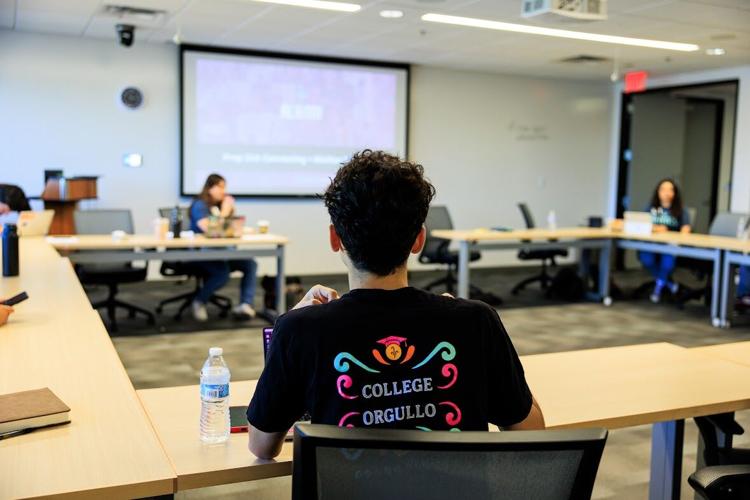

Undocumented students, also known as Dreamers, attend a college workshop offered by Aliento in Phoenix, Arizona.
Aliento has two meanings in Spanish. It can mean breath, but it can also mean offering someone words of encouragement.
That’s how Aliento, a nonprofit organization dedicated to helping the immigrant community in the Phoenix and Tucson area, particularly young people and their academic pursuits, starts off its 2025 Impact Report, in which its accomplishments, progress and steps moving into the new year are detailed.
“This year, I heard heartbreaking stories. From students coming to Aliento asking how to complete a FAFSA when their parents are detained to teachers inquiring about what to do when their students have been detained by immigration," wrote Reyna Montoya, Aliento’s founder, in her 2025 reflection. "As I hold so much pain from these stories, I also hold immense gratitude for knowing that we were not only trusted with this information but also able to provide tangible support to students and teachers."
According to the report, the organization engaged over 4,000 teenagers and young adults in 2025, a drop from 2024, when it engaged over 10,000 youth. According to leadership, 2024 was a civic-heavy year due to the November general election, which required the organization to host numerous online and in-person events to share information and educate young voters.
And while not backed by concrete data, leadership also believes immigration enforcement in the Valley contributed to lower participation, based on "anecdotal observations."
In a year riddled with uncertainty, particularly among the immigrant community, José Patiño, vice president of Aliento, sat down with CALÓ News to reflect on the organization’s ninth year in operation — sharing more about the youth-oriented programs born from education needs not being met in Arizona.
“It was probably our toughest year for our community,” Patiño said. “In terms of immigration, it was just a lot [with] keeping up with all the executive orders or all the actions taken by [the] administration, all the keeping up with the ICE raids, all the changes in education and higher ed, scholarships going away.”
An analysis of Immigration and Customs Enforcement (ICE) arrest data by CALÓ News, obtained through a FOIA request by the Deportation Data Project, showed a significant escalation in enforcement activity in Arizona for the 2025 fiscal year. More than 6,000 detentions were recorded in Arizona — the bulk of which occurred soon after President Donald Trump returned to office.
These operations in Arizona and across the country have severely impacted families, undocumented and mixed-status, and Aliento is one of the organizations at the forefront of protecting and engaging that community in Phoenix.

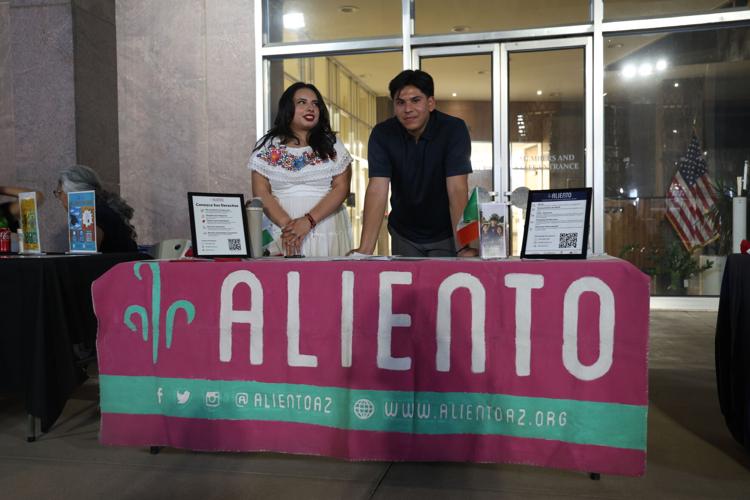
Ivette Sosa, family and community liaison at Aliento, tables during the Mexican Independence Day celebration in front of the Arizona State Capitol on Sept. 15, 2025. (Nicole Macias Garibay / CALÓ News)
Run by and for immigrants, the organization faced challenges in 2025 that, while not foreign, were intensified by the current anti-immigrant climate and a direct attack on migrant access to higher education from the Trump administration.
Angel Palazuelos, an education coordinator at Aliento, noted that he would see students assume adult responsibilities at home.
“People are scared to leave the house, and something that we've been seeing is students taking on a more parental role, like picking up their siblings from schools, going out to get the groceries and stuff like that, because they don't want to put their parents at risk,” Palazuelos said.
Palazuelos shared that he was one of the staff members who was affected this year.
“I still live with that same fear that I had when I was a kid,” Palazuelos said.
“Now that I'm older, it's just more pressure on me because I still have that feeling of impotence. There's not much that I can do, but all I can do is try to make sure that we're as prepared as possible… ‘What am I going to do? Is this going to be, like, the last time that my family sees me?’” he asked himself.
Art as a vehicle for self-reflection and healing
Immigrant communities have also been subject to obstacles placed by the federal government in terms of access to higher education.
In April, an executive order was issued, tasking the U.S. Attorney General with suing states that grant undocumented students access to in-state tuition. This has yet to impact Arizona.
And in September, the Department of Education announced it would end funding to Hispanic Serving Institutions (HSIs) that serve many first-generation college students, including public universities like Arizona State University (ASU), University of Arizona (UA) and Northern Arizona University (NAU).
Amidst the troubles, Aliento continued to engage with its members through its popular Cultiva events.
These art-centered events are considered the heart of Aliento, serving as a coping mechanism for Aliento’s Founder, Reyna Montoya, when she experienced family separation in 2016, according to Patiño.
Aliento staff work in partnership with elementary, middle and high schools to create “safe spaces” where students can process traumas through art, poetry and songwriting. According to Aliento’s 2025 Impact Report, these spaces have helped students, their families and the schools they attend by providing an increase in coping skills and reducing anxiety levels.
“I love the gallery that we have with our schools. When you just go and see all the arts, the little proud parents and students, you hear the little stories of how they have learned to identify their emotions and process them. And in many ways, sometimes, I'm like, ‘you're more emotionally mature than I am,’” Patiño said of the students.

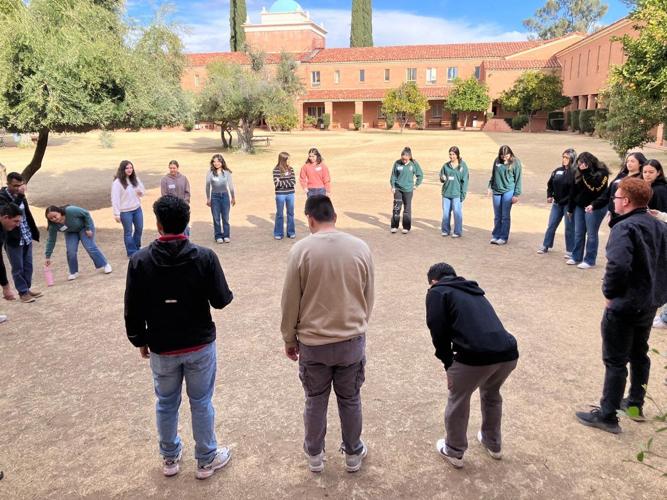
Students take part in a healing workshop offered by Aliento in Phoenix, Arizona.
In 2025, Cultiva events reached nearly 2,000 people, partnering with 17 schools and putting on 94 art and healing workshops.
“You forget how calm, how introspective it can just feel for you to just color. I feel it after going to an event that I'm driving the next week. The bad things that may cause stress and anxiety hurt less and less,” Patiño said. “I also have heard from our students that they are able to focus more on the things they can control, they can ignore the noise, they can minimize the stress and anxiety. The feeling, it's still there, but they have better tools to manage.”
Engaging future leaders at a young age
A 2025 focus for Aliento was helping students understand their civic privileges through their Education Days (E-days), in which students visited the Arizona Legislature at the Arizona State Capitol and spoke with state lawmakers.
“Your opinion is just as valuable as the CEO of Carvana,” Patiño said. “You're important because we live in a democracy where each person has one vote, especially as young people, because all the policies that are being written in the systems. The structures that you live through are here and these are the people who make them.”
According to the 2025 Impact Report, more than 270 students from 20 different Valley schools participated in the E-days. Students would undergo preparations that included meetings with Aliento leaders, school staff and attending workshops on the weekends to research topics and questions to ask lawmakers.
Even though some feel anxious and nervous when sitting down with elected officials, Patiño said that eventually they settle in and realize that sometimes the experts in the room are the students themselves.
“That's always great to be able to see their smiles and work through the nervousness of it all. They can see themselves doing this work and the Capitol or the lawmakers or the governor doesn't seem as far away,” Patiño said.
The next E-day is planned for mid-January.
Aliento will enter its 10th year of operations in 2026, aiming to expand resources for its students and community members.
These include Aliento’s fellowship program, through which students learn about self-advocacy skills, get to participate in organizing Aliento campaigns and create spaces where students can share stories of how their immigration-tied experiences have affected them and their communities.
Aliento will also continue to develop its Arizona’s Future Fellowship cohort leaders. In August 2025, Aliento welcomed 10 students who in 2025 hosted 10 events that impacted nearly 200 students. Their work will continue through May 2026.
Looking back on a year's worth of work, Patiño said he is grateful for focusing on the positives rather than letting the negatives get in the way: “Honestly, it was rough, but let’s hold on to the little things, the little victories. At least for me, just focus on the good and try to compromise the bad things out of my control, and celebrate our events as much as we can.”
Ghadiel Navarrete is a freelance reporter based in Phoenix, Arizona. He graduated in 2024 from ASU with a bachelor’s in Political Science and Journalism.







(0) comments
Welcome to the discussion.
Log In
Keep it Clean. Please avoid obscene, vulgar, lewd, racist or sexually-oriented language.
PLEASE TURN OFF YOUR CAPS LOCK.
Don't Threaten. Threats of harming another person will not be tolerated.
Be Truthful. Don't knowingly lie about anyone or anything.
Be Nice. No racism, sexism or any sort of -ism that is degrading to another person.
Be Proactive. Use the 'Report' link on each comment to let us know of abusive posts.
Share with Us. We'd love to hear eyewitness accounts, the history behind an article.