
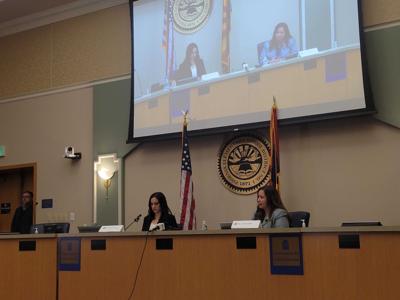

U.S. representatives from Arizona, Yassamin Ansari (left) and Adelita Grijalva, lead a town hall about detention center oversight in Arizona on April 2, 2026.
Medical negligence, verbal and physical abuse from guards, small metal beds, dirty clothes, overcrowding, a lack of access to legal representation, nutrient-less food and unfiltered, dirty water. These are some of the inhumane conditions detainees are facing inside of U.S. Immigration and Customs Enforcement (ICE) detention centers, according to various first-hand accounts heard during a detention center briefing held in Phoenix.
Against the backdrop of at least 45 reported deaths of people in ICE custody since January 2025 and a rise in reports of callous conditions from inside the over 360 known detention centers — according to data from Freedom for Immigrants’ interactive detention center map — Arizona U.S. representatives Yassamin Ansari (D-3), Adelita Grijalva (D-7) and Greg Stanton (D-4) organized a town hall to address the many questions and concerns Phoenix community members have about the rising number of detention centers popping up in Arizona.
The briefing, held Thursday evening at the Phoenix Elementary School District district office in Central Phoenix, called on panelists that included immigration advocates, attorneys, family members of detainees and former detainees to answer questions and share their testimony regarding ICE detention.
“Under this administration, increased immigration enforcement has also led to a dramatic over-population of these detention centers. And this is really just not a space issue, this is a public health issue that threatens the well-being of individuals who are detained,” Phillip Rody, a Florence Immigrant & Refugee Rights Project representative, explained. “I don’t think there’s any reason to believe that this facility in Surprise will be any different than what we see in Eloy and Florence. I really think people should expect to see similar things as what I’ve described — a facility that fundamentally doesn’t respect the duty of care that ICE has to people in its custody.”
Operational facilities where detainees are held in Arizona include the Eloy Detention Center — the facility where Arbella ‘Yari’ Rodriguez Marquez, a lesbian woman with leukemia and declining health, is currently being held without access to proper medical care — and the Florence Correctional Center, where Haitian asylum-seeker Emmanuel Damas was being held in custody before dying of an untreated tooth infection.
“There’s so many things that happen in this administration that have not happened before. I know that we’ve always had an issue with private prisons, but in this case, the abuses are really significant,” Grijalva said to CALÓ News after the briefing. “When you hear the fact that people are eating rotten food, not purified water, have horrible conditions, [are] getting clothes that are dirty back to wear. I mean, the amount of germs and infection that are happening on a regular basis, you see that translated in the number of people that have died in detention and how that continues to increase.”
With two new spaces the Department of Homeland Security (DHS) has slated for additional detention centers in Surprise and Marana, Phoenicians are not only concerned about the proximity of these facilities to their community, but about the safety and security of those held within them as well.
“There are different ways that someone is detained. In other administrations, typically we would see that after them being arrested for a crime and then the facilities… work in collaboration with ICE. When a criminal judge releases them on their own recognizance or a small bond, most individuals think that they’re getting out, but they’re being handed over to ICE,” Arizona immigration attorney Salvador Macias explained, detailing the process detainees face before being transported to Eloy or Florence. “The difference now… they’re not just going after criminals. They’re picking up people just because they’re collateral.”
Since the start of the second Trump administration, DHS — endowed with $175 billion in funding by President Donald Trump’s budget bill passed last summer atop an already boisterous multi-billion dollar budget — has detained over 68,000 migrants, currently being held in detention centers nationwide, according to most recent data from Transactional Records Access Clearinghouse (TRAC), and reportedly deported over 605,000 migrants, according to a December DHS press release.
One of those migrants deported was Marlon Parris whose wife Tanisha Hartwell-Parris spoke on his behalf at the briefing. Parris migrated to the U.S. in the 90s from Trinidad and Tobago and served with the Army for two tours in Iraq following 9/11, she shared.
Parris received a letter from ICE and DHS following a 2011 nonviolent felony drug charge that stated he would be allowed to stay in the country despite the conviction. However, only two days after Trump’s inauguration into office, Hartwell-Parris’s husband was detained and later deported following a prolonged stay at the Florence Detention Center.
When questioning his detainment, the only explanation authorities could give was, “We have orders. He’s on a list,” she said.
“We were forced to face the reality that we could no longer build a future here together. We are choosing stability, dignity and peace for our family, even if it means doing so outside of the country he once served,” Hartwell-Parris explained, stating that she and their seven children have already secured citizenship in another country. “This is not just about my husband. This is about the values we claim to uphold and whether we truly honor the sacrifices made by those who serve.”
Parris is now one of an estimated 10,000 veterans that have been deported since the beginning of Trump’s second term.
Grijalva and Ansari shared their own limited experiences inside of the Arizona detention centers while conducting congressional oversight and meeting with constituents facing long-term detention in inhumane conditions like Rodriguez Marquez, whose health continues to decline since her detainment over a year ago, according to her partner and advocate, Sonia Almarez.
Rodriguez Marquez was in the U.S. under protected status when she was arrested and taken to Eloy Detention Center where she has remained in need of critical medical care since February 2025. She suffers from chronic lymphoma leukemia, lymphedema, rheumatoid arthritis, a stomach infection and possibly lupus — conditions that have worsened during the time she’s been held at Eloy.
“The ligaments in her arms and legs are still feeling the impacts of months of medical neglect. She has developed new symptoms; small dark spots all over her back and stomach. Doctors suspect it may be from the dirty clothes provided at the facility… Yet, despite the severity of her condition, she’s only been given Tylenol,” Almarez said of her partner’s status. She went on to answer several questions from Ansari regarding conditions at the detention center. “[Detainees] live under horrible, horrible conditions. To start with, they provide them with used underwear, contaminated drinking water. Their food, it’s horrible. No nutrients, no nothing. Their beds? Metal… It’s just inhumane.”
Edder Diaz Martinez, a DACA recipient and now communications director at GreenLatinos that spent time detained inside of the Eloy Detention Center almost 15-years ago, spoke of his experience within the immigration carceral system.
“Simply losing your freedom, being locked in a cage is dehumanizing. And thinking about today and the fact that there are these warehouses that the federal government is scoping out where commodities are produced or stored, they’re storing humans. And the very fact of humans being thought of as commodities is unheard of,” Diaz Martinez said during the panel. “The people who are running a lot of these places are private corporations and there’s people that make money off of the backs of people, so you are commodified. So, it’s dehumanizing just the very fact of being in there.”
Eloy and Florence facilities are just two of several privately owned detention facilities operated by companies like CoreCivic, making them unbound by the same policies and regulations state-run facilities are required to abide by while profiting off of the increased flow of detainees coming in. Getting records and information from these private facilities has proven to be difficult for not only Almarez — who claimed ICE authorities within Eloy refuse to release Marquez’s medical records to her — but also congressional members like Ansari and Grijalva, who have faced difficulties reaching their constituents.
“Donald Trump has turned ICE into his own personal paramilitary force turned against the civilian population of this country, no matter who you are… We need to not only close the Eloy detention center, but we need to end for-profit detention centers in the United States,” Ansari said. “My heart goes out to everyone who has been harmed by Trump’s cruel mass deportation agenda. Our fight is not over. In fact, our fight is very much just getting started.”
Analisa Valdez (she/her) is a freelance journalist based in Phoenix. Her reporting includes community & culture, social justice, arts, business, and politics.









(0) comments
Welcome to the discussion.
Log In
Keep it Clean. Please avoid obscene, vulgar, lewd, racist or sexually-oriented language.
PLEASE TURN OFF YOUR CAPS LOCK.
Don't Threaten. Threats of harming another person will not be tolerated.
Be Truthful. Don't knowingly lie about anyone or anything.
Be Nice. No racism, sexism or any sort of -ism that is degrading to another person.
Be Proactive. Use the 'Report' link on each comment to let us know of abusive posts.
Share with Us. We'd love to hear eyewitness accounts, the history behind an article.