
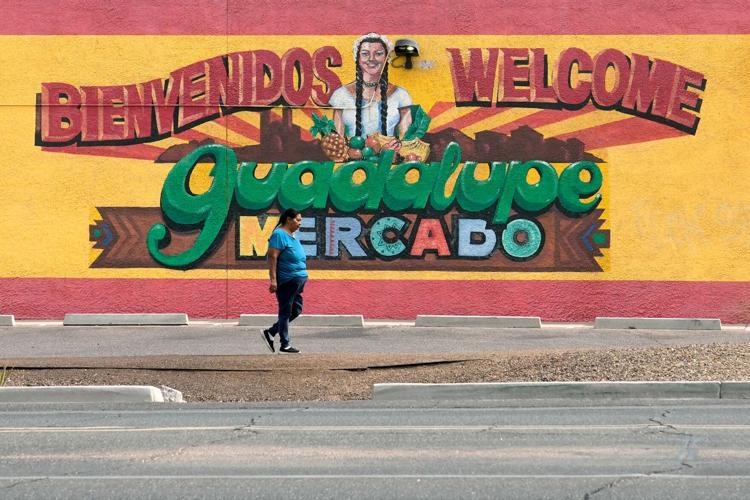



A person walks past a mural promoting Guadalupe, Ariz., May 19, 2026. (AP Photo/Ross D. Franklin)
For many Arizona families, economic success is not necessarily about becoming wealthy — having enough money to cover the bills, taking a vacation once a year or knowing that an unexpected expense will not force a family into debt can be indicators as well.
But for many Latino households, reaching that kind of financial stability can be more difficult.
A new study from Chicanos Por La Causa (CPLC), conducted in partnership with Arizona State University’s Seidman Research Institute and WestGroup Research, examines the financial behaviors, attitudes and barriers shaping economic mobility among low- and middle-income Latinos in Arizona.
The research detailed in “Pathways to Prosperity: Latino Financial Capability Trends in Arizona,” conducted from April 2024 through March 2025, surveyed more than 1,800 Arizonans and included 12 focus groups with more than 90 participants. Researchers examined factors including income, education, homeownership, credit, investing, entrepreneurship and generational differences.
For Victoria Iwinski, an evaluation and analyst with CPLC, one of the study's biggest takeaways was that financial success looks different for everyone.
“Success is very individualized,” Iwinski told CALÓ News.
For some people, success is reflected in financial wealth. For others, it means having close family relationships, good health, meaningful work or a healthy work-life balance.
Financial stability, she said, can mean not having to live paycheck to paycheck or constantly worrying about whether there will be enough money to support a family.
“If that is the goal for so many individuals,” Iwinski said, “then that means that there are so many individuals that don't feel stable.”
Income shapes opportunity
The study found that income was a major factor shaping financial opportunity — often more so than ethnicity itself.
Lower-income households were more likely to lack emergency savings and disposable income and were less able to participate in wealth-building activities such as investing and homeownership.
Iwinski emphasized that those differences should not automatically be interpreted as poor financial decision-making.
“The dollar doesn't stretch the way that it does for higher-income households,” she said.
The distinction is important because some of the study's findings could otherwise be interpreted as differences in financial attitudes or priorities.
The research found, for example, that 36% of Latino respondents considered a college education essential for financial success, compared with 28% of non-Latino whites. At the same time, Latinos earn college degrees at rates 14 percentage points lower than non-Latino whites.
Iwinski said the education gap is influenced by several barriers, including nativity, affordability and the difficulty of navigating higher education systems.
First-generation Latino respondents were significantly less likely to have a bachelor's degree or higher than second- and third-generation respondents.
For families unfamiliar with the college system, navigating processes such as financial aid can be difficult, especially when information isn't available in a language they understand or when no one has helped them understand how the system works.
Affordability can create another obstacle.
A person considering college may have to weigh the potential long-term income increase against the immediate loss of wages while attending school.
“Some individuals have to weigh out the benefits of supporting a family member or supporting themselves or going to school,” Iwinski said.
That can be an especially difficult calculation for families supporting multiple generations.

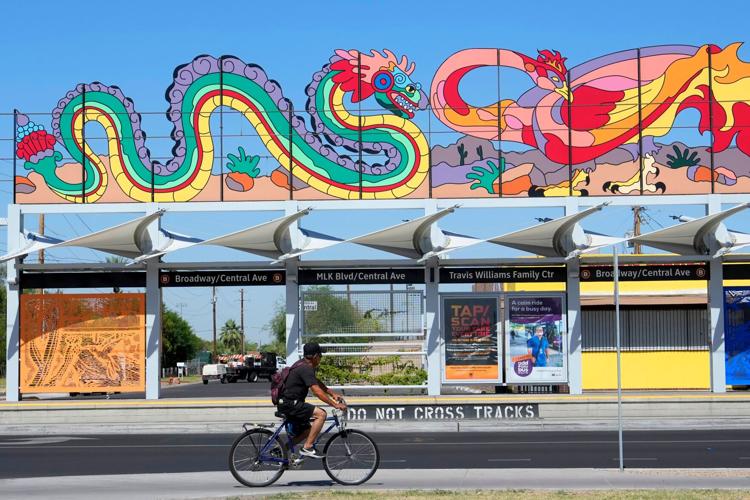
A cyclist rides past a Phoenix Light Rail station, May 20, 2026, in Phoenix. (AP Photo/Ross D. Franklin)
Building wealth takes more than income
Homeownership is another important part of the study's examination of generational wealth.
The research found that 59% of Latinos in Arizona own homes, compared with 73% of non-Latino whites.
Homeownership, business ownership and investing can provide opportunities to build wealth that can benefit future generations, but the study found disparities across each of those pathways.
Only 10% of Latino respondents reported currently investing in the stock market, compared with 17% of non-white respondents, despite similar reported levels of risk tolerance and patience.
Iwinski said one lesson from the research was that financial knowledge and access can matter as much as someone's willingness to take financial risks.
That distinction also appeared in the study's findings about credit.
Seventy percent of Latino cardholders reported carrying a credit-card balance, compared with 57% of non-Latino white cardholders.
Carrying a balance can mean paying interest instead of putting that money toward savings or investments. For lower-income households, Iwinski said, that can contribute to a cycle in which more money goes toward existing debt and less is available for building wealth.
At the same time, she cautioned against looking only at credit-card debt.
Latinos were also statistically less likely to have credit cards, which can create another challenge. While avoiding debt can protect a household from interest payments, having no established credit history can make it more difficult to access financial opportunities such as renting an apartment, buying a home or, in some cases, applying for certain jobs.
The result is a complicated picture: some households are carrying costly debt, while others may lack access to the credit system altogether.
Optimism remains strong
Despite the barriers identified throughout the research, the study also found strong optimism among Latino respondents.
Seventy-two percent said they believed they were better off financially than the previous generation, while 71% expected the next generation to be better off than they were.
For Iwinski, that optimism challenges the idea that a lack of ambition or motivation is driving economic disparities.
Instead, she said, the research points to the importance of creating accessible pathways for people already working toward stability.
Entrepreneurship is one example. The study found that 73% of Latino respondents believed owning a business could make them as much money or more than working a traditional 9-to-5 job. Business ownership was particularly notable among first-generation Latinos.
Higher education can also be an important pathway, but Iwinski said it is not the only one.
The study intentionally examined multiple drivers of economic mobility, including skilled trades and job-specific credentials.
“It's not the only pathway,” Iwinski said of higher education. “It doesn't fit everyone's lifestyle.”
For someone who cannot afford to stop working for several years to earn a degree, a trade credential or other workforce pathway may offer a different route to higher income.
Ultimately, the study suggests that economic mobility cannot be reduced to a single statistic or individual financial choice.
Income affects how far a paycheck can stretch. Education can open doors but also comes with upfront costs. Credit can create access while debt can erode wealth. Homeownership and investing can build assets, but access to those opportunities remains uneven.
And behind those numbers are people trying to define what financial success means for themselves and their families.
The research aims to identify those barriers and inform ways to create more accessible pathways to stability and, eventually, prosperity.
“These challenges and this work are not something that one person or only one organization or one entity can do alone,” Iwinski said. “It's going to take all of us.”
To read the full research report and explore interactive data tools, visit www.cplcmobilityinsights.org.






(0) comments
Welcome to the discussion.
Log In
Keep it Clean. Please avoid obscene, vulgar, lewd, racist or sexually-oriented language.
PLEASE TURN OFF YOUR CAPS LOCK.
Don't Threaten. Threats of harming another person will not be tolerated.
Be Truthful. Don't knowingly lie about anyone or anything.
Be Nice. No racism, sexism or any sort of -ism that is degrading to another person.
Be Proactive. Use the 'Report' link on each comment to let us know of abusive posts.
Share with Us. We'd love to hear eyewitness accounts, the history behind an article.