
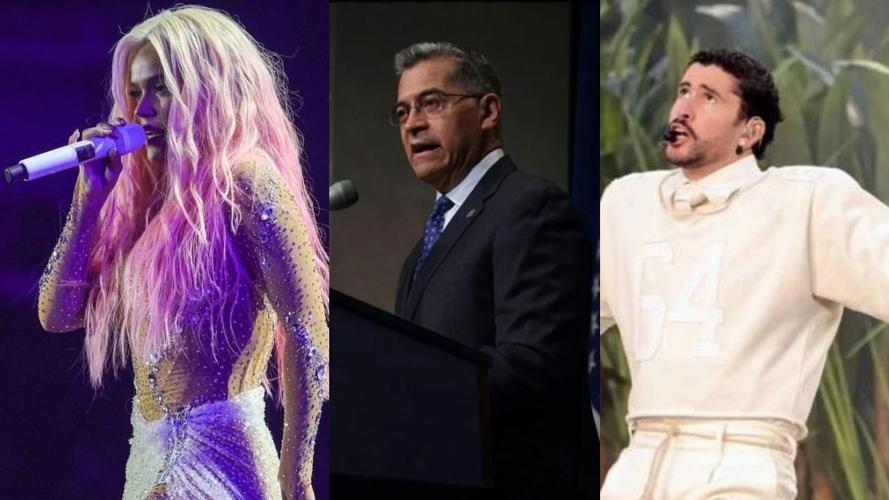



From left: Karol G, Xavier Becerra and Bad Bunny. (Getty Images)
It’s official: I have landed my dream position. While I am beginning my twelfth year at Long Beach State, I am now starting as an Assistant Professor in the Department of Chicano and Latino Studies (also known as CHLS).
Naturally, I must be more Latina now, right? Perhaps yes, perhaps no…
Yet, what helps me to answer such a question is considering the uniqueness of Latinx Heritage Month, which is occurring now. Our university has promoted numerous events to highlight this time, such as the first-ever “Carne Asada,” a Bienvenida event where our Latinx students brought their families so we could inform them, in Spanish at times, about college life at the Beach, and a special spotlight on our CHLS department during Hispanic Serving Institute Week.
But what about beyond the Beach? What makes Latinx Heritage Month special in 2026? For me, the answers may be found by looking at the political and musical progress made this year.
Politically, we have continued to move forward despite these ICE raids attacking our communities. In the spirit of solidarity, Latinx-owned businesses have made several moves to protect one another, including hosting fundraisers, giving certain percentages of their profits to groups that support immigrant families, sponsoring comedy nights and posting signs outside businesses stating that they “know their rights,” in an effort to have federal agents not trespass on their private property without a warrant. I was in awe to learn, at our bienvenida, that our campus has lawyers who are willing to help our students and their families with their legal disputes during this turbulent time.
And if we look at this gubernatorial race in our own state, we see Xavier Becerra on the ballot in November. If he wins, he will become California’s first Latino governor since Romualdo Pacheco in 1875. When I attended his watch party in June during the primaries, I stood in awe at how well he speaks for our Latinx communities. More importantly, he demonstrated his credentials to prove why he was qualified to be the next governor of California.
In a way, I can relate to this: I have been working at CSULB for 11 years; I have gone through countless evaluations and have had to prove myself not only to a department, but to a college and entire university. Such commitment, whether it be to politics or education, highlights not only our intellectual strength, but our willingness to serve the public.
In addition, another political player who is making progressive moves is Monique Limón. She is the first Latina (and mother) to serve as the president of the upper house in the California Legislature. As the daughter of Mexican immigrants, she certainly understands the struggles Latinx constituents face. According to the California State Senate website, she has “served on numerous negotiating teams and working groups, including the Senate Negotiating Team on oil profits, the Infrastructure Working group to streamline climate-friendly energy proposals, and the negotiating team to create the state’s largest clean water and wildfire bond.” Again, I relate to this hard work ethic very much. My parents came to this country in 1980 from Lima and, thanks to then-President Reagan, received amnesty several years later. While I cannot speak for her, I deduce that we learned from our parents’ struggles in the U.S.; as a result, we are difference makers (for the better)

Clariza Ruiz De Castilla, Ph.D.
Aside from politics, two musical artists have dominated massive stages. In February 2026, Bad Bunny headlined the Super Bowl halftime show, which was almost fully in Spanish for the first time ever. As a result, he won his first Emmy for a variety special (live). In total, this 13-minute performance won seven Emmys, including directing for a variety special and music direction.
The week before this historic musical performance, he won multiple Grammy awards, including Album of the Year, for “Débi Tirar Más Fotos.” This became the first-ever Spanish-language album to win this award. In addition, he also went on a world tour based on this album. As someone who has seen “El Conejo Malo” thrice in concert, I see how he is influencing us to be ourselves, to follow our dreams, to be true to our roots.
Bad Bunny, however, is not the only one advancing our Latinx culture this year. Karol G has also had much success in 2026. She became the first Latina to headline Coachella. After her electrifying headlining performances, she announced her current concert series: Viajando Por El Mundo Tropitour. As this title implies, she is touring all over the world and leaving her impact, not only in a musical genre that once featured very few women, but on Latinas all over the world. She certainly left her mark on me during her previous tour, Mañana Sera Bonito. Her authenticity, in front of thousands, is a goal we should all strive for.
From these last two examples, we see how these Latinx musicians are performing on some of the largest stages, not only in this country, but around the globe. Bad Bunny and Karol G, along with California Latinx politicians Becerra and Limón, all make one thing clear: we are thriving, not only in our communities, but around the world. While I am just one faculty member of many at Long Beach State, I strive to serve my community, just like these four have.
And perhaps more than ever, that’s a message we all need to remember. Because whether one is trying to obtain tenure (which is my future goal, meaning that I aim to get promoted from Assistant to Associate Professor) at a prominent state university like CSU, Long Beach, or trying to dodge ICE in their relentless raids, we Latinx people are moving forward. We are not allowing fear or hate to bring us down. We are demonstrating our resilience despite opposition.








(0) comments
Welcome to the discussion.
Log In
Keep it Clean. Please avoid obscene, vulgar, lewd, racist or sexually-oriented language.
PLEASE TURN OFF YOUR CAPS LOCK.
Don't Threaten. Threats of harming another person will not be tolerated.
Be Truthful. Don't knowingly lie about anyone or anything.
Be Nice. No racism, sexism or any sort of -ism that is degrading to another person.
Be Proactive. Use the 'Report' link on each comment to let us know of abusive posts.
Share with Us. We'd love to hear eyewitness accounts, the history behind an article.