
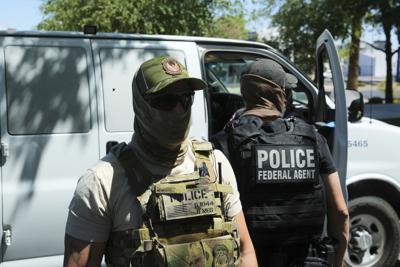


ICE and HSI police protect a van after taking into custody a person outside an immigration court Wednesday, May 21, 2025, in Phoenix. (AP Photo/Ross D. Franklin)
As Arizonans face increased government surveillance and access to confidential, personal information — from employing the Mobile Fortify facial scanner to using IRS data for the Department of Homeland Security’s immigration enforcement efforts to AI-powered Flock Safety license plate readers that line metro Phoenix streets for local law enforcement use — immigration and civil rights groups are raising additional concerns regarding city- and state-sponsored reporting forms tied to immigration-enforcement incidents.
City and state officials have rolled out ways for residents to report alleged misconduct by Immigration and Customs Enforcement (ICE) agents this year — a countermeasure to President Donald Trump’s aggressive immigration enforcement tactics seen across the country. Yet some immigrant rights advocates say the systems that could lead to an investigation into that misconduct may also expose vulnerable communities to new risks, as that sensitive information could be accessed by other parties.
Their concern is not necessarily that the forms are malicious, organizers told CALÓ News, but that there is little clarity about where sensitive information goes once it is submitted, who may ultimately access it and how long it could remain in government records.
“The general problem is that it asks people to share their demographic information, like phone number, address,” said Maria Castillo Rincon with Keep Flagstaff Together, an immigrant rights and resource organization. “Because this is a third-party platform, it is not run by the city itself. And we do not know who has or who doesn't have access to this information.”
City and state officials have said the forms that are subject to Arizona public records laws are a way for residents, regardless of immigration status, to document possible civil rights violations involving immigration enforcement
But according to experts, the concerns community groups are raising are valid given the current administration’s record of accessing sensitive data in order to comply with mass deportation directives.
Organizers say their concerns are shaped by a broader reality in which digital records can persist long after they are submitted and may be accessible to government agencies through public records laws or future administrations. That has led groups like Keep Flagstaff Together to advise residents to think carefully about where they submit sensitive information.
Flagstaff, Phoenix and other cities launch reporting forms
In March, Flagstaff City Council backed new protocols on how the city will handle interactions with federal agencies, including ICE. The reporting form was included in these protocols.
That is when Castillo Rincon and other organizers noticed the form was operated by a third-party service known as Social Pinpoint.
Eva Putzova, co-executive director of Catch Fire Movement, sounded the alarm in an Instagram post. “City staff, the vendor and the vendor’s contractor may all have access to submitted information,” Putzova says in the video. “Anything you type can become stored personal data.”
She goes on to cite the vendor’s privacy policy, noting that information may be disclosed if required by law.
In an email statement to CALÓ News, the City of Flagstaff reaffirmed existing regulations that “stored data must be provided only when requested by warrant”. They also said, “There are mechanisms to reject or challenge these requests if it is believed that the request violates privacy rights.”
This is not the first time Flagstaff residents have raised concerns over privacy. Late last year, the City of Flagstaff Council faced pushback from its contract with Flock Safety, which has come under fire for privacy policies allowing federal immigration enforcement to access its data. Despite potential guardrails put in place by the police, the city council voted unanimously to end its contract and deactivate the cameras.
Two hours south, the City of Phoenix launched its own complaint portal through the Community Transparency Initiative, a package of measures passed earlier this year aimed at documenting interactions involving ICE and protecting immigrant communities. Earlier this year, the Arizona Attorney General Kris Mayes’ office also launched a reporting form.
But organizers who participated in some of those discussions say there are still unanswered questions about confidentiality and data sharing.
Alejandra Echeverria, program coordinator with Borderlands Resource Initiative in Phoenix, said advocates repeatedly asked city officials what guarantees exist that keep submissions confidential.
“They did straight up answer us that they are open to being submitted to Phoenix [Police] for review,” Echeverria said. “So there is no guarantee of confidentiality.”
As of June, Maye’s office told CALÓ that they “have not provided info submitted via the form to federal agencies like the FBI and DHS or others.”
Similar to Flagstaff, the City of Phoenix’s reporting portal is managed by Sivil, a third-party case management platform used by governments and oversight agencies. The company’s privacy policy states that user data may be shared with public-sector clients and disclosed to government agencies or law enforcement in response to subpoenas, court orders or other legal requests.
It also notes that information submitted through the platform may become subject to public records laws after being submitted to the intended agency. Additionally, if the company is acquired by or merged with another, information previously submitted would be accessible to that third-party seller/purchaser.
In a statement to CALÓ News, Dan Wilson, the city’s director of communications, disputed concerns that submissions are routed through a third party, saying the information is protected within city systems even though Sivil "does host the database." He also said that reports are received by the Office of Accountability and Transparency before they may be shared with Phoenix police for investigative consideration or forwarded to the Arizona Attorney General's Office or a federal investigative agency if warranted.
Mayes’ office confirmed that “all submissions to the office's portal are subject to Arizona’s public records law and will be retained according to the state’s retention schedules, which could include into future administrations.”
Echeverria noted that Mayes is up for reelection this year, raising additional concerns among advocates about how potential future officeholders could access records.
“With her opponent being a Republican,” Echeverria said, “if she weren’t to be in office in a few months, would those not be open completely to them?”


As heightened immigration enforcement activity makes its way into Phoenix and Tucson areas, these groups are stepping up to support immigrants.
An ‘important public service’ that requires transparency
For organizers working directly with undocumented families, the responses and the language used by the third-party service providers raise concerns about whether community members fully understand where their information could ultimately end up.
“If we don’t have full details on how the information is going to be used, then how can it be beneficial?” Echeverria asked.
Saira Hussain, a senior staff attorney at the Electronic Frontier Foundation whose work focuses on the intersection of government surveillance and immigrant justice, said concerns about where sensitive information goes after it is submitted are reasonable, regardless of what platform hosts the form.
"I think it's always a fair concern about where exactly the data is going to go and who's going to be able to view it when you're talking about submitting sensitive and confidential information through a form like that,” she said.
She said people should consider limiting submissions to the information necessary to initiate an investigation before sharing additional details directly with investigators
While she said she was not commenting on any specific reporting system, she noted that people often don't know what happens to information "on the back end," making it ideal to share only the minimum needed initially.
“When cities are trying to respond in the moment, I think that it's an important public service that they're providing,” Hussain said, "At the same time, because we're in this age of data just basically flowing — and the goal of the federal government at this moment, particularly DHS, is to suck up as much data as possible — I think that we have to also be responsive to the moment and be very careful about what you're seeking and how you're protecting people's information.”
While uncertainty surrounds official reporting systems, community groups are simultaneously building their own alternatives focused on direct accompaniment and community observation.
Keep Flagstaff Together operates a volunteer rapid response network that dispatches trained observers to potential ICE sightings and incidents.
“We have about 60 observers ready to go at any minute,” Castillo Rincon said.
In Phoenix, Borderlands Resource Initiative, in partnership with Puente Human Rights Movement, developed a volunteer-driven network called Rapid Response Migra Watch that verifies and tracks enforcement activity and provides accompaniment to support at-risk individuals. Organizations in Tucson, such as BorderLinks and the Tucson Community Rapid Response Team, have also built grassroots response networks to assist with similar duties.
Echeverria said their incident reports are kept confidential and stored independently on a secure off-site server that can be used down the line to assist with potential lawsuits.
She said many organizers prefer direct community support models because they keep information and evidence closer to impacted families and their attorneys, rather than entering broader government systems.
For them, the issue is not whether documentation should exist, but who controls it.
“We are just on edge right now,” Castillo Rincon said of the atmosphere in Flagstaff following ICE’s expansion into the city. “It’s like the quiet before the storm.”
Organizers emphasized that they are not encouraging panic. Instead, they hope communities ask more questions before handing over personal information or footage documenting immigration enforcement activity.
“Without that clear transparency,” Echeverria said, “we have to just use our best judgment.”
Lorenzo Gomez is a multimedia journalist based in Phoenix, Arizona. He reports on politics, borderlands, culture and minority communities. He obtained a Master of Mass Communication from the Walter Cronkite School of Journalism and Mass Communication. His work has been featured in the Associated Press, CALÓ News, LOOKOUT, Phoenix New Times and Cronkite News.









(0) comments
Welcome to the discussion.
Log In
Keep it Clean. Please avoid obscene, vulgar, lewd, racist or sexually-oriented language.
PLEASE TURN OFF YOUR CAPS LOCK.
Don't Threaten. Threats of harming another person will not be tolerated.
Be Truthful. Don't knowingly lie about anyone or anything.
Be Nice. No racism, sexism or any sort of -ism that is degrading to another person.
Be Proactive. Use the 'Report' link on each comment to let us know of abusive posts.
Share with Us. We'd love to hear eyewitness accounts, the history behind an article.