
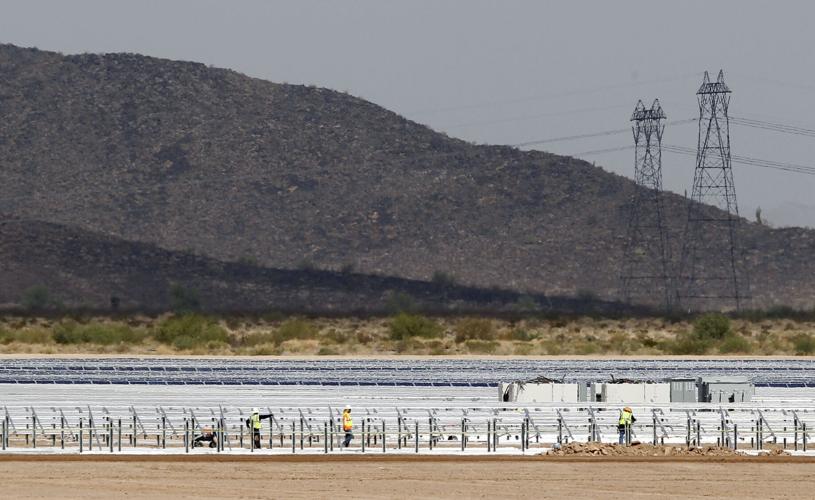

FILE - Workers continue to build rows of solar panels at a Mesquite Solar 1 facility under construction in Arlington, Ariz., Sept. 30, 2011. One of President Joe Biden's signature laws aimed to invigorate renewable energy manufacturing in the U.S.
PHOENIX – As record-breaking heat arrives early, the “Tierra Mía” climate series heads to Arizona to highlight the toll of rising heat indexes amid increased energy costs, water scarcity and the role data centers play in contributing to climate change.
In collaboration with Poder Latinx, El Tiempo Latino and Climate Power En Acción, Tiempo News’ latest installment of their Tierra Mía series covers Latino communities living at the intersection of extreme heat, rising electric bills and funding cuts to clean energy programs, bringing attention to the impact of climate change felt across Arizona and the potential clean energy solutions locals can invest in to abate these effects.
“Solar energy has been something that we need to be utilizing a lot more in the state of Arizona for us to have access to cheaper energy, cleaner energy and more reliable energy than we have,” said Christian Avila, national programs director at Poder Latinx. “That's one of the reasons why we have been engaging in community, not only through Tierra Mía, but also having presence at the doors, working with other Spanish language media to make sure that they're aware of what's happening and then just bringing other resources to them so they can take advantage.”
Tierra Mía’s second episode of its second season comes after last year’s termination of the Solar For All program — a U.S. Environmental Protection Agency (EPA) $156 million grant-funded initiative administered by the Arizona Governor’s Office of Resiliency geared towards families, farmers and businesses to help increase solar capacity, lower electricity bills by 20% for participating households and electrify households without power while avoiding 96,000 tons of CO2 annually.
In addition to the 15.6% of Arizona homes that are powered by solar power now at risk of losing access to affordable clean energy, those affected also include rural farmers and low-to-moderate income families that had plans to install solar panels on their properties before the federal subsidies from the Inflation Reduction Act (IRA) fell through, as covered by the Tierra Mía production crew during their time in the desert.
“What begins as a decision in Washington ends up affecting workshops, installers and working families. Clean energy jobs in Arizona depend on consistent federal investment. When those investments increase, the industry grows. When they go down, thousands of jobs are at risk,” a reporter explains in the Spanish-language documentary episode, at which point Arizona farmers are shown having to decide whether they can expand their farm’s workforce or choose to pay for food and bills instead.
“In Arizona, extreme heat is already a public health crisis. Rolling back programs like Solar for All means higher energy bills, fewer protections and more families left vulnerable when temperatures soar,” said Antonieta Cádiz, executive director of Climate Power En Acción, in an accompanying statement with the release of the episode. “Within just one year, much of the progress made under the Inflation Reduction Act has been reversed, and Latino communities are paying the price.”

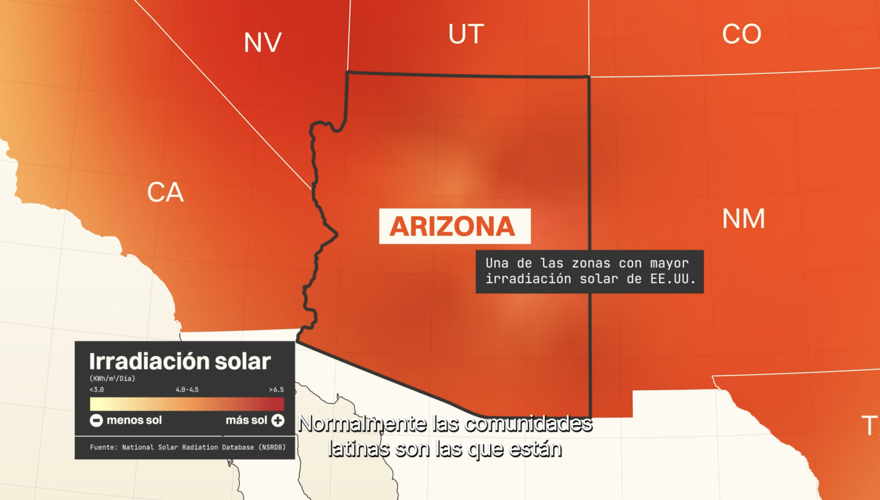
A screengrab from the Tierra Mía episode shows that Arizona has one of highest solar irradiation scores in the U.S. (Tierra Mía)
Arizona is ranked fourth nationally for total installed solar capacity, according to the Arizona Solar Energy Industries Association (AriSEIA), with over 9,700 jobs in the state’s solar market worth an estimated $23.7 billion. The Biden-era Inflation Reduction Act was intended to expand this and give financial incentives for households and businesses switching to clean energy alternatives in order to reduce the federal deficit and carbon emissions by at least 40% by 2030.
The Trump Administration has since foiled these plans with the “One Big Beautiful Bill Act” that passed July 4, effectively eliminating the Greenhouse Gas Reduction Fund — that included the $7 billion budget for Solar For All — while simultaneously allocating $170 billion to the U.S. Immigration and Customs Enforcement’s (ICE) and over $1 billion for federal AI investments, which includes expansions on temperature-raising, water-draining data centers.
“Data centers are taking a big surge of the energy that we don't have, and passing a lot of that cost over to the consumers. Then the issue of the water, specifically, more in the state of Arizona… water can be scarcity,” Avila said. “There [have] been different efforts we've been working with and not working with. Having different conversations with elected officials, possible ways that we can meditate this, but… This is not just a Latino issue. This is an Arizona issue, and they need to have bipartisan support.”
A recent study conducted by Arizona State University’s School of Geographical Sciences and Urban Planning found that data centers have been raising temperatures in their neighboring communities. According to director David Sailor and his team,“for each 1-degree Fahrenheit increase during a heat wave, the risk of death rose by 2.5 percent.”
According to the Cleanview map of data centers in Arizona, there are currently 24 operating data centers and 30 planned projects. Amid the water crisis and rising heat indexes, clean energy is becoming a necessity that many — especially those in low-income and minority communities where climate change impacts are felt the most — are unable to afford without subsidies.
Organizations like Climate Power en Acción and Poder Latinx are working on alternatives and solutions.
“We are part of the Governor's Office of Resiliency meetings and some of the work that we're doing in the community is putting together different workshops and letting them know about the HEARs program. Our community [is] eligible for this kind of relief that helps them for new AC units, different appliances that are going to be more cost effective in terms of energy usage,” Avila explained, referring to the Home Electrification and Appliances Rebate (HEAR) program for these low-to-moderate income households that qualify for discounted energy application and appliance installation.
With a goal of providing Latino communities with economic, immigrant and environmental justice, Poder Latinx is heavily involved in campaigns that uplift climate champions to be elected into positions of power, including the recent Salt River Project (SRP) election in which clean energy beat out Turning Point USA’s pro-industry candidates last year.
They encourage those looking to advocate for cleaner alternatives to go out and vote, keep up to date on upcoming elections and to get active in their communities to start mitigating the effects of climate change in Arizona.
“We know that affordability is a key issue… With Arizona being as hot as it is, and the utility prices continue to go up, one of the only solutions that we see is making sure that we have access to solar energy,” Avila said. “But also the other side of things is making sure that we're investing in community, making sure that folks are empowered to be part of the solution, not only in this issue, but any other issue that they may have.”
Analisa Valdez (she/her) is a freelance journalist based in Phoenix. Her reporting includes community & culture, social justice, arts, business, and politics.









(0) comments
Welcome to the discussion.
Log In
Keep it Clean. Please avoid obscene, vulgar, lewd, racist or sexually-oriented language.
PLEASE TURN OFF YOUR CAPS LOCK.
Don't Threaten. Threats of harming another person will not be tolerated.
Be Truthful. Don't knowingly lie about anyone or anything.
Be Nice. No racism, sexism or any sort of -ism that is degrading to another person.
Be Proactive. Use the 'Report' link on each comment to let us know of abusive posts.
Share with Us. We'd love to hear eyewitness accounts, the history behind an article.