
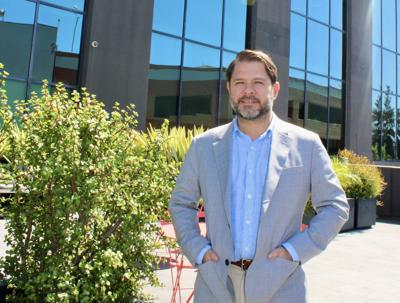



Ruben Gallego in Los Angeles. Photo by Brenda Verano
EDITORS' NOTE: This interview with Sen. Ruben Gallego was conducted on April 6, days before sexual assault allegations against former California gubernatorial candidate Rep. Eric Swalwell were released to the public.
U.S. Sen. Ruben Gallego, the first Latino elected to represent Arizona in the U.S. Senate, sat with CALÓ News in Los Angeles recently to provide his insights on immigration, voter suppression, the war on Iran, the 2026 California gubernatorial election and more.
As senator for Arizona, Gallego represents over 7.4 million people, Latinos are the largest ethnic minority in the state.
Unlike California, Arizona has been known to be a swing state, turning purple for the past six years — electing Donald Trump in 2024 and Joe Biden in 2020. Arizona was also one of the states Trump targeted in his efforts to discredit the 2020 election results and claim election fraud.
He was born and raised in South Chicago with three sisters and his single mother. His parents are Latino immigrants, his mother from Colombia and his father from Mexico.
Gallego said he leads with honesty and transparency, especially as a Democrat in a majority red state. His policies, however, have put him at odds with some members of his party who draw a hard line against issues like immigration, whereas he leans toward the middle of the aisle.
During his stop in L.A. and visit to the CALÓ News office, here’s what the senator had to say as these issues continue to impact Latinos in California, Arizona and the rest of the country.
Immigration and border security
Gallego has publicly criticized the Trump administration's anti-immigration agenda, calling the policies "aggressive, chaotic and restrictive," arguing that the Immigration and Customs Enforcement (ICE) raids prioritize family separation over security. At the same time, Gallego has also supported legislation like the Laken Riley Act, which was signed into law in 2025, mandating that the Department of Homeland Security (DHS) detain undocumented immigrants arrested or charged with theft, burglary, larceny or shoplifting.
Gallego said his legislative decisions reflect the constituents of his state who believe immigration reform and border security are both possible.
“The Arizona Latino and the Arizona voter are very different from other voters,” he told CALÓ News in an exclusive interview. “I respect and trust refugees, but I don't want the refugee system to be abused. I want to take care of Dreamers and people who have been here for a while who have no criminal record or have minor offenses, but I do want the ability to get rid of [undocumented] people who are here in this country who are dangerous.”
“That's like my reflection of how I vote,” he continued. “When I see the opposite happening, when there's an abuse of the system… I didn't vote for funding of ICE and I haven't for a while now, because of what they're doing; massive roundups, they're doing this racial profiling.”
He’s referring to the increase of ICE activity seen around the country but especially in his home state. According to a CALÓ News analysis, immigration enforcement arrests in Arizona more than tripled in Fiscal Year 2025 as street-level operations have become a growing presence in neighborhoods and workplaces during the second Trump administration.
Endorsement retracted for California Governor
During his visit in L.A., Gallego had expressed support for Democratic Congressman Eric Swalwell, who last November officially announced his campaign for California governor.
That quickly changed after sexual allegations against Swalwell surfaced days after he visited the CALÒ News offices. As CALÓ News previously reported, a former staffer of Swalwell told the San Francisco Chronicle that he sexually assaulted her twice, an allegation that the representative has labeled as false. Over the weekend, Swalwell suspended his gubernatorial campaign.
In a statement to CALÓ News, Gallego said he was fully retracting his support for Swalwell.
“I’ve read the San Francisco Chronicle’s reporting and I take it seriously,” Gallego said. “What is described is indefensible. Women who come forward with accounts like this deserve to be heard with respect, not questioned or dismissed. I regret having come to his defense on social media prior to knowing all the information. I am equally as shocked and upset about what has transpired. I am withdrawing my endorsement of Congressman Swalwell, effective immediately.”
Gallego did not add if he was endorsing any of the remaining Democratic gubernatorial candidates.
As California prepares to elect a new governor this year, Gallego said Arizona has learned a lot from the Golden State, especially in a time when Trump carries out an unprecedented immigration agenda. “We know how to fight and organize and basically activate our communities to really defend ourselves,” he said. “When I started getting involved in politics, it was really young Latino and Latina activists who were leading the marches and organizing the protests.”
"We have also seen what happened here in Los Angeles,” Gallego said, in reference to the increasing ICE raids that began last summer. “We recognized that it could also come to Arizona. We've been preparing ourselves as a community.”
War on Iran
As Trump threatened in a Truth Social post on Tuesday that “a whole civilization will die tonight” if Iran failed to meet his latest deadline to strike a deal that included reopening the Strait of Hormuz, a vital shipping route that about a fifth of the world's oil and natural gas usually passes through, Gallego said he — like many other Democrats and Republicans — does not approve of the war.
“It's an illegal war and they're conducting a war in our name,” he said.
Now more than ever Latinos should care about international affairs and wars, he said. “[Latinos] are largely in the military. If you go visit the military bases, it's a lot of Latinos that are serving and if this war spirals out of control, it's going to be more working-class white, Black and Latino kids that [will] keep going overseas," he said.
Before being elected to the Arizona House of Representatives, Gallego enlisted in the Marine Corps in 2002, serving as an infantryman. He deployed to Iraq in 2005, serving in a unit known as “Lucky Lima,” where 22 Marines and a Navy Corpsman were killed in action over eight months, making it one of the hardest-hit units during the war.
“I served in Iraq when I was a young man. It was a horrible war. I saw some horrible things. I don't want to send our men and women to die for the wrong causes,” he said.
Today, Gallego is a member of the House Armed Services Committee, where he has advocated retaining the U.S. qualitative military edge and employing U.S. military power only when necessary.
Voter suppression
As midterm elections approach, Gallego also talked about voter suppression and what that could mean for the 435 seats in the U.S. House of Representatives and 35 of the 100 seats in the Senate that are up for grabs in November.
Arizona is one of the states that, earlier this month, sued against Trump’s mail ballot executive order, which attempts to restrict mail-in voting and impose federal control over state election procedures.
Trump's executive order looks to require the United States Postal Service to determine who is eligible to vote by mail and to track their ballots. The executive order, titled “Ensuring Citizenship Verification and Integrity in Federal Elections,” also requires the Secretary of Homeland Security to provide to each state lists of eligible voters who are state residents and instructs the Department of Justice to prioritize criminal prosecutions of state and local officials “who issue federal ballots to individuals not eligible to vote in a federal election,” as well as withhold federal funding from states that refuse to comply with the mandates in the order.
States like Arizona, California, Colorado, Nevada, New York, Oregon, Michigan, Delaware, Massachusetts and more argue the order is unconstitutional and a violation of the separation of powers, as states have the primary authority to manage their own elections.
“They’re trying to stop mail-in voting because Latinos now use mail-in voting,” Gallego said.
According to Gallego, Arizona’s mail-in voting was started by Republicans to “help their base, which is older voters, largely white retirees,” a practice he said was picked up by Latinos around 2007.
“At that time, we knew that we could talk many times to our voters and not just rely on a small [voting] window, especially because our people work. In Arizona, and I’m sure it's the same here in Los Angeles, you have to pick up your kids first from school and go to work. So we had very little turnout because it just wasn't physically possible to go to vote,” he said. “That's when we used the rules of the game that they established and we got Latinos to sign up to vote by mail. We got really good at it.”
Gallego said the Trump administration fears the power of Latino voters, which is why he looks to advance executive orders that could make it harder for working-class Latinos to cast their vote. “Trump is so unpopular right now and instead of him trying to fix himself, he is trying to make it hard for people to vote,” he said.
Language justice
When he was the representative for Arizona's third congressional district, he held the first House of Representatives’ hearing on the crisis of Missing and Murdered Indigenous Women (MMIW) to address high rates of violence against Indigenous women, focusing on federal, state and tribal investigations.
He said language justice is also a principle he holds close in politics.
“We bring headsets for translation services [to town halls] that are offered to people who might not understand English,” he said. “We've seen that it encourages more and more people to come out and participate and feel comfortable asking questions that they normally wouldn't. Cultural connection matters too. If you're Latino, do not be afraid to speak Spanish. Maybe we're imperfect in how we use it, but the attempt really matters.”
The 2028 presidential race
Gallego, 46, said he is not closed to the idea of running for president in the near future. He told CALÓ News he would be open to a potential presidential bid only if he could still be a present father to his three kids.
“I do worry about this country. I worry about its future. We can't have another [presidential] Republican win,” he said.
For Gallego, it is the future of his kids in this country that has pushed him to keep the 2028 presidential door open.
Gallego is next up for reelection in 2030 and will serve in his current Senate seat until January 2031.










(0) comments
Welcome to the discussion.
Log In
Keep it Clean. Please avoid obscene, vulgar, lewd, racist or sexually-oriented language.
PLEASE TURN OFF YOUR CAPS LOCK.
Don't Threaten. Threats of harming another person will not be tolerated.
Be Truthful. Don't knowingly lie about anyone or anything.
Be Nice. No racism, sexism or any sort of -ism that is degrading to another person.
Be Proactive. Use the 'Report' link on each comment to let us know of abusive posts.
Share with Us. We'd love to hear eyewitness accounts, the history behind an article.