
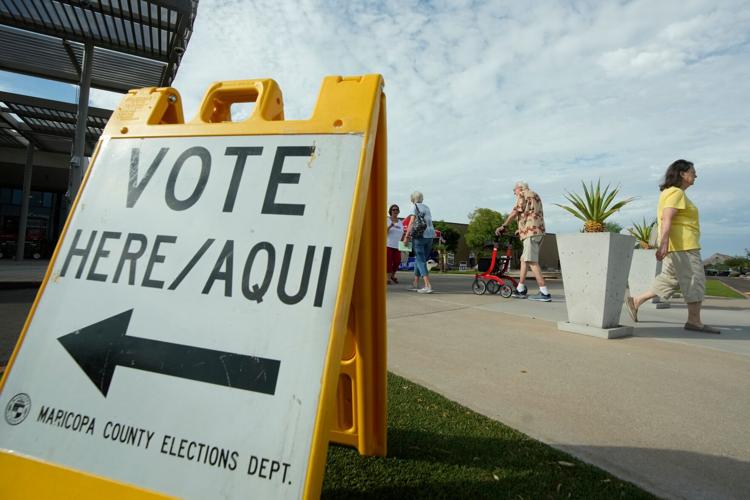


Arizona voters come and go as cast their ballots at a polling location on primary election day, Tuesday, July 21, 2026, in Phoenix. (AP Photo/Ross D. Franklin, File)
As Latino communities across Arizona grapple with the fear and uncertainty surrounding immigration enforcement, voters are also confronting the everyday pressures of making ends meet in a state where extreme heat, rising electricity bills and the overall cost of living continue to strain household budgets. With the Nov. 3 election approaching, these concerns, along with environmental issues and access to clear, trustworthy information, are shaping how Latino voters make their choices on the ballot.
National polling by UnidosUS and a 2026 Arizona voter poll from Arizona State University offer insight into Latino voters’ priorities. Meanwhile, community organizations such as Chispa Arizona, Living United for Change in Arizona (LUCHA) and Progress Arizona are helping residents understand the issues on the ballot.
Vianey Olivarria, executive director of Chispa AZ, said affordability and climate concerns remain priorities for the Latino and working-class families her organization serves. Some ballot measures address issues that intersect with these concerns, but understanding the complex ballot language adds another challenge.
The Phoenix-based organization works with Latino families and working-class communities statewide to build political power, advocate for environmental justice, and engage in civic life.
According to a UnidosUS bipartisan poll, “Only 16% of Latino voters in Arizona said they were living comfortably while another 81% said they were just meeting expenses, having trouble meeting them or had only a little money left over.” The poll surveyed 400 Latino voters in Arizona, including 200 respondents in competitive congressional districts.
“We believe that everybody, regardless of where they live or what their income is, deserves clean air, clean water, access to the outdoors, to be protected from the system heat, and to have their voices heard,” Olivarria told CALÓ News.
Rising costs put pressure on families
The cost of living is a leading concern for Latino voters in Arizona, with utility bills adding to the financial strain many families face.
According to a 2026 UnidosUS poll of Latino voters in competitive districts, 57% of Latino voters in Arizona identified the cost of living as a top issue. The economy, including jobs and wages, followed at 44%, while health care ranked at 32%, housing at 25% and immigration reform at 23%.
Olivarria emphasized this, saying that “the cost of electricity and the rising cost of living is a top priority for many Latinos.”
That responsibility lies with the Arizona Corporation Commission (ACC), a five-member elected body that regulates investor-owned utilities, including Arizona Public Service (APS) and Tucson Electric Power (TEP), and determines the rates they can charge customers.
The commission has the authority to “act as judges in rate cases.” Unlike regulators in most states, Arizona’s utility commissioners are elected by voters.
Two commission seats are on the ballot. The candidates include incumbent Republican Kevin Thompson and party fellow Ralph Heap, Democrats Jonathon Hill and Clara Pratte and Green Party member Mike Cease.
The results will help determine who oversees future utility decisions.
In central Arizona, APS has proposed a rate increase that, if approved, could raise the average customer’s annual electricity costs by $240. The commission is expected to issue its final decision before the end of 2026.
In southern Arizona, an administrative law judge recently recommended an 11.2% rate increase for TEP and supported allowing annual rate adjustments. The ACC is scheduled to consider the recommendation on Nov. 17.
Olivarria says residents want utility companies held accountable by regulators.
“There are people who are supposed to be regulating our electricity and holding utility corporations accountable to make sure that it’s serving the community and not just making a profit,” she said in reference to the upcoming ACC election.
Statewide Prop. 316 also addresses rising costs of living. It would require voter approval for new or increased local taxes on groceries and cap those taxes at 2%. Although the measure addresses grocery taxes rather than electricity rates, it is also part of the broader debate over rising costs among Latinos in Arizona.
Extreme heat and data centers raise environmental concerns
Climate change is another priority for Latino communities, particularly in neighborhoods with fewer trees, less shade and more pavement. These conditions contribute to the urban heat island effect, in which developed areas become hotter than surrounding areas.
In Phoenix, the city’s 2024 Shade Phoenix plan indicates that while most neighborhoods in the city have an average tree canopy coverage of 11%, “Central City South, much of West Phoenix, and several neighborhoods along Interstate 17” have less than 8% tree canopy “and in some cases, lower than 5%.”
In Tucson, the city’s Climate Action Hub tracks neighborhood tree canopy and heat levels to identify areas most in need. The tree equity score (0-100) measures “how equitably tree canopy is distributed, with 100 indicating achieved tree equity and lower scores signaling a greater need for canopy.” The heat severity score measures “the deviation from mean surface temperatures in urbanized areas.”
Their tree equity dashboard gives Rita Ranch a tree equity score of 62 and a heat severity score of 7.2. Wilmot scores 55 for tree equity and 7.4 for heat severity. Midvale Park scores 56 and 7.8, while Menlo Park scores 54 and 6.2.
Olivarria said neighborhoods with fewer trees can experience higher summer temperatures, adding to the burden on families already struggling with electricity bills.
“Just by having fewer trees in a neighborhood, the neighborhood can become up to five degrees hotter in the summer. We just went through the summer, and some folks are paying $600 to $700 a month; we cannot afford not to keep the lights on,” she said.
Data centers are another growing concern among communities. These facilities require electricity to operate and water for certain cooling systems, raising concerns about their effects on local resources as Arizona continues to experience extreme heat and drought.
“There are a lot of people who are making the connection between data centers and the rise in utility costs and how much that can impact,” Olivarria said, adding that these concerns are prominent in Maricopa and Pima counties and are spreading as data centers expand across the state.
Although no specific ballot measure addresses data centers, the issue could shape how voters evaluate candidates and decisions about future development, energy use and environmental protections.

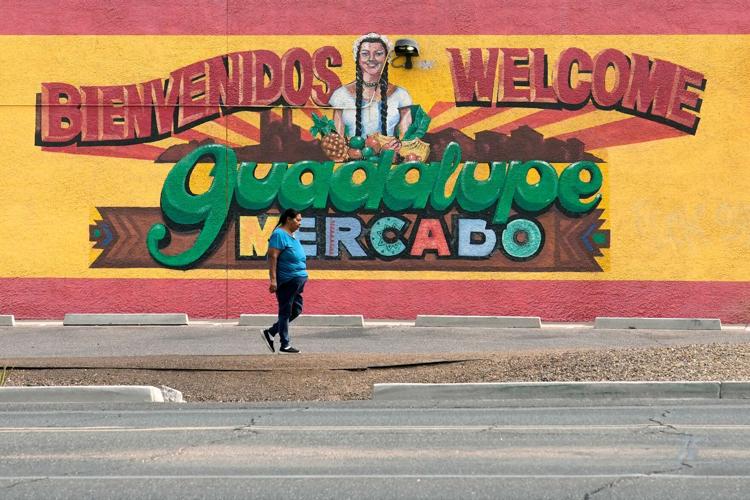
A person walks past a mural promoting Guadalupe, Ariz., May 19, 2026. (AP Photo/Ross D. Franklin)
Trusting the electoral process
Election rules and voter confidence are also part of the debate ahead of the Nov. 3 election.
Prop. 144, a statewide measure, seeks to change Arizona election rules by requiring voters to show a government-issued identification when voting, including by mail. It also includes other changes to election laws and campaign finance rules.
A 2026 poll by Arizona State University’s Center for Latinas/os and American Politics Research and Hispanic Research Center surveyed 1,300 registered voters from Aug. 18 to Sept. 4, including 700 Latino respondents.
The poll found that 61% of Latinos were “somewhat” or “very concerned” that voter fraud would be a significant problem in the Nov. 3 election, compared with 51% of Arizona voters overall.
At the same time, 64% of Latino respondents said they were confident that mail-in ballots would not be a problem, compared with 70% of voters statewide who said they were confident that ballots returned through the U.S. Postal Service would be fairly counted and free of fraud.
Spanish-language information helps voters make informed choices
Understanding a long ballot can be challenging for any voter, particularly when it includes judicial candidates, local races, and propositions with unfamiliar or technical language. For voters whose preferred language is Spanish, clear translations and accessible explanations can help make the process more manageable.
Olivarria noted that translating ballot language can be difficult when the original wording is confusing. Phrases such as “vote for no more than two” can require additional explanation to ensure voters understand what they are being asked to do.
That’s why Chispa Arizona and other organizations provide bilingual voter guides, social media education, canvassing and phone banking. Olivarria said the organization also helps residents understand how to register, locate polling places and engage with elected officials and public meetings.
“All of our material is bilingual,” she said. “We make sure Spanish-speaking voters and the community are also informed, like everybody else.”
LUCHA, which focuses on social, racial and economic justice, also provides Spanish-language election resources through its vote center. The guide includes election dates, links to registration and ballot tracking resources and information on where to vote or drop off a ballot. They also offer this information in English.
Progress Arizona’s Spanish-language progressive voter guide provides information about Arizona’s ballot measures and lets users select a county to find local voter guide information.
These resources can help Latino voters, regardless of the language they speak, make confident and informed decisions when casting their ballot.
“Organizations like us do a huge effort to make sure that everybody has the information they need,” said Olivarria. “That’s why we do a lot of community education because we believe that regardless of how much investment is happening in our communities, we deserve to have a voice.”
Barbara Flores is a freelance writer for CALO News. She grew up in San Diego, California, before moving to Tucson, where she studied journalism at the University of Arizona. She reports on elections, Latino communities, sports and community events.








(0) comments
Welcome to the discussion.
Log In
Keep it Clean. Please avoid obscene, vulgar, lewd, racist or sexually-oriented language.
PLEASE TURN OFF YOUR CAPS LOCK.
Don't Threaten. Threats of harming another person will not be tolerated.
Be Truthful. Don't knowingly lie about anyone or anything.
Be Nice. No racism, sexism or any sort of -ism that is degrading to another person.
Be Proactive. Use the 'Report' link on each comment to let us know of abusive posts.
Share with Us. We'd love to hear eyewitness accounts, the history behind an article.