
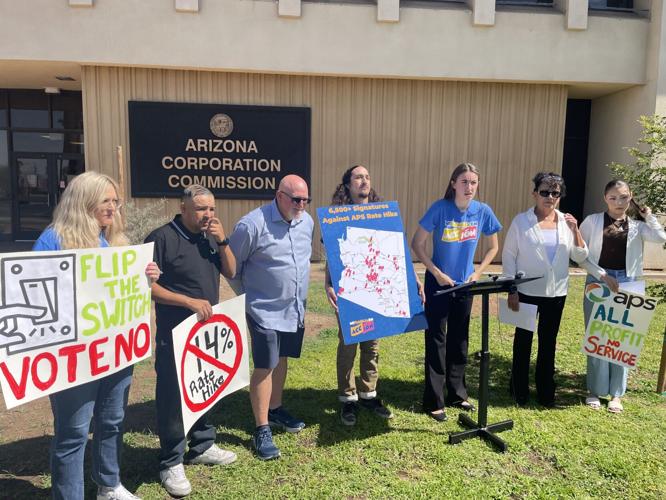




Mi Familia En Acción members and Valley residents stand outside of the Arizona Corporation Commission building, prepared to speak out against the rate increase proposed by APS, on Wednesday, May 6, 2026. (River Graziano/CALÓ News)
With two seats on the Arizona Corporation Commission (ACC) up for election this November, Arizona voters can benefit from understanding the agency’s powers and responsibilities.
Referred to occasionally as “the fourth branch of government,” the ACC has the capacity to enforce regulations, adopt new regulations and act as judges in rate cases.
Article 15 of the Arizona Constitution established the ACC in 1912. Originally, the commission had three seats and commissioners served six-year terms with no term limits. After voters passed Proposition 103 in 2000, the commission added two seats, set terms at four years and limited commissioners to two consecutive terms.
Arizona is one of about a dozen states that elect their regulatory utility commissioners. In most states, governors or legislators appoint them. The ACC also stands out for having responsibilities beyond public utility regulation, including business incorporation, railroad and pipeline safety and securities regulation.
Who’s running for the ACC?
Currently, the ACC commissioners are Chairman Nick Myers, Vice Chair Rachel Walden and Commissioners Lea Márquez Peterson, René Lopez and Kevin Thompson, all of whom are Republican.
On Nov. 3, two ACC seats — Myers’ and Thompson’s — will be up for election. This means Arizona voters can select two names on the ACC section of their ballot.
Following the July 21 primary election, the candidate list was solidified, including Democrats Jonathon Hill and Clara Pratte, Republicans Kevin Thompson and Ralph Heap and Green Party member Mike Cease.

Event moderator Reagan Priest (right) asks Arizona Corporation Commission candidates Clara Pratte, Jonathon Hill and Mike Cease about utility rates, data centers and renewable energy, among other topics, during a candidate Q&A on Oct. 2, 2026, in Phoenix, Ariz. (River Graziano/CALÓ News)
Kevin Thompson (Republican, incumbent)
Thompson has been serving on the ACC since 2023 and held the position of chairman prior to Myers. Before his time with the ACC, he worked in the natural gas industry for over a decade and served on the Mesa City Council for eight years. According to his campaign website, Thompson’s priorities as commissioner include: eliminating utility mandates and subsidies, reducing regulations for new energy technologies and improving the efficiency of the ACC’s proceedings.
Ralph Heap (Republican)
After a 40-year career in orthopedic surgery, Heap was elected to the Arizona House of Representatives for the 14th district in 2024. According to his website, Heap aims to “bring accountability, common sense, and conservative values” to the ACC. His platform prioritizes rural water access, small business freedom and regulatory transparency.
Jonathon Hill (Democrat)
Before campaigning for the ACC, Hill earned advanced degrees in aerospace engineering and geology from Arizona State University, where he went on to contribute to several NASA space missions — a background that Hill’s website describes as “unconventional yet highly relevant”. His platform calls for limiting data centers, reforming the rate-setting process and protecting water access for low-income Arizonans.
Clara Pratte (Democrat)
Pratte has held senior roles at the U.S. Small Business Administration and the Department of Commerce, and spent time as an adviser to President Joe Biden at the start of his administration. She is also the co-founder of Navajo Power, an electricity provider with a focus on tribal and rural utility access. According to her campaign website, Pratte aims to improve transparency for utility companies, protect water resources and advocate for smaller communities.
Mike Cease (Green Party)
Cease currently serves as a secretary for the Arizona Green Party, and has previously campaigned in elections for Pima County Recorder, Tucson City Council and Mayor of Tucson. According to a Facebook page for his ACC campaign, Cease’s platform includes expanding business accountability beyond utility rate cases and accelerating renewable energy adoption.
The Citizens Clean Elections Commission hosted a debate on Sept. 9 that included Pratte, Hill and Thompson. All five candidates were invited to a candidate meet-and-greet hosted by a coalition of local organizations on Oct. 2, but only Pratte, Hill and Cease attended.
What’s at stake at the ACC
Interest in the ACC’s decisions and activities has increased after a rate-increase proposal for Arizona Public Service (APS), which would raise the average customer’s cost by $240 a year if approved. Public hearings were held in May and July of this year, and the final vote is expected as soon as late Nov., with a deadline of Dec. 31.
Tucson Electric Power (TEP) also filed a rate-increase proposal in June 2025, with public comment hearings being held by the ACC in April and May of this year. If approved, Tucson customers would pay around $233 more per year for utilities. The deadline for a final vote on this case is Nov. 17.
Data center expansion and its associated utility costs are also a current concern for many Arizonans. In April, the ACC held a workshop on the topic of data centers and other large load utility customers; in a statement on its website, the ACC said there was a “clear consensus” that the average rate payer should not be responsible for the cost of large load users and that there is a need for new or improved policy to ensure transparency from utility companies.
However, a report submitted to the ACC on Oct. 2 by citizen activist and data analyst Abhay Padgaonkar, and reviewed by an independent utility consultant, claims that homeowners and businesses paid a total of $537 million between 2023 and 2025 for costs associated with the large-load industry. An APS spokesperson denied these claims, according to a 12News report.
Earlier this year, Attorney General Kris Mayes filed a lawsuit against the ACC over their approval of a contract for the Project Blue data center. She also filed several rehearing requests in March, accusing commissioners of violating state law and acting against utility customers' interests.
Recent actions taken by the ACC include serving a subpoena on JW Water Holdings regarding its utility purchases, issuing a temporary cease and desist order against a stablecoin company alleging it offered and sold unregistered securities and approving a one-time bill credit for APS customers for the month of November.
Mail-in ballots were sent last week to Arizona voters on the Active Early Voting List. Voters should return them by Oct. 27. Election day is Nov. 3.
River Graziano is a freelance journalist for CALÓ News. They grew up in the Ahwatukee area of Phoenix and later attended ASU in Tempe, where they spent two years as an editor at The State Press. Their reporting with CALÓ News covers advocacy efforts impacting Latine communities across the Valley.








(0) comments
Welcome to the discussion.
Log In
Keep it Clean. Please avoid obscene, vulgar, lewd, racist or sexually-oriented language.
PLEASE TURN OFF YOUR CAPS LOCK.
Don't Threaten. Threats of harming another person will not be tolerated.
Be Truthful. Don't knowingly lie about anyone or anything.
Be Nice. No racism, sexism or any sort of -ism that is degrading to another person.
Be Proactive. Use the 'Report' link on each comment to let us know of abusive posts.
Share with Us. We'd love to hear eyewitness accounts, the history behind an article.