
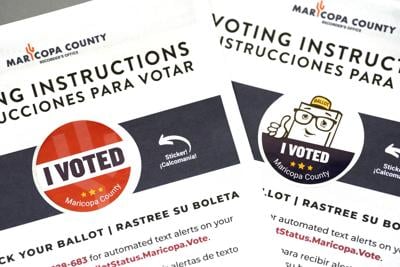

Two of the "I Voted" stickers that are mailed, one for each ballot mailed, with mail in ballots in Maricopa County shown here Wednesday, Oct. 30, 2024, in Tempe, Ariz. (AP Photo/Ross D. Franklin)
Arizona voters will decide statewide races and ballot propositions on Nov. 3, with early voting already underway. For Latino voters across Arizona, this election presents an opportunity to weigh in on issues affecting their communities, including affordability, housing, taxes and education.
Community organizations across Arizona are working to make election information accessible, address concerns and encourage civic participation by helping residents understand how elected officials influence their daily lives. They emphasize the importance of staying informed, participating in public meetings and holding elected leaders accountable.
As the general election approaches, Arizona voters have several ways to cast their ballots, including early mail-in ballots, voting in person at early voting locations and voting in person on Election Day.
From key deadlines to Latino voters' concerns, here’s what Arizona voters need to know before the general election.

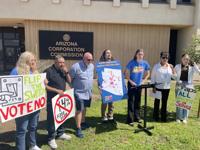
With two seats up for grabs in November, here’s what you should know about the Arizona Corporation Commission and how the outcome of this race will impact your everyday living costs.
Key voting deadlines in Arizona
Friday, Oct. 23: Last day to request a mail-in ballot.
Tuesday, Oct. 27: Recommended deadline to mail back your ballot to allow time for delivery.
Unlike other states, Arizona ballots need to be mailed out at least a week before Election Day.
Friday, Oct. 30: Last day to vote early in person.
Saturday, Oct. 31 and Monday, Nov. 2: Emergency voting days.
If a voter cannot vote during the early voting period, emergency voting is available to them. Voters must sign an affidavit under penalty of perjury stating that an emergency prevents them from voting on Election Day.
Tuesday, Nov. 3: Election Day is the last day to vote in person or drop off your ballot.
How to vote in Arizona
Arizona voters can vote early in person, by mail or on Election Day. Voters can request a mail-in ballot and check their ballot status through the state’s Voter Information Portal website. The last day to request a ballot is Oct. 23.
Polling locations, voting hours and ballot drop-offs may vary by county.
Maricopa County voters can visit the county’s election website for the nearest polling center. Most centers operate from 9 a.m. to 5 p.m. until Election Day.
Pima County residents can visit their county's voter information page. Hours vary by location.
For other counties and residential areas, voters can visit the Arizona Voter Information Portal website.

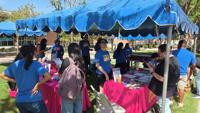
By educating Phoenix residents on how everyday issues are impacted by who’s in office, a new campaign by Mi Familia en Acción aims to encourage Latinos in Arizona to become more civically engaged.
Do I need to show ID to vote in Arizona?
To cast a ballot, voters must present an acceptable form of identification, such as a valid Arizona driver's license Arizona identification card, Tribal enrollment card or a valid U.S. federal, state or local government-issued ID.
Voters who cannot provide one of these forms of identification must present two documents that show their name and current address. Acceptable documents include a voter registration card, utility bill, bank or credit union statement, Arizona vehicle registration or a property tax statement.
For more information about voter identification requirements, visit the Maricopa County Election website or the Pima County Recorder's Office website. Voters in other Arizona counties can visit their county recorder’s website or the Arizona Secretary of State’s website for additional information.
What will be on the Arizona ballot?
The general election includes federal, state and local contests, as well as statewide and county ballot propositions. The offices and measures on your ballot will vary by district and county.
Arizona voters will choose representatives for Congress and key state offices that shape education, tax and public-safety policies.
The ballot includes the following statewide races:
Governor and Lieutenant Governor
Secretary of State
Attorney General
State Treasurer
Superintendent of Public Instruction
State Mine Inspector
Corporation Commissioner
Congressional district, county and other local contests will vary depending on your voter registration address.
Voters will also consider eight statewide propositions. The measures address a variety of policy issues, which include taxation, election requirements, school district budgets, student athletics and more.
The propositions are:
141: Vehicle mileage taxes
142: Preferential treatment and discrimination
144: Election I.D. requirements
316: Local grocery taxes limit
317: Arizona Department of Homeland Security
318: Student athletics
319: Photo enforcement systems
320: School district budgets
Pima and Maricopa counties also have their own propositions, which include:
425: Pima County spending limit
427: Pima Joint Technical Education District $250 million bond
430: Pima Community College $250 million bond
421: Tucson Electric Power franchise agreement
422: Reid Park Zoo sales tax
413: Extend the public-safety sales tax

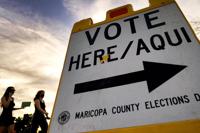
The state is preparing to remove voters from its early voting list under a state law signed by former Gov. Doug Ducey, a Republican, in 2021.
What issues matter to Latino voters?
For many Arizona families, elections are connected to concerns that extend beyond politics. Housing costs, utility bills, access to health care and immigration policies can shape household decisions and their communities' well-being.
According to a recent article by Celia Montoya for CALÓ News, Monica Sandschafer, Arizona state director of Mi Familia en Acción, said that “rising living costs are putting pressure on families, with some turning to food banks.”
Those economic pressures provide important context for the general election, when Arizona voters will decide federal, state and local contests, along with statewide and local ballot propositions. Those results will help determine who makes decisions about taxes, schools, public services, voting and law enforcement.
In Pima County, their local ballot measures bring decisions about education, public spending and municipal services. Propositions 427 and 430 focus on education funding, while Propositions 421 and 422 concern Tucson’s relationship with Tucson Electric Power and a proposed sales tax supporting Reid Park Zoo.
In Maricopa, voters will consider Proposition 413, which proposes extending a countywide public-safety sales tax that funds adult and juvenile detention facilities and public safety programs.
These decisions can connect directly to issues concerning household budgets, school facilities, public safety, workforce and local services.
Civic engagement organizations such as Mi Familia en Accion, Living United for Change (LUCHA), Chispa AZ, Aliento AZ, GreenLatinos AZ and Grita Canta Vota are helping Latino voters understand which public officials and government agencies make decisions affecting these issues and how community members can participate in the process.
Where can I find Spanish-language voter information?
The U.S. Department of Justice identifies Maricopa, Pima, Santa Cruz and Yuma counties as covered by the federal Spanish-language voting assistance requirements under Section 203 of the Voting Rights Act. The act provides language assistance, such as translating ballots and providing oral assistance to voters who need help understanding voting information.
Ballots from the counties listed above include Spanish translations for federal, state and local contests, as well as statewide and county propositions.
For more information on voting accessibility, voters can visit the Pima County Recorder’s website or Maricopa County voter information page.
Barbara Flores is a freelance writer for CALO News. She grew up in San Diego, California, before moving to Tucson, where she studied journalism at the University of Arizona. She reports on elections, Latino communities, sports and community events.






(0) comments
Welcome to the discussion.
Log In
Keep it Clean. Please avoid obscene, vulgar, lewd, racist or sexually-oriented language.
PLEASE TURN OFF YOUR CAPS LOCK.
Don't Threaten. Threats of harming another person will not be tolerated.
Be Truthful. Don't knowingly lie about anyone or anything.
Be Nice. No racism, sexism or any sort of -ism that is degrading to another person.
Be Proactive. Use the 'Report' link on each comment to let us know of abusive posts.
Share with Us. We'd love to hear eyewitness accounts, the history behind an article.