

(Arizona Luminaria)
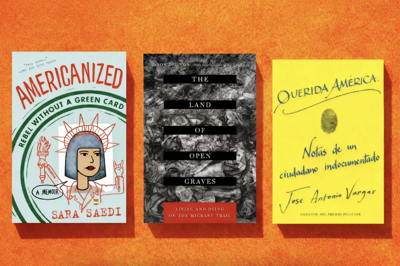
Weaving together ethnography, archaeology, linguistics and forensic science, anthropologist Jason De León starkly documents the human consequences of U.S. immigration policy in "The Land of Open Graves: Living and Dying on the Migrant Trail."
In the book, he documents how federal strategies have pushed thousands of migrants to cross through the Sonoran Desert in Arizona, where the risk of death is constant. His work not only describes a crisis — it reveals a system that turns the landscape into a lethal border.
With moving detail, De León reconstructs the journeys of those who have attempted to cross the border again and again, and reveals the stories held by objects and bodies left behind.
"My dad is from México, my mom is Filipino, my whole family are immigrants," De León said in an interview with PhillyCAM, a community media outlet. "For many years working in México, I met many migrants who were preparing to migrate or who had been deported from the United States; those stories affected me deeply."
De León is a professor of anthropology and Chicana/o and Central American studies. He is also the director of the Cotsen Institute of Archaeology at the University of California, Los Angeles. Over the years, he developed an idea: "Maybe I can use archaeology to understand the migrant experience."
That led to initiatives such as the Undocumented Migration Project and several key books on migration, including "Soldiers and Kings," winner of the 2024 National Book Award for nonfiction, and "The Land of Open Graves," which is spotlighted here alongside works from two other authors.
The books represent three distinct approaches to immigration: personal memoir, ethnographic research and young adult narrative. Each deepens the conversation in a different way.
Jose Antonio Vargas, originally from the Philippines, came to the United States without documentation at age 12. He lived for decades in the shadows while building a notable career at outlets including the Washington Post and The New Yorker. In 2011, he disclosed his immigration status — an act that transformed his life and work. In "Dear America, Notes of an undocumented citizen," Vargas sets aside the political debate to offer an intimate and unflinching reflection on identity, citizenship and belonging.
Sara Saedi discovered at 13 that her life in the United States was shaped by a secret: her undocumented status. Having arrived from Iran as a child, she grew up as any high-achieving student would — until her sister's inability to get a job without a Social Security number revealed the truth. In "Americanized: Rebel Without a Green Card," Saedi turns that revelation into a sharp and honest account of identity, fear and belonging in an undocumented adolescence.
The human cost of the border
"The Land of Open Graves" brings together six years of ethnographic, archaeological and forensic research on migration — between Latin America and the United States — by De León between 2009 and 2015. Michael Wells' photographs bring the realities of life and death to the book.
In the striking book, De León illuminates one of the most urgent issues of our time: the human cost of U.S. immigration policy. Through sober, penetrating narrative, the work exposes the suffering and death that repeat daily in the Sonoran Desert in Arizona, where thousands of people face extreme conditions in their attempt to cross from México into the United States.
De León has built a career that blends academic leadership with fieldwork in diverse settings. He is a member of the Academic Council of the Field Research Consortium and has taught at the University of Michigan and the University of Washington. Trained at UCLA and holding a doctorate from Pennsylvania State University, his early research took him to Tlaxcala, México.
His experience in the desert borderlands focused on migrating people dying because of government policies.
"Many of these deportees are now running scared across Arizona's Mars-like landscape to reunite with family members or simply return to the only place they have ever called home," De León says in his book. "My argument is quite simple. The terrible things that this mass of migrating people experience en route are neither random nor senseless, but rather part of a strategic federal plan that has rarely been publicly illuminated and exposed for what it is: a killing machine that simultaneously uses and hides behind the viciousness of the Sonoran Desert."
Identity without papers
"Dear America: Notes of an undocumented citizen" is not a policy treatise but an intimate intervention in the debate over citizenship and belonging. In this provocative memoir, Vargas — a Pulitzer Prize-winning journalist and perhaps one of the most visible immigrants without citizenship in the United States — reconstructs a life marked by public invisibility and constant exposure. Born in the Philippines and brought to the country without documentation as a child, Vargas managed to work in some of the country's most prestigious newsrooms while concealing the origins of his story.
His decision to disclose his immigration status — accepting personal and professional risks — makes the book something more than a memoir: an act of defiance.
Vargas questions conventional notions of national identity and articulates a defense of immigrants' rights at a moment defined by mass displacement on a global scale. The work also asks what it means to call a country home that may never claim you back.
His book dedication is personal and global: "To Mama in the Philippines, and to every American who has made me feel at home in the United States. To the world's migrant population, 258 million and counting."
An undocumented youth
In "Americanized: Rebel Without a Green Card," Saedi — a bright student with a spotless academic record — discovers a family secret that reconfigures her place in the world: her undocumented status in the United States. Having arrived from Iran as a small child, she does not grasp the weight of being undocumented, and the invisible limitations it carries, until her school years.
Soon, constant fear of deportation coexists with the ordinary anxieties of any young person. Saedi narrates her path toward obtaining legal residency, though the immigration process is only one layer of her experience as an Iranian American teenager. Amid family revelations — including her parents' strategic divorce — and the anxieties common to adolescence, she moves fluidly between the intimate and the political, drawing a portrait in which legal precarity and daily life intertwine with incisive candor.
For Saedi, narrating her experience of growing up undocumented has been a cathartic process. "It’s so liberating to take something I was so ashamed of as a teenager and turn it into a project that has opened so many doors for me," she said in a 2021 interview.
This article first appeared on AZ Luminaria and is republished here under a Creative Commons Attribution-NoDerivatives 4.0 International License.






(0) comments
Welcome to the discussion.
Log In
Keep it Clean. Please avoid obscene, vulgar, lewd, racist or sexually-oriented language.
PLEASE TURN OFF YOUR CAPS LOCK.
Don't Threaten. Threats of harming another person will not be tolerated.
Be Truthful. Don't knowingly lie about anyone or anything.
Be Nice. No racism, sexism or any sort of -ism that is degrading to another person.
Be Proactive. Use the 'Report' link on each comment to let us know of abusive posts.
Share with Us. We'd love to hear eyewitness accounts, the history behind an article.