
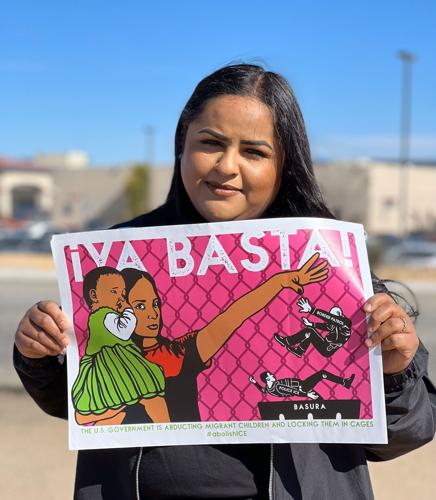



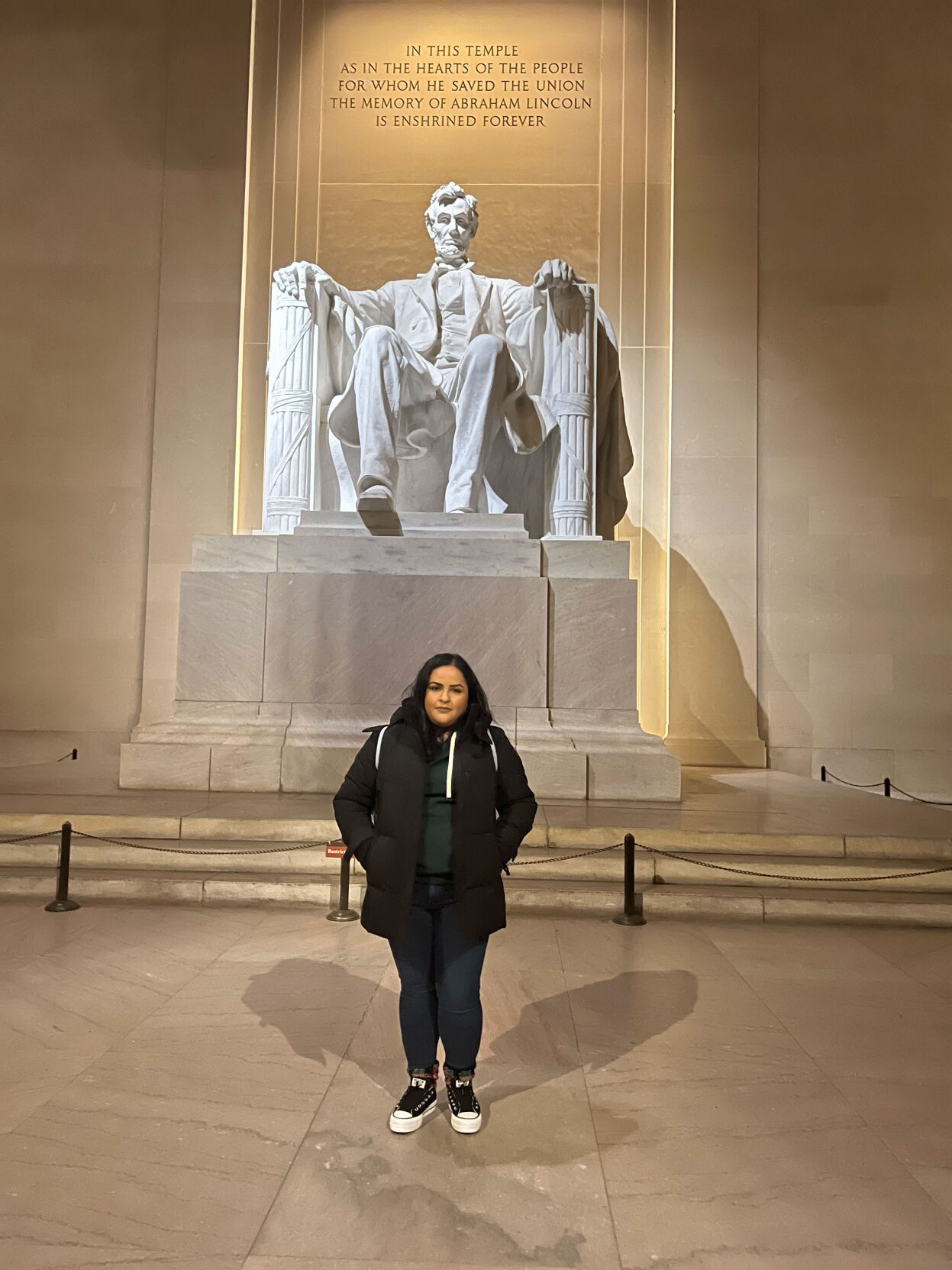
Mariela Jaquez holding a sign that reads "Ya Basta."
Get stories like these delivered straight to your inbox. Sign up for the CALÓ Newsletter.
When Javier Garcia, Mariela Jaquez’s husband, was denied residency in 2012, they were required to leave the U.S. and move temporarily to Nayarit to begin the application process anew.
That experience gave Jaquez an even stronger understanding of the suffering of immigrant families in the country.
“[He] was forced to stay in Mexico for seven months,” she remembers. “[When] I decided to go with him […] I did, in a way, live what it is to be living in a country that you're used to […] and then having to just leave everything behind. I was afraid because I wasn't sure. There was nothing that guaranteed that he would be able to come back.”
In 2017, when Donald J. Trump won the Presidential election, Jaquez felt it was a tipping point in her life, a call to action to make things better for the Latino immigrant community. She recounted that during the Trump administration, she had — and continues to have — family and friends who are undocumented. During that time, she witnessed their deep fear and uncertainty about what the future held. They were apprehensive about the possibility of deportation, unsure whether they would be forced to leave their minor children behind or uproot their families entirely.
Reflecting on the period leading up to the 2016 election, she admitted that she never believed such an outcome was possible. “I remember I would say, ‘No, I don't think anyone would vote for him. Who in the right mind would vote for him?’” she recalled, adding that the election results felt like a “big bucket of cold water” for her.
Motivated by the situation's urgency, she decided to take action to support her community. It was then that she joined the Coalition for Humane Immigrant Rights (CHIRLA), committing herself to advocate for the rights and dignity of undocumented individuals and their families, especially in the California High Desert region, serving Adelanto, Hesperia and Victorville.
After joining CHIRLA, her first assignment was assisting with the efforts to pass the Dream Act of 2017, which unfortunately did not succeed.
The Dream Act of 2017 aimed to establish a pathway to lawful permanent residency for certain undocumented immigrants. To qualify, individuals needed to have lived in the U.S. for at least four years prior to the bill’s introduction, entered the country before turning 18, and maintained a clean record with no disqualifying criminal, security, or terrorism-related history.
The legislation sought to protect Deferred Action for Childhood Arrivals (DACA) recipients by allowing them to transition to conditional permanent resident status. Additionally, the measure proposed repealing laws that barred undocumented immigrants from accessing higher education benefits based on state residency.
Jaquez’s contributions included collecting postcards and signatures from local businesses to demonstrate community support. She also visited churches to disseminate information on topics like “Know Your Rights” and other related resources, all while actively advocating for the legislation.
Her next task was establishing a solid base in the High Desert region, with monthly meetings to share information and empower the community. In her early efforts to build a communal advocacy group, she faced significant challenges that tested her resolve. At her very first meeting, only one person showed up, leaving her feeling deeply discouraged and questioning her ability to succeed in this work. Determined to try again, she held a second meeting later that afternoon, where two more people joined.
She explained that in the early years, her work primarily focused on building trust and establishing a foundation within the community. The initial challenge was encouraging individuals to engage with CHIRLA, especially since many were hesitant to disclose their undocumented status. She emphasized the importance of creating a safe environment where people felt secure enough to share their stories if they chose to do so while also reassuring them that it was perfectly fine if they decided not to share.
Over time, members began to open up naturally as they recognized Jaquez’s meetings as a safe and supportive space. However, the process was challenging, especially in areas where CHIRLA was relatively unknown compared to Los Angeles, where the organization already had a solid presence. In the High Desert region, much of her time was spent explaining CHIRLA’s mission, its past achievements and its role in legislative advocacy, ensuring people understood the organization's purpose and impact.
Despite Jaquez’s initial disappointment with the turnout, she persevered. Over time, the group began to grow, meeting initially in her living room due to the lack of a local office. As the number of attendees increased, they moved to a hotel conference room, where they now hold meetings every month with turnouts of 15 to 30 persons per session. There, members get informed and organize to support social justice pursuits in different ways, from calling Congressional members when there are specific campaigns to joining marches or rallies or program educational “Know Your Rights” gatherings to offer in-depth information.
“Before Mariela arrived with CHIRLA, there was no organization that represented and organized us in the High esert. Since Mariela started organizing, we have had many movements. With her, we feel supported by an organization. One thing a leader must have is empathy. The people seek after Mariela because she responds; she tries to give solutions to the immigration needs that people have here,” said Irma Escobar, CHIRLA volunteer in Hesperia.
During the 2020 electoral season, she took on the mission of encouraging voter turnout. While knocking on doors alongside volunteers, she encountered hostility that highlighted the resistance to immigrant rights advocacy. One incident stood out vividly: an elderly man in Victorville threatened to shoot her if she knocked on his door again after learning she was with an immigrant rights organization. Though she was merely encouraging voter turnout without endorsing specific candidates, the man’s reaction underscored the prejudice immigrants faced in the region.
This experience left her shaken, not only for her own safety but also for the volunteers who were courageously assisting in the canvass. After discussing the incident with her team, they unanimously decided to press on. They believed their work was crucial to changing perceptions about immigrants. Despite the fear and challenges, she remained steadfast in her commitment to creating a more inclusive and informed community.
“Now I no longer feel alone no matter what happens. I know that I have great support from my organization and others that we have worked with before. I feel confident that at any moment, I will have the support of the organizations,” expressed Escobar.
This month, Jaquez is actively involved in organizing vigils and banner drops to support the passage of theRegistry Bills.The existing law allows individuals who entered the United States before January 1, 1972, to adjust their status to permanent residency. The proposed update aims to bring the eligibility date closer to 2022. She firmly believes this update offers a straightforward and effective solution to addressing the country's immigration challenges, as it builds on an existing legal framework.
To mobilize support, she is helping coordinate forty days of action across the country, including vigils, press conferences, and banner drops. One key planned event is a vigil on November 26 outside the ICE office in San Bernardino. This vigil will advocate for the Registry Bill and also highlight the broader impact of this reform, emphasizing that detention centers would be unnecessary if individuals could adjust their status and secure legal residency. Partner organizations in other states are also joining these efforts, amplifying the push for this crucial legislation before the current administration's term concludes.
With determination and strong convictions, Jaquez has been a steadfast advocate for immigrant justice in a region that has often been resistant to change. Her tireless efforts to empower and uplift the immigrant community have left a lasting impact, from organizing grassroots campaigns to encouraging voter participation, even in the face of adversity and hostility. Her unwavering commitment to fighting for immigrant rights has not only helped amplify the voices of those often overlooked but has also helped shift perceptions. Through her dedication and hard work, she has become a true champion for immigrant justice, inspiring those around her to continue the fight for equality and respect.









(0) comments
Welcome to the discussion.
Log In
Keep it Clean. Please avoid obscene, vulgar, lewd, racist or sexually-oriented language.
PLEASE TURN OFF YOUR CAPS LOCK.
Don't Threaten. Threats of harming another person will not be tolerated.
Be Truthful. Don't knowingly lie about anyone or anything.
Be Nice. No racism, sexism or any sort of -ism that is degrading to another person.
Be Proactive. Use the 'Report' link on each comment to let us know of abusive posts.
Share with Us. We'd love to hear eyewitness accounts, the history behind an article.