
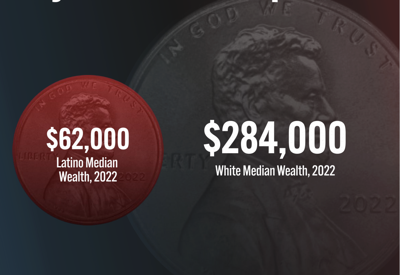


Image depicts the Latino wealth gap in 2022.
(Source: latino.ucla.edu)
Advocates, researchers and community leaders came together at a free webinar this week to discuss a new joint report on the forces shaping the Latino wealth gap in the U.S., hosted by the UCLA Latino Policy and Politics Institute in partnership with UnidosUS.
The free webinar called the “Latino Wealth Gap: Causes, Consequences, and Policy Paths Forward” examined policy patterns shaping economic opportunity for Latino communities across generations, examining how structural decisions influence access to jobs, housing, education and financial security — and what it would take to change that trajectory.
Vivian Lopez Green, the Senior Director of the Latino Knowledge Lab at UnidosUS, said on Tuesday, “The Hispanic community is central to our nation's economic progress. There are around 66 million [Latinos]. That is nearly 20% of this country. 80% of [Latinos] are U.S. citizens. We generate $4.1 trillion in economic output, larger than all but four largest economies in the world.”
“Despite these contributions, the Latino community faces lower wages and wage growth,” Green said.
According to the report, Latinos own only 22 cents for every dollar of wealth, identified as assets such as homes, savings and retirement, held by white households, illustrating the scale of the Latino wealth gap.
This wealth gap has many Latinos across the country struggling to make ends meet.
Gabriella Carmona is a senior research analyst at the UCLA Latino Policy and Politics Institute and lead author of the report, “Sueño Incompleto: A History of the Latino Wealth Gap in the United States.”
She said the conversation at Tuesday's webinar is more timely than ever.
“The report shows that there are many components of history that really affirm the fact that Latinos are and have been central to the U.S. economy,” Carmona said. “Latino economic power shows up across the economy, not only in the labor force participation, but also as business owners. Latino-owned businesses employ nearly 3 million people.”
U.S. Latino purchasing power hit $4.1 trillion in 2023.
Despite major contributions to the economy, wealth in Latino households does not match their economic contributions.
The data shows that the wealth gap has persisted since 1989, fluctuating over the years. In 2022, Latino households earned around $62,000 annually, compared with about $284,000 for white households.
“These outcomes are not due to circumstances or choices. They are shaped by the very system people move through,” Carmona said.
Those systems include land loss and barriers to homeownership, education segregation, wage disparities and job discrimination, limitations in public benefits and social safety nets, and restrictive immigration policies.
Julian Castro, the CEO of Latino Community Foundation and former U.S. Secretary of Housing and Urban Development and Mayor of San Antonio, said these systems, especially housing, keep Latinos stagnant even though more Latinos and Latinas are receiving two-year and four-year degrees.
“We have a legacy that is more difficult when you apply for a mortgage or a loan,” Castro said. “Folks in our communities are moving up in one way by fighting the effects of systems in place.”








(0) comments
Welcome to the discussion.
Log In
Keep it Clean. Please avoid obscene, vulgar, lewd, racist or sexually-oriented language.
PLEASE TURN OFF YOUR CAPS LOCK.
Don't Threaten. Threats of harming another person will not be tolerated.
Be Truthful. Don't knowingly lie about anyone or anything.
Be Nice. No racism, sexism or any sort of -ism that is degrading to another person.
Be Proactive. Use the 'Report' link on each comment to let us know of abusive posts.
Share with Us. We'd love to hear eyewitness accounts, the history behind an article.