






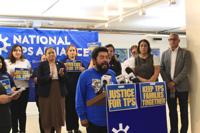
CHIRLA Action Fund hosted the California gubernatorial candidates forum from the lens of the large immigrant and Latino electoral block. (Photo courtesy of CHIRLA Action Fund.)
As immigrants and Latinos become the fastest-growing voting bloc in California, they are expected to play a decisive role in shaping the state’s future. Last Friday, CHIRLA Action Fund hosted a gubernatorial forum featuring candidates former state Controller Betty Yee, former U.S. Secretary of Health and Human Services Xavier Becerra and U.S. Representative Eric Swalwell (D - Dublin).
The bilingual forum titled “Winning California: A Civic Dialogue with Gubernatorial Candidates,” was held at the Los Angeles Theatre Center in front of a live audience, touching on a variety of topics, including immigration, healthcare, housing, education, climate justice and criminal justice reform.
All questions were asked by members of the organization and invited guests. Angelica Salas, president of the CHIRLA Action Fund, co-moderated the discussion alongside Pedro Trujillo, the nonprofit’s director.
Salas, who emphasized in a statement that hosting a forum through an immigrant community lens was not just important but essential, also highlighted that over 15 years of work, the organization has connected with 1.3 million voters.
“In 2024, we were able to turn out over 253,000 voters to the poll on a pro-immigrant progressive agenda. And just this November 2024, we helped get 33,000 Latino and new citizen voters to the polls in support of Proposition 50,” she shared with the audience.
Governor Gavin Newsom launched the Proposition 50 campaign in August of 2025 in response to Texas Governor Greg Abbott’s announcement that his state would be redrawing its maps, effectively eliminating five Democrat-held seats. On Nov. 4, the measure passed decisively, with early returns showing roughly 64% voting “Yes” to 36% voting “No.”
Salas also added that CHIRLA Action Fund has been working to ensure that California elect pro-immigrant, progressive leaders while pushing for policy changes that support the full inclusion of immigrants and refugees. “In 2026, voters will have the opportunity to elect California's next governor. And we are able to make sure today that immigrants, refugees, their families and our CHIRLA members have a say on who they believe should fill this role,” she said.

Candidates at the forum, (Photo courtesy of Chirla Action Fund.)
First up on stage was Becerra, the first Latino to hold the position of Health Secretary. He is a Sacramento native and first-generation college graduate. He served 12 terms in Congress, helped pass the Affordable Care Act (ACA), and later defended Deferred Action for Childhood Arrivals (DACA) and the ACA as California Attorney General. At HHS, he led the nation's COVID response and expanded health coverage to record levels.
Family separation was the first topic addressed. Kenya, a CHIRLA Action Fund member, was invited onstage to share her testimony about how last year’s raids personally impacted her and her family. Kenya explained that her father was detained at the Adelanto Immigration Center and, while in custody, changes in the law made him ineligible for bond even though he had a valid work permit, protections from deportation, and is currently awaiting a decision on his U-visa application.
“Officers handcuffed him and took him away without explanation or compassion. During his time in detention, my father experienced conditions that left lasting trauma. Detainees were frequently woken up, disrupting their sleep and leaving them disoriented. Food was extremely limited, often just a slice of spam and bread,” she said. “Despite being diabetic, my father was denied the medical care that he needed. Even after release, fear continues. Agents come to our home to monitor him. My father, our family, and our entire community continues to be targeted. We live in constant anxiety that we will be next.”
While onstage, Kenya also took the opportunity to pose the first question to Becerra, asking how he would support legislation allowing Californians to hold immigration agents accountable and sue them for assault and violations of their constitutional rights.
Becerra explained that what occurred to Kenya’s father was a violation of the Constitution. “We have to fight to make sure that the rights of all of us, even those who are undocumented under the Constitution, are never violated. So we have to be aggressive. We will do everything we can and we will push the envelope.” he said. “When I was attorney general that's exactly what I did when the Trump administration first tried to separate families. I sued to stop them from doing that separation and we were able to beat them back enough that they had to stop doing that.”
Kenya also asked Becerra how he would hold private detention centers accountable, including requiring them to release data, provide adequate medical services and uphold the rights of detainees. Becerra said that the state would exercise as much oversight as possible over any facility holding detainees, emphasizing that laws require fair treatment, sanitary conditions and standards that meet legal expectations.
He noted that while California does not have the authority to decide whether individuals are detained in specific facilities, since that falls under federal jurisdiction, it can require that anyone held in the state be treated in accordance with California’s safety and humane standards.
Lastly, he was asked how, as governor, he would promote the full inclusion of immigrants and refugees in California, and whether he would support creating an Office of Immigrant Affairs to unify laws and policies across the many agencies that serve these communities.
“I believe any family that works hard in California has a home in California. If you work hard, you should be able to go home safely,” Becerra said. If you work hard, you should have enough to be able to buy enough food to put on the table. If you work hard, you should have access to a doctor or a hospital. If you work hard, your children are entitled to go to a good school. If you work hard, you should be able to buy a home. If you work hard, you should be able to start a business. If you work hard in California, you should be able to retire here in California.”
He also emphasized that a person’s immigration status or language makes no difference to him. “If you work hard, you have built up my state. I owe you. You should be rewarded and I will make sure every family feels that way when I'm governor of the state of California,” he said.
Yee was the next candidate to take the stage for the live discussion. As California's State Controller, she manages the finances of the world’s fifth-largest economy. In her 2018 reelection, Yee received over eight million votes, the highest number of votes of any candidate on the ballot that year nationwide and the most in California’s history. With nearly 40 years of public service, she is recognized for her accountability and principled leadership and is now seeking to lead California forward as governor.
During Yee’s time, climate justice was another key topic that was addressed. Maria Carmen from the Antelope Valley emphasized the need for more parks and green spaces in her community, which faces a high risk of wildfires.
She also pointed out that a UCLA report identifies extreme heat as one of the most pressing climate threats to Latino communities across California. “Immigrant workers face heightened risks, with 25% of Latino workers employed in outdoor or heat-exposed jobs, such as agriculture, construction, landscaping, delivery or manual labor, compared to roughly 10–12% of white workers. The report further highlights how Latinos often fall through the cracks, particularly when climate disasters impact their communities,” Carmen shared.
Yee responded by saying that environmental policies should prioritize the communities most burdened by climate impacts, as these groups are often overlooked in traditional solutions.”We tend to fund programs that we're familiar with but don't really even think about the impacts that it will have on our most burdened communities. And so my plan really as governor is to look at how we prioritize many of the frontline communities that are bearing some of the worst impacts,” she said.
Arturo, another community member from the Antelope Valley, shared his story with the audience. He explained that he has lived in the U.S. since he was 17 and has consistently paid his taxes for over 25-plus years. Despite working hard throughout his life, he has never had the opportunity to adjust his immigration status because he entered the country without a visa.
“There are many people like me or in a similar situation. Many of us are getting older and approaching retirement age with no solutions to this problem in sight. My greatest fear is to be deported to a country I don't know in the later years of my life without being able to see my children who live in the United States,” Arturo said.
He followed his testimony by asking whether she would support creating a social security safety net for older undocumented individuals who have contributed to the program but cannot access its benefits. He noted that such a measure would not only assist undocumented people but also benefit those with disabilities who have been excluded from other federal programs.
“As governor Arturo, you and others like you, we're going to be sure that you are able to stay here in California with your families. We're going to be sure that all the years that you have contributed to our economy are rewarded at the end of your work life, this is not going to be a life where you're going to be struggling,” Yee said. “We're also going to be sure that we are going to demonstrate to the rest of the world that immigration is not the boogeyman here. It is what makes our economy work. California's economy would not work without immigrants. Period. And that's across the entire economy.”
The third and last candidate at the forum was Swalwell, who was raised in Dublin, California. He became the first in his family to attend college. After serving as an Alameda County prosecutor, where he led the Hate Crimes Unit, he was elected to the Dublin City Council, then to Congress in 2012. In the House, he has served on the Intelligence Committee and currently serves on the Judiciary and Homeland Security Committees.
Bringing healthcare into the discussion, Salas spoke about the 2024 medical expansion, which provided full medical-scope coverage to all income eligible California residents regardless of immigration status. It was a long overdue legislative win for immigrants. Since its expansion, however, it has undergone significant cuts and has left millions of people without essential life-saving medical care. Turning it back to Swalwell, he was asked if he was willing to give a full restoration to the medical program for the immigrant population.
“I will make sure that healthcare in California is available for all Californians. That is the most humane thing that we can do. Healthcare is a human right as far as I see it. But also, that's the most affordable way to do it. The worst thing we could do would be to eliminate access to preventive care and then have folks when they get sick go to the hospitals because we will all end up paying for it anyways,” he said.
He also added that his job is to secure funding by ensuring that California’s wealthiest companies, who have profited immensely from the economy, pay for it. “If their employees rely on state assistance or medical benefits, we will put an end to corporate welfare and make sure all Californians are supported,” Swalwell said.
Another question came from Juan, a community member from the Central Valley, who asked how HR1, the so-called “One Big Beautiful Bill,” will impact immigrants and refugees’ access to healthcare and how he plans to address the federal funding cuts affecting certain populations starting October 1st.
“We have to be able to financially cover all Californians,” Swalwell said. “[It’s] my day one revenue plan, [as] I have told SEIU, which is the largest union in the state, which represents almost a million workers in the state. They have a big stake in this and I was honored to have their endorsement, but they're going to be partners with me in this as we solve it.”
He further explained that he would follow a strategy similar to Nancy Pelosi’s to prevent government shutdowns during budget negotiations. He plans to collaborate with House Democratic Leader Hakeem Jeffries to draft a congressional budget that expands healthcare access in California and offsets cuts from the president’s “big, brutal” bill. For midterm revenue, he highlighted a corporate accountability tax as a key component of the plan.






(0) comments
Welcome to the discussion.
Log In
Keep it Clean. Please avoid obscene, vulgar, lewd, racist or sexually-oriented language.
PLEASE TURN OFF YOUR CAPS LOCK.
Don't Threaten. Threats of harming another person will not be tolerated.
Be Truthful. Don't knowingly lie about anyone or anything.
Be Nice. No racism, sexism or any sort of -ism that is degrading to another person.
Be Proactive. Use the 'Report' link on each comment to let us know of abusive posts.
Share with Us. We'd love to hear eyewitness accounts, the history behind an article.