
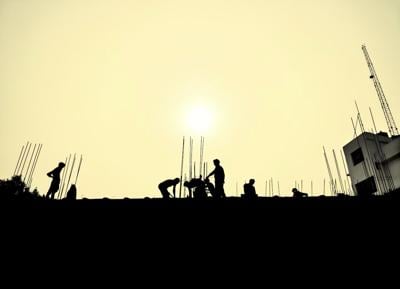

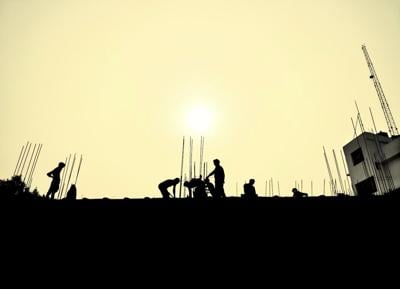

Latinos account for four out of five workers (81%) employed in post-fire recovery occupations. Photo by Rahul Kashyap
This month will mark 15 months since the January 2025 Eaton and Palisades wildfires burned more than 38,000 acres and destroyed over 16,000 structures across multiple Southern California communities.
As the state, county and local mutual aid efforts began activating around-the-clock support for those affected, in the days and months that followed, there was one group of people who led the recovery efforts and who remain there today: Latino workers.
A new data analysis released this week by the UCLA Latino Policy and Politics Institute (LPPI) and the UCLA Center for Neighborhood Knowledge (CNK) shows that the majority of workers in post-fire recovery occupations are Latino, who, despite being essential to the improvements after the fires, continue to face structural disadvantages, including lower wages, limited access to health insurance and gaps in unemployment insurance coverage.
“As the region recovers, the ongoing efforts to clean up, repair and rebuild depend on a workforce whose contributions are far less visible than the destruction left behind by the fires,” the study states.
The study titled “The Invisible Workforce in Wildfire Recovery Occupations," authored by Silvia González, Paul M. Ong,Yina Marin and Chhandara Pech, examines the workforce connected to the January 2025 wildfires, proving that Latino workers taking on debris removal, construction, utility repair and landscaping are what have moved the needle when it comes to the multiple neighborhood’s long-term recovery.
“It’s been several months since the fires had so many negative consequences for these communities and our region as a whole, but this isn't over for those affected. The impacts are not over for the families and it isn't over for the workers who are continuing to be there every day to rebuild communities,” González told CALÒ News.
The data shows that Latinos make up nearly half (47%) of the civilian labor force in Los Angeles County, but account for four out of five workers (81%) employed in post-fire recovery occupations. In contrast, white workers represent a little over a quarter (27%) of the labor force but only about 10% of workers in these same post-wildfire recovery occupations.
Earning less money
Despite Latinos making up the majority of workers in post-fire recovery occupations, they are not compensated at the same level as workers from other racial and ethnic groups. In fact, they are the lowest paid, with median annual earnings of approximately $36,000 compared to about $54,000 for white workers. With the increasing wage gaps, many Latinos working in these occupations live below the poverty line.
“Latinos are essential to the rebuilding post-fires, but they are also in jobs that tend to be lower-paying despite being essential,” González said.
Ong, director of CNK, said he believes true recovery is not only in how communities start improving physically but also in the ways people doing the reconstruction are treated and valued. “These findings are especially important because they show how recovery is shaped not only by physical damage but also by the conditions facing the workforce who are doing the rebuilding,” he said. “An equitable recovery requires attention to the workers who make it possible and to the communities that depend on their income.”
When driving around places like Malibu, Topanga Canyon or Altadena, one can often see Latinos working on top of roofs, carrying heavy-duty materials or demolishing big pieces of debris. Many of them do not have health insurance coverage.
Health insurance inequities
The study shows that Latino workers have the lowest rate of health insurance coverage, at about 66%, compared to roughly 88% to 90% for other groups. It is something that the authors of the study said they consider particularly alarming, being that Latinos already face health vulnerabilities, such as suffering from asthma due to living in neighborhoods with high levels of air pollution.
González told CALÒ News that the social and economic impacts of wildfires also extend beyond fire-affected areas to surrounding communities, especially as many of these workers commute from where they reside and live. She said one of the latest examples of this has been the racial profiling of many Latino workers during the ICE raid that began last June.
“We were able to talk to some of the workers about the impacts of immigration raids. They've lost income because they're scared to go to these sites; at the same time, they need to work,” she said. “We are putting people who are helping us rebuild L.A. through terrible conditions.”
González said the writers hope this kind of data underscores the importance of the working class and the full workforce behind recovery efforts. They aim for the study to help strengthen economic protections that do not leave behind the workers who play a central role in rebuilding communities after disasters.
“Latinos are essential workers for the recovery process. It won’t happen on its own. It depends on workers whose labor is crucial to rebuilding homes, infrastructure and daily life,” she said.






(0) comments
Welcome to the discussion.
Log In
Keep it Clean. Please avoid obscene, vulgar, lewd, racist or sexually-oriented language.
PLEASE TURN OFF YOUR CAPS LOCK.
Don't Threaten. Threats of harming another person will not be tolerated.
Be Truthful. Don't knowingly lie about anyone or anything.
Be Nice. No racism, sexism or any sort of -ism that is degrading to another person.
Be Proactive. Use the 'Report' link on each comment to let us know of abusive posts.
Share with Us. We'd love to hear eyewitness accounts, the history behind an article.