
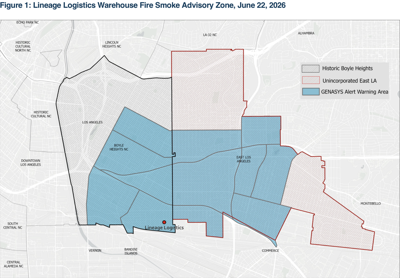


Figure 1. Map of residents and workers within the smoke advisory zone following the Lineage Logistics warehouse fire in Boyle Heights. Source: UCLA Latino Policy and Politics Institute, "The Lineage Logistics Fire in Boyle Heights: Who Lives and Works in the Smoke Zone?"
A new rapid-response data brief conducted on the Lineage cold-storage facility fire in Boyle Heights reports that the smoke advisory zone created by the blaze is home to tens of thousands of residents and workers, including over 31,000 workers, roughly eight in 10 of whom are Latino, according to the UCLA Latino Policy and Politics Institute (LPPI).
Plumes of smoke have filled the skies throughout the region since Friday, a contribution of the Lineage cold-storage facility fire, affecting Boyle Heights and East Los Angeles residents and workers.
LPPI researchers and analysts report that while the fire is contained, lingering air quality threats continue, adding that the fire is not only a public safety and air quality emergency, but also a worker exposure, workplace disruption and environmental justice issue.
“The fire is adding another layer of harm to communities already affected by economic hardship, limited access to health care and disproportionate exposure to environmental hazards,” said Julia Silver, co-author and a senior research analyst at LPPI. “There needs to be coordinated relief efforts that reach both residents and workers, including access to health care services, income support, multilingual emergency information and resources for affected individuals.”
The rapid-response data brief, the first in a planned series, details that many of the workers most directly affected by the fire may have a limited financial cushion to absorb lost wages, health costs, or business interruptions.
Other key findings include:
At least 31,700 workers live within the smoke advisory zone, and approximately 26,000 — about 81% — are Latino.
Nearly 13,600 jobs are located inside the advisory zone and two-thirds are held by Latino workers.
Roughly half of resident workers in the smoke advisory zone earn $3,333 per month or less, below Los Angeles County’s very-low-income threshold for a single-person household.
Over half of resident workers in the smoke advisory zone may have limited access to paid leave, health coverage or remote work.
Nearly nine in 10 jobs in the smoke advisory zone are held by workers who commute into the area, meaning the fire’s impacts extend to thousands of households beyond Boyle Heights and East Los Angeles.
Many workers living or working in the affected area are employed in sectors that often require in-person work, including health care, retail, food service, manufacturing, transportation,and warehousing.
“The smoke zone is also a worker zone,” said Arturo Vargas Bustamante, co-author and LPPI’s director of faculty research. “The impacts do not stop at the neighborhood boundary. Thousands of workers commute into Boyle Heights and East Los Angeles for jobs, which means this emergency reaches families across the region. An equitable response must account for both residents and workers.”





(0) comments
Welcome to the discussion.
Log In
Keep it Clean. Please avoid obscene, vulgar, lewd, racist or sexually-oriented language.
PLEASE TURN OFF YOUR CAPS LOCK.
Don't Threaten. Threats of harming another person will not be tolerated.
Be Truthful. Don't knowingly lie about anyone or anything.
Be Nice. No racism, sexism or any sort of -ism that is degrading to another person.
Be Proactive. Use the 'Report' link on each comment to let us know of abusive posts.
Share with Us. We'd love to hear eyewitness accounts, the history behind an article.